
The construction industry has traditionally depended on experience, paperwork, spreadsheets, phone calls, and face-to-face coordination. While these methods can still play an important role, growing project complexity has made it increasingly difficult for construction companies to manage everything manually. Tight deadlines, rising costs, labor shortages, changing designs, and increasing client expectations are pushing contractors to find more efficient ways to operate.
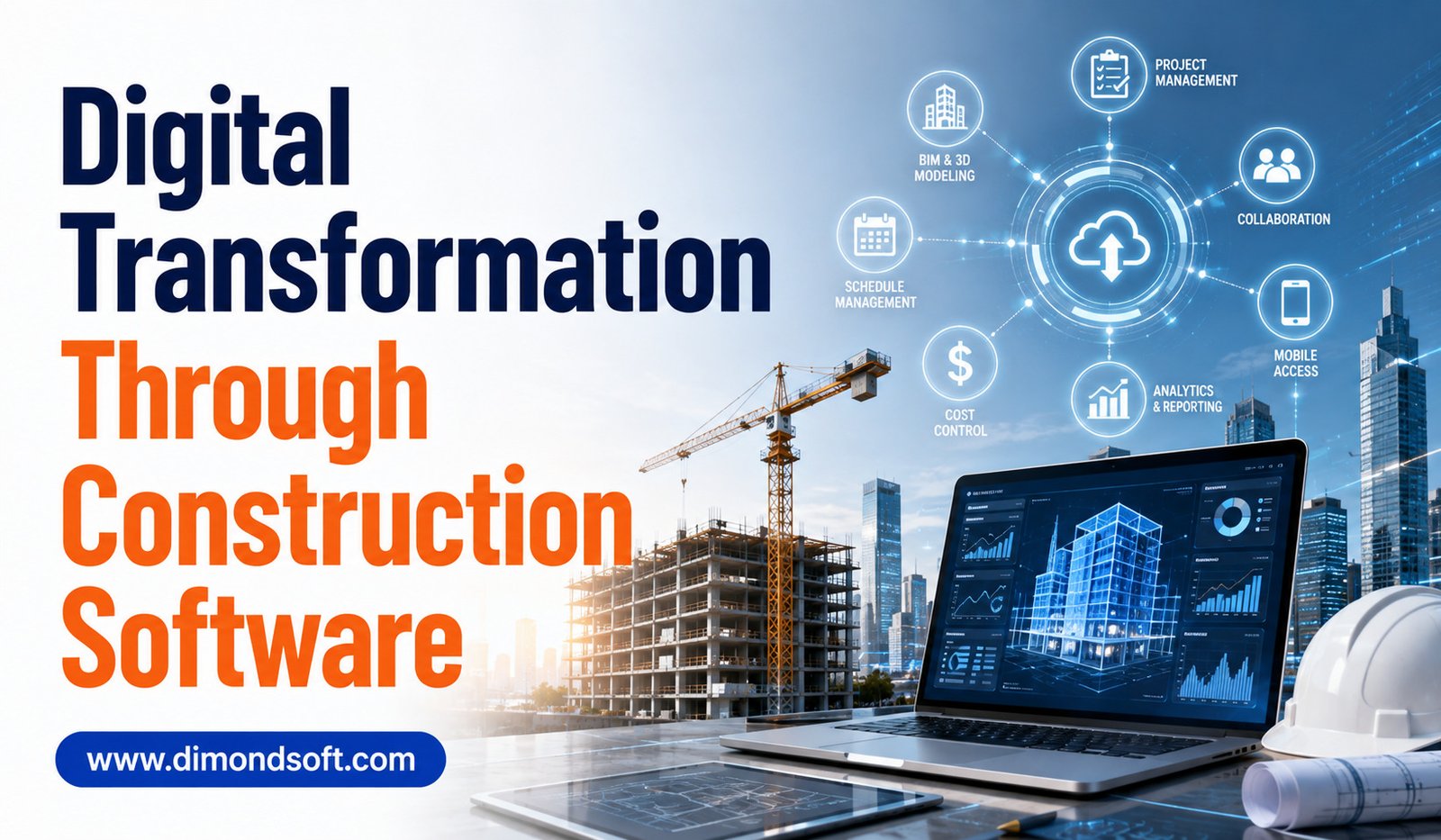
Digital transformation is becoming an important part of this change. Construction software is helping companies move away from disconnected processes and toward integrated digital workflows. From estimating and project planning to field communication, cost control, document management, and reporting, modern software can connect different parts of a construction business.
Digital transformation does not simply mean replacing paper documents with digital files. It involves changing how information is collected, shared, analyzed, and used to make decisions. When implemented properly, construction software can improve productivity, reduce administrative work, increase visibility, and help companies deliver projects more effectively.
What Is Digital Transformation in Construction?
Digital transformation in construction refers to the adoption of digital technologies to improve business processes, project management, communication, and decision-making. It involves using software and connected tools to create more efficient workflows across the entire project lifecycle.
For example, a traditional construction company may use separate spreadsheets for estimating, scheduling, budgets, and labor tracking. Employees might exchange updates through email or messaging applications while important documents are stored in different folders. This creates disconnected information and makes it difficult to understand the complete status of a project.
With construction software, these processes can become more connected. Project information can be stored in a central platform, field updates can be shared immediately, and managers can monitor schedules and budgets from a single system.
The objective is not technology for its own sake. The real purpose is to reduce inefficiencies and give construction professionals better tools for managing their work.
Why Construction Companies Need Digital Transformation
Construction projects generate enormous amounts of information. Drawings, contracts, estimates, schedules, purchase orders, invoices, change orders, RFIs, inspection reports, safety records, and daily updates all need to be managed.
When information is handled manually, even a small mistake can create significant consequences. An outdated drawing could lead to rework, a missed deadline could affect the schedule, and an incorrect cost entry could reduce project profitability.
Digital transformation helps companies address these challenges by creating more organized and accessible workflows.
Some of the biggest reasons construction businesses are adopting digital solutions include:
- Reducing repetitive administrative work
- Improving communication between office and field teams
- Increasing visibility into project costs and schedules
- Managing documents more efficiently
- Identifying project risks earlier
- Improving collaboration with subcontractors and clients
- Making decisions using current project information
These benefits can be especially important for companies managing multiple projects simultaneously.
Construction Software as the Foundation of Digital Change
Construction software provides the foundation for many digital transformation initiatives. Instead of relying on separate tools for every activity, businesses can use specialized or integrated platforms to manage important construction processes.
Project management software can help teams organize tasks, schedules, documents, communications, and responsibilities. Estimating software can support quantity takeoffs and cost calculations. Accounting integrations can connect project financial information with broader business operations.
The most valuable systems are often those that allow information to move between different functions. For example, information from an estimate can eventually support project budgeting, while field updates can influence scheduling and cost forecasting.
This connected approach reduces duplicate data entry and helps create a more reliable source of project information.
Transforming Construction Estimating
Estimating is one of the earliest stages where digital tools can make a major difference. Traditional estimating often involves reviewing plans manually, calculating quantities, entering costs into spreadsheets, and repeatedly checking figures.
Construction estimating software can organize these activities into a more structured workflow. Digital takeoff tools can help estimators measure quantities, while cost databases and reusable templates can reduce repetitive calculations.
Advanced software may also use historical project information to help contractors evaluate costs and identify patterns. Artificial intelligence can further support estimating by analyzing large volumes of project data.
However, technology does not eliminate the importance of experienced estimators. Construction costs vary based on location, materials, labor availability, project conditions, and market changes. Human professionals still need to review assumptions and apply industry knowledge.
The value of digital estimating comes from making the process faster, more organized, and easier to review.
Improving Project Scheduling
Scheduling is another major area affected by digital transformation. Construction schedules contain numerous dependencies, and a delay in one activity can influence many others.
Digital scheduling tools allow project managers to create detailed timelines, assign tasks, monitor progress, and update schedules more efficiently. Teams can see which activities are complete, which are delayed, and which require attention.
Some modern platforms can also provide alerts and automated updates when deadlines change. This can reduce the amount of time project managers spend manually communicating schedule adjustments.
More advanced systems can analyze historical and current project data to support forecasting. These capabilities can help teams identify potential scheduling problems earlier, giving them more time to respond.
Connecting the Field and Office
One of the most important benefits of digital transformation is better communication between construction sites and office teams.
In traditional workflows, field workers may record information on paper and deliver it to office staff later. This creates delays and increases the possibility of lost or incorrectly entered information.
Mobile construction applications allow supervisors and field workers to submit updates directly from the jobsite. They can upload photographs, complete forms, record progress, access drawings, and communicate with project managers using mobile devices.
Office teams can receive this information without waiting for paperwork to arrive. This creates a faster feedback loop between field operations and project management.
When information moves quickly, managers can respond to problems sooner instead of discovering them after significant time has passed.
Digital Document Management
Document management is another area where construction companies can gain substantial efficiency.
Projects can involve thousands of documents, and finding the correct version can become difficult when files are distributed across email accounts, computers, cloud drives, and physical folders.
Construction document management software provides centralized storage and search capabilities. Team members can access relevant files from approved locations and, depending on the platform, track document versions and changes.
This can reduce the risk of using outdated information. It can also save time because employees no longer need to search through multiple locations to find a specific document.
Effective document management becomes especially valuable during project closeout, audits, disputes, and future reference.
Better Cost and Financial Control
Profitability is a major concern for every contractor, making financial visibility an important part of digital transformation.
Construction software can help teams monitor budgets, commitments, invoices, expenses, labor costs, and change orders. Instead of waiting for periodic reports, project managers may be able to view updated financial information throughout the project.
This makes it easier to identify unusual spending or potential budget overruns.
For example, if labor costs are rising faster than expected, managers can investigate the cause before the problem becomes more serious. The issue could involve overtime, productivity, schedule changes, or additional work.
Early visibility gives contractors more opportunities to take corrective action.
Using Data for Better Decisions
Digital transformation creates another major advantage: access to usable project data.
Construction companies generate data every day, but data is only valuable when it can support meaningful decisions. Modern software can organize project information into dashboards, reports, and performance indicators.
Managers can examine areas such as schedule performance, labor productivity, budget status, outstanding tasks, and project progress.
Over time, historical data can also help companies compare projects and identify recurring problems. A contractor might discover that certain types of projects consistently experience procurement delays or that specific activities regularly exceed labor estimates.
These insights can influence future planning and improve business performance.
The Role of Artificial Intelligence
Artificial intelligence is becoming an important component of construction software. AI can analyze large amounts of information and identify patterns that may be difficult to detect manually.
Potential applications include predictive scheduling, automated document analysis, estimating assistance, risk identification, cost forecasting, and progress monitoring.
AI can help construction teams work more efficiently, but it should be viewed as a supporting technology rather than a replacement for professional judgment.
Construction projects are affected by unpredictable circumstances, and experienced professionals understand practical factors that may not be captured by software. The strongest results occur when AI-generated insights are reviewed by people who understand the project and its environment.
Challenges of Digital Transformation
Although digital transformation offers many benefits, implementation is not always easy.
Employees may resist new systems if they believe technology will complicate their work. Older project data may be inconsistent or difficult to transfer. Different software platforms may not integrate properly, and companies may need to invest in training.
Cybersecurity is another consideration. Construction businesses manage sensitive financial information, contracts, project designs, and customer data. Companies need appropriate security practices when adopting cloud-based platforms and connected applications.
Successful transformation therefore requires more than purchasing software. Businesses need clear goals, employee training, strong implementation processes, and ongoing evaluation.
How Contractors Can Start Their Digital Transformation
Construction companies do not have to transform every process at once. A gradual approach can be more practical.
The first step is to identify the areas causing the most inefficiency. A contractor might discover that document management consumes too much time, while another company may have greater problems with estimating or project communication.
Once the main problem is identified, the company can select software designed to address it. Employees should be trained before implementation, and management should measure whether the new system is actually producing improvements.
Successful tools can then be expanded into other areas of the business.
This approach reduces disruption and helps employees become comfortable with digital workflows.
The Future of Digital Construction
Digital transformation is likely to become an increasingly important part of the construction industry. Cloud platforms, mobile applications, artificial intelligence, connected equipment, building information modeling, and data analytics are creating opportunities for more connected project management.
The future will not necessarily belong to companies that use the most technology. Instead, successful construction businesses will be those that use technology strategically to solve practical problems.
Software will continue to become more intelligent and integrated, allowing contractors to access project information faster and make decisions with greater confidence.
Conclusion
Digital transformation through construction software is changing how contractors plan, manage, and deliver projects. From estimating and scheduling to document management, field communication, cost control, and data analysis, digital tools can reduce manual work and improve project visibility.
However, successful transformation requires more than adopting new software. Construction companies need to understand their operational challenges, choose technology that fits their workflows, train employees, and continuously measure results.
When technology and construction expertise work together, digital transformation can create more efficient processes, stronger communication, better financial control, and more informed decision-making. For contractors preparing for the future, construction software is becoming not just a useful tool but an important part of building a more productive and competitive business.