Choosing the right content management system has become an important decision for businesses building modern digital experiences. Websites are no longer the only place where companies publish content. Businesses may need to deliver the same information to websites, mobile apps, ecommerce stores, smart devices, customer portals, and other digital channels.
This has created interest in two different approaches to content management: traditional CMS and headless CMS.
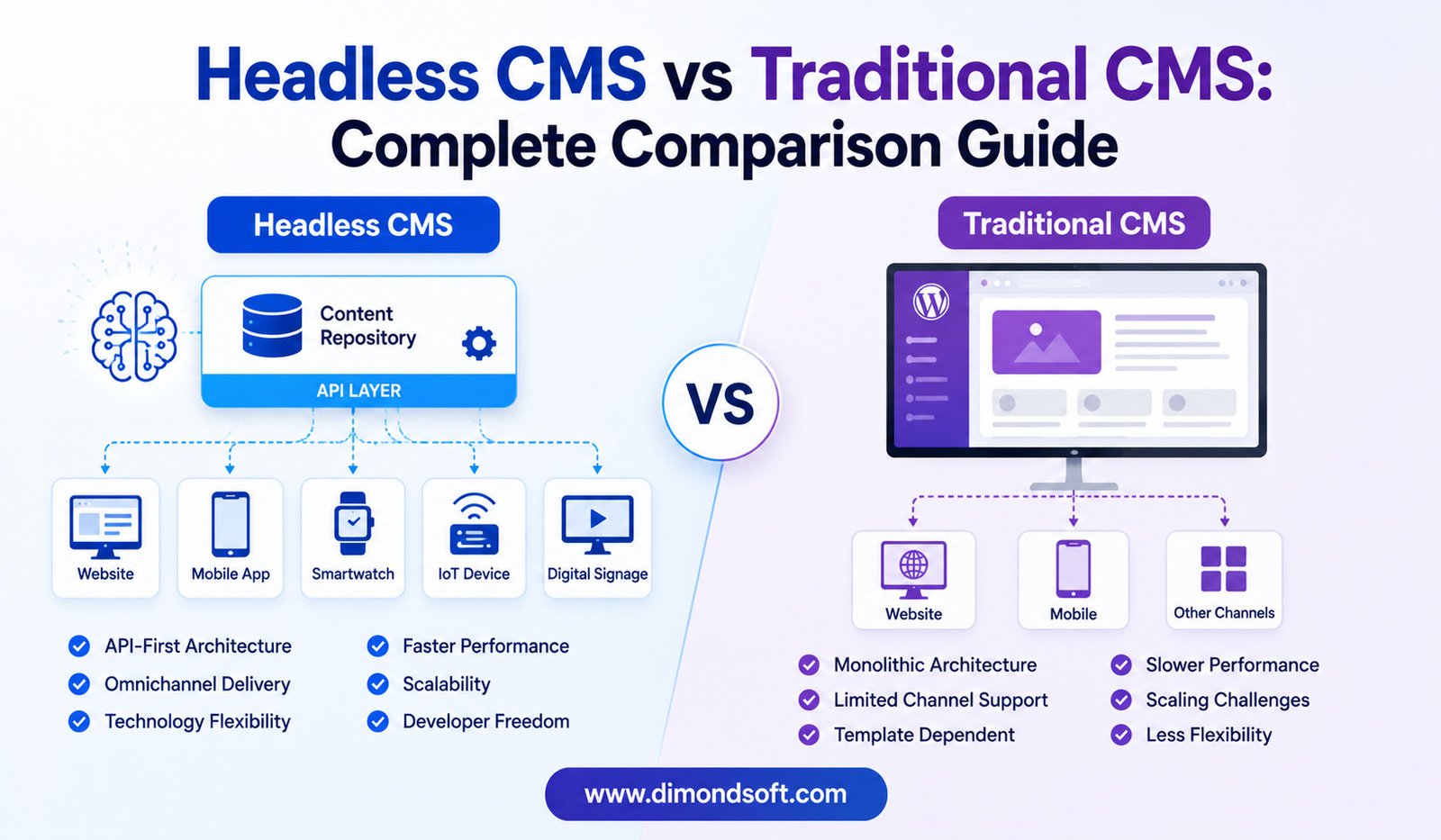
A traditional CMS combines content management with the presentation layer. A headless CMS separates the content repository from the front-end experience and delivers information through APIs.
Neither approach is automatically better. The right choice depends on your business goals, technical resources, publishing requirements, budget, and future plans.
What Is a Traditional CMS?
A traditional CMS manages both content and how that content appears to website visitors.
The backend allows employees to create and organize content, while the front end determines how visitors see that information.
Popular traditional CMS platforms are often designed to allow businesses to manage websites without extensive programming knowledge.
This approach is particularly useful for organizations that primarily need a website and want an integrated environment for content creation, design, plugins, SEO, and publishing.
For many small and medium-sized businesses, a traditional CMS provides everything necessary to build and manage a professional website.
What Is a Headless CMS?
A headless CMS separates the content management system from the presentation layer.
The CMS stores and manages content in the backend, while APIs deliver that content to different front-end applications.
The term “headless” refers to removing the predefined presentation layer, or “head,” from the CMS.
This allows developers to use different technologies to display the same content across websites, mobile apps, digital displays, ecommerce interfaces, and other platforms.
For organizations managing multiple digital experiences, this flexibility can be valuable.
How the Two Approaches Differ
The biggest difference is architecture.
A traditional CMS connects the content management system directly to the website presentation layer.
A headless CMS focuses on managing content independently and delivering it through APIs.
With a traditional system, marketers and developers often work within the same platform. With a headless approach, content teams can manage information separately from the technology used to display it.
This separation creates greater flexibility but may also introduce additional technical complexity.
Ease of Use
Traditional CMS platforms generally have an advantage in ease of use.
Many provide visual editors, templates, drag-and-drop components, plugins, and straightforward publishing workflows.
A marketing employee can often create and update pages without writing code.
Headless systems can provide excellent content management interfaces, but creating the front-end experience usually requires development work.
This means businesses with limited technical resources may find traditional CMS platforms easier to operate.
For companies with experienced development teams, the additional flexibility of a headless architecture may be more valuable.
Design Flexibility
Traditional CMS platforms provide design flexibility, but the presentation layer is usually closely connected to the CMS.
Businesses can customize themes and templates, add components, or make code-level changes depending on the platform.
A headless CMS provides much greater freedom because the front end is independent.
Developers can use different frameworks and technologies to build unique experiences without being constrained by the CMS’s presentation system.
This can be especially useful for organizations with highly customized digital products.
Omnichannel Content Delivery
This is one of the strongest advantages of a headless CMS.
Traditional CMS platforms are primarily designed around websites, although many can support additional channels through extensions and integrations.
A headless CMS can deliver the same structured content through APIs to multiple destinations.
For example, a business could manage a product description once and distribute it to:
- A website
- Mobile applications
- Ecommerce interfaces
- Digital displays
- Customer portals
This makes headless architecture attractive to companies following an omnichannel digital strategy.
Content Reuse
Content reuse is another important consideration.
Traditional CMS platforms can support reusable content, but content is often created within page templates.
Headless CMS platforms typically treat content as structured data that can be reused across different experiences.
A product description, article, author profile, or location record can be delivered to multiple front ends without recreating the information for each channel.
This can improve consistency and reduce duplicate content management.
Development Requirements
Traditional CMS platforms usually require less development effort for standard websites.
Businesses can select a theme, configure settings, install necessary extensions, and begin publishing.
A headless CMS generally requires more development work because the front end must be built separately.
Developers need to connect the CMS to the desired applications through APIs and create the presentation experience.
Therefore, technical resources should be considered before choosing a headless solution.
A highly flexible system can become difficult to manage if the organization does not have developers available to support it.
Performance Considerations
Website performance depends on many factors, including hosting, architecture, images, code, caching, integrations, and content delivery.
Headless architecture can provide performance advantages because developers have greater control over the front-end technology.
They can select frameworks and delivery methods based on specific performance requirements.
Traditional CMS platforms can also be optimized effectively, particularly with caching, content delivery networks, optimized themes, and appropriate hosting.
Therefore, it would be inaccurate to assume that every headless CMS is faster than every traditional CMS.
Performance depends on implementation.
Security
Security is another important difference, although neither architecture is automatically secure.
Traditional CMS platforms can have a larger attack surface when websites rely on numerous plugins, themes, extensions, and server components.
Headless architectures can reduce some risks by separating content management from the public-facing application.
However, APIs introduce their own security requirements.
Authentication, authorization, API access, data protection, and third-party integrations all need to be managed carefully.
Businesses should evaluate the security practices of the specific platform and implementation rather than relying solely on the CMS architecture.
SEO Capabilities
Traditional CMS platforms often provide convenient SEO tools.
Users can manage page titles, metadata, URLs, headings, sitemaps, redirects, and other SEO elements through the administrative interface.
With a headless CMS, SEO capabilities depend more heavily on how the front end is developed.
Developers have greater control over technical SEO, page structure, performance, rendering, and structured data.
However, this flexibility also means that SEO mistakes are possible if developers do not implement important features correctly.
For organizations with limited technical resources, traditional CMS platforms may provide a simpler SEO experience.
Content Workflow
Traditional CMS platforms often provide integrated publishing workflows.
Writers can create drafts, editors can review them, and administrators can publish the final content.
Headless CMS platforms can also provide workflows, but the final presentation is handled separately.
This separation can be advantageous for larger organizations with complex publishing structures.
For example, a global company could maintain centralized content while different applications and regional websites consume the information through APIs.
The best choice depends on how complicated the organization’s publishing operation is.
Integrations
Both CMS approaches can integrate with external applications.
Traditional platforms often use plugins, extensions, or built-in connectors.
Headless CMS platforms generally rely heavily on APIs.
This can make headless systems particularly attractive for businesses building custom digital ecosystems.
A company can connect its content repository to ecommerce systems, mobile applications, customer portals, and other services.
However, integrations may require development resources, which can increase implementation costs.
Cost Comparison
Cost is more complicated than comparing subscription prices.
Traditional CMS platforms can be relatively affordable to launch because many features are available in one system.
Businesses may still spend money on hosting, themes, plugins, development, maintenance, and security.
Headless CMS platforms can have different pricing structures based on users, API usage, content volume, environments, or other factors.
They may also require more development work.
Therefore, companies should calculate the total cost of ownership, including development, maintenance, hosting, training, integrations, and future upgrades.
Scalability
Both traditional and headless CMS platforms can support growing businesses.
Traditional systems may work well for organizations that primarily operate websites and have predictable requirements.
Headless architecture can provide greater flexibility for organizations that expect to add new digital channels.
For example, a business may start with a website and later add mobile apps, kiosks, smart displays, and customer portals.
Instead of rebuilding the content system for each new channel, a headless CMS can provide content through APIs.
Which Is Better for Small Businesses?
For many small businesses, a traditional CMS is the more practical option.
Small organizations often need a website that can be launched quickly and managed by non-technical employees.
A traditional platform can provide templates, content editing, SEO tools, plugins, and publishing capabilities in one environment.
If the business does not require multiple digital channels or highly customized front-end experiences, the additional complexity of headless architecture may not provide enough value.
Which Is Better for Large Organizations?
Large organizations with complex digital ecosystems may benefit from headless CMS architecture.
Companies managing multiple websites, mobile applications, regional experiences, ecommerce platforms, or other digital channels can use centralized content and distribute it through APIs.
Headless CMS can also be useful when different teams require different front-end technologies.
However, large organizations should ensure they have the technical resources and governance processes needed to manage the architecture effectively.
When Traditional CMS Makes More Sense
A traditional CMS may be the better choice when:
- You primarily need one website.
- Marketing teams need direct control over design and publishing.
- Development resources are limited.
- You want a faster implementation.
- Standard templates meet your requirements.
- You prefer an integrated platform.
For many businesses, these advantages outweigh the flexibility offered by headless systems.
When Headless CMS Makes More Sense
A headless CMS may be appropriate when:
- Content needs to reach multiple digital channels.
- You have a strong development team.
- Custom front-end experiences are important.
- Content needs to be reused across applications.
- You expect significant digital expansion.
- You want greater control over front-end technology.
The decision should be based on actual business requirements rather than the popularity of headless technology.
Hybrid CMS: A Middle Ground
Businesses do not always have to choose between completely traditional and completely headless architecture.
A hybrid CMS can combine elements of both approaches.
It may provide a traditional website editing experience while also offering APIs for delivering content to other channels.
This can provide marketers with familiar publishing tools while giving developers greater flexibility.
For organizations transitioning gradually toward a multi-channel strategy, a hybrid approach can be an attractive option.
AI and the Future of CMS Platforms
Artificial intelligence is influencing both traditional and headless content management.
AI features can assist with content creation, classification, metadata generation, search, personalization, translation, and optimization.
Headless systems may become particularly useful for AI-driven digital experiences because structured content can be delivered to different applications.
Traditional CMS platforms are also integrating AI tools directly into their publishing interfaces.
The future is therefore unlikely to be defined solely by one CMS architecture. Instead, businesses will choose systems based on how effectively they support automation, personalization, content reuse, and multi-channel delivery.
How to Choose Between Headless and Traditional CMS
Start by examining your business rather than the technology.
Ask where your content needs to appear, who will manage it, how much development support you have, and how complex your digital strategy is.
If you need a straightforward website that marketing employees can manage easily, traditional CMS may be the better choice.
If you need centralized content across multiple applications and have strong technical resources, headless CMS may provide greater long-term flexibility.
Also consider budget, security, SEO, performance, integrations, scalability, and maintenance requirements.
Testing both approaches with a small project can help organizations understand which workflow fits their teams.
Conclusion
The choice between a headless CMS and a traditional CMS ultimately depends on the needs of your business.
Traditional CMS platforms provide an integrated approach that is often easier to use, faster to deploy, and suitable for organizations focused primarily on website publishing.
Headless CMS platforms separate content from presentation, offering greater flexibility for businesses delivering information across websites, mobile apps, ecommerce platforms, and other digital experiences.
Neither approach is universally superior. A small company may gain more value from the simplicity of a traditional CMS, while a large organization with a multi-channel digital strategy may benefit from the flexibility of headless architecture.
The most important step is to evaluate your current requirements and future goals before selecting a platform. Choose the architecture that your team can realistically manage and that provides enough flexibility for your digital strategy.
As digital experiences continue to expand, both traditional and headless CMS platforms will evolve. The winning solution will be the one that helps your organization manage content efficiently while delivering useful, consistent, and engaging experiences across the channels that matter most.