
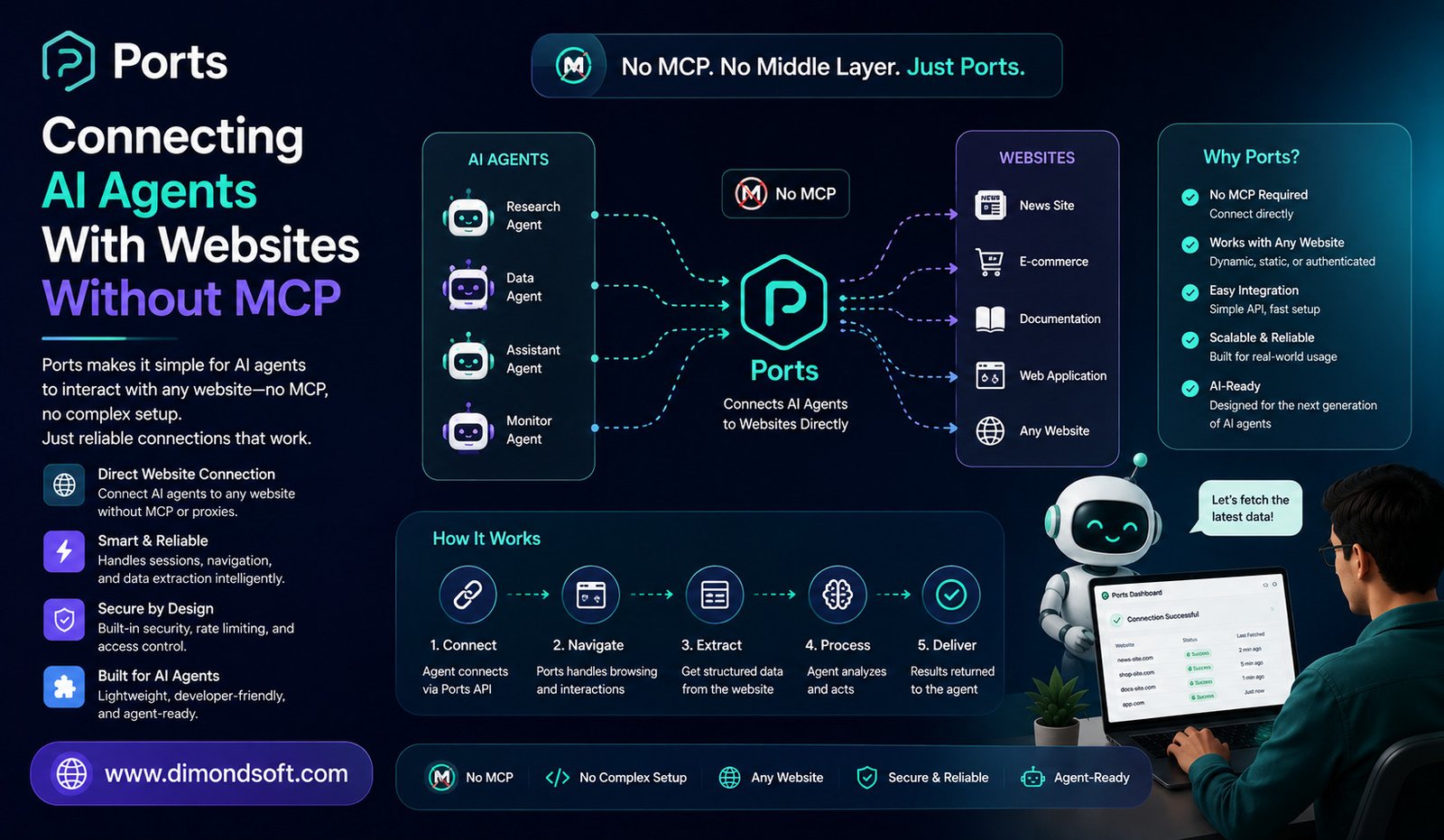
AI agents are quickly moving beyond simple conversations. Modern agents can search for information, interact with applications, complete forms, collect data, and perform multi-step tasks on behalf of users. As these capabilities grow, one important technical challenge remains: how can AI agents reliably interact with websites?
One approach gaining attention is connecting AI agents to websites without requiring the Model Context Protocol, commonly known as MCP. Ports represents this broader idea of creating a simpler bridge between AI agents and web applications.
Instead of requiring every website to build a specialized integration for every AI platform, new approaches can make existing websites more accessible to autonomous software.
This could become important as AI agents increasingly act as a new type of internet user.
What Are Ports?
Ports can be understood as an approach for connecting AI agents with websites and web-based services without depending on MCP as the primary integration layer.
The underlying idea is straightforward: an AI agent needs a way to understand what a website offers, identify available actions, and interact with those actions safely.
Traditional websites were designed mainly for humans. People can visually interpret buttons, menus, forms, icons, and page layouts.
AI agents require a more structured understanding of these elements.
A system such as Ports can potentially provide a bridge between an agent and the existing web experience, allowing software to interact with websites without requiring every service to create a dedicated AI integration.
Why AI Agents Need Better Web Connections
AI agents are becoming increasingly useful because they can perform tasks instead of simply providing information.
Consider a user who asks an AI assistant to:
“Find three suitable hotels, compare their prices, and help me choose one.”
The agent may need to visit several websites, search for availability, compare information, and potentially interact with booking interfaces.
A human can perform these steps visually.
An AI agent needs reliable mechanisms for understanding the website and determining what actions are possible.
This creates a need for infrastructure that connects agents with the existing web.
What Is MCP?
The Model Context Protocol is a standardized approach designed to help AI applications connect with external tools and data sources.
It has attracted significant attention because it can provide a structured way for AI systems to interact with external capabilities.
However, MCP is not the only possible approach to agent-to-website interaction.
Different architectures can solve different problems.
Ports represents the idea that AI agents can interact with websites through another layer without requiring websites to become MCP servers.
This can be particularly interesting for the enormous number of websites that were never designed with AI agents in mind.
The Existing Web Was Built for Humans
Most websites were created around human interaction.
A user opens a page, reads its content, clicks a button, selects an option, and submits a form.
The interface is often visual.
AI agents don’t necessarily need to see the page in exactly the same way a human does. They need to understand its underlying structure and determine which actions are available.
For example, an online store may contain a product title, price, availability indicator, product options, and purchase button.
A human understands these elements immediately.
For an AI agent, the information needs to be interpreted through machine-readable signals and reliable interaction mechanisms.
Connecting Agents to Existing Websites
One advantage of approaches that work with existing websites is that businesses may not need to completely rebuild their digital infrastructure.
A company may already have a functioning website, online catalog, booking system, or customer portal.
Instead of creating an entirely separate AI interface, an agent-access layer could potentially sit between the website and the AI system.
This can help make existing digital services more accessible to autonomous software.
The concept is similar to creating a bridge between two different environments:
Human Web → Agent Interaction Layer → AI Agent
The exact technical implementation can vary, but the objective is to make interaction more structured.
AI Agents as a New Type of Web User
For decades, website owners primarily optimized for two major audiences: humans and search engines.
AI agents could become a third important audience.
An AI agent might search for products, compare services, retrieve information, complete forms, or coordinate tasks across several websites.
This changes the role of a website.
Instead of expecting every customer to navigate the interface manually, businesses may increasingly need to support customers who arrive through AI assistants.
The website remains important, but the interaction may happen through an agent.
Potential E-Commerce Applications
E-commerce is one of the clearest examples.
Imagine a user telling an AI agent:
“Find running shoes under my budget, compare four options, and show me the best choices.”
The agent could potentially visit multiple stores and gather product information.
If the websites are accessible to AI agents, the system could compare prices, specifications, availability, shipping information, and return policies.
Eventually, agents could potentially go further by adding products to carts or assisting with checkout.
However, actions involving purchases should include clear authorization and safeguards.
An AI agent should not be given unlimited purchasing authority simply because it can technically interact with a website.
Travel and Booking
Travel websites also involve many repetitive interactions.
An AI agent may need to search destinations, compare hotels, check availability, examine cancellation policies, and organize information.
Connecting agents directly with existing travel websites could make this process more efficient.
Instead of manually opening multiple tabs, a user could rely on an AI system to gather the relevant information.
The agent could then present options to the user for approval.
Automating Business Tasks
Businesses could also benefit.
Employees frequently work with web-based applications for sales, research, customer service, administration, and operations.
An AI agent could potentially navigate approved websites and perform routine tasks.
For example, an internal operations agent might gather information from several business portals and compile a report.
A marketing agent could collect campaign data from approved platforms.
A research agent could visit public websites and organize relevant information.
These use cases depend on website permissions, terms of service, authentication, and appropriate security controls.
Why Avoiding MCP Could Matter
There can be practical reasons for using an alternative to MCP.
A company may not have the technical resources to build and maintain a dedicated MCP integration.
Another business may already have a website that works well and simply wants to make it accessible to agents.
An agent interaction layer could reduce the amount of custom infrastructure required.
It can also be useful in environments where many websites need to be accessed.
Instead of building a separate integration for every website, a common approach could potentially work across existing web interfaces.
This is one of the key ideas behind agent-friendly web infrastructure.
Security Is Critical
Allowing AI agents to interact with websites creates new security considerations.
An agent that can read information is different from one that can take actions.
Reading a public product page may be relatively low risk.
Submitting a form, changing an account setting, sending a message, or completing a purchase can have real consequences.
Agent systems therefore need permission boundaries.
Businesses should determine exactly what actions an agent can perform and when human confirmation is required.
Authentication, authorization, logging, rate limits, and monitoring can all become important parts of an agent-enabled web environment.
Protecting Against Unintended Actions
AI agents can misunderstand instructions.
A user may say something that sounds simple but contains ambiguous requirements.
For example:
“Book the cheapest hotel.”
Does that mean the cheapest total price, cheapest room, or cheapest option that meets certain quality requirements?
A responsible agent should clarify important ambiguities or present the proposed action before executing it.
This is particularly important for transactions and other irreversible actions.
Agent interaction infrastructure should therefore focus not only on connectivity but also on controlled execution.
The Importance of Website Compatibility
Not every website will immediately work perfectly with AI agents.
Some websites depend heavily on JavaScript, dynamic interfaces, visual elements, or authentication systems.
Others may actively restrict automated access.
Websites can also contain inconsistent layouts and unclear labels.
Agent-focused infrastructure can help, but it cannot eliminate every compatibility issue.
Developers still need to consider how websites expose information and actions.
Clear semantics, predictable interfaces, appropriate APIs, and accessible page structures can all make websites easier for software to interact with.
Ports and the Future of Agentic Web Browsing
The broader idea behind Ports reflects a major shift in how the internet may be used.
The web was originally designed around people visiting individual websites.
Search engines changed this by helping people discover information across the web.
AI agents could create another shift by allowing software to navigate multiple websites and complete tasks on behalf of users.
In that environment, the ability to connect agents with existing websites becomes increasingly important.
Different technologies may compete or complement one another, including APIs, browser automation, structured data, agent protocols, and other emerging standards.
There may not be a single solution for every use case.
What Businesses Should Consider
Companies preparing for an agent-driven web should begin by identifying their most important customer journeys.
They can ask:
Can an AI system understand our products or services?
Can it identify important information?
Can it navigate our website?
Are forms clearly structured?
Are important actions clearly defined?
Do we provide APIs where appropriate?
Which actions should require human confirmation?
These questions can help businesses prepare without immediately rebuilding their entire digital presence.
Final Thoughts
Ports represents an interesting direction in the development of the agentic web: connecting AI agents with websites without relying exclusively on MCP.
As AI agents become more capable, they will need reliable ways to interact with the enormous amount of information and functionality already available online.
An agent-friendly connection layer could help bridge the gap between traditional human-focused websites and autonomous software.
The opportunity extends across e-commerce, travel, research, business operations, customer service, and many other areas.
However, connectivity alone isn’t enough. Security, authorization, reliability, privacy, and human oversight must remain central.
The future internet may not simply be a collection of websites that people visit. It could become an environment where AI agents navigate, compare, communicate, and perform tasks across websites on behalf of humans.
Technologies and approaches such as Ports could play a role in making that transition possible.