
Artificial intelligence agents are becoming more capable of researching information, analyzing websites, monitoring markets, and completing multi-step digital tasks. But AI agents need access to reliable information to perform these jobs effectively. Much of that information exists on websites, making web data an important part of many AI projects.
This is where Scrape.do comes into the picture.
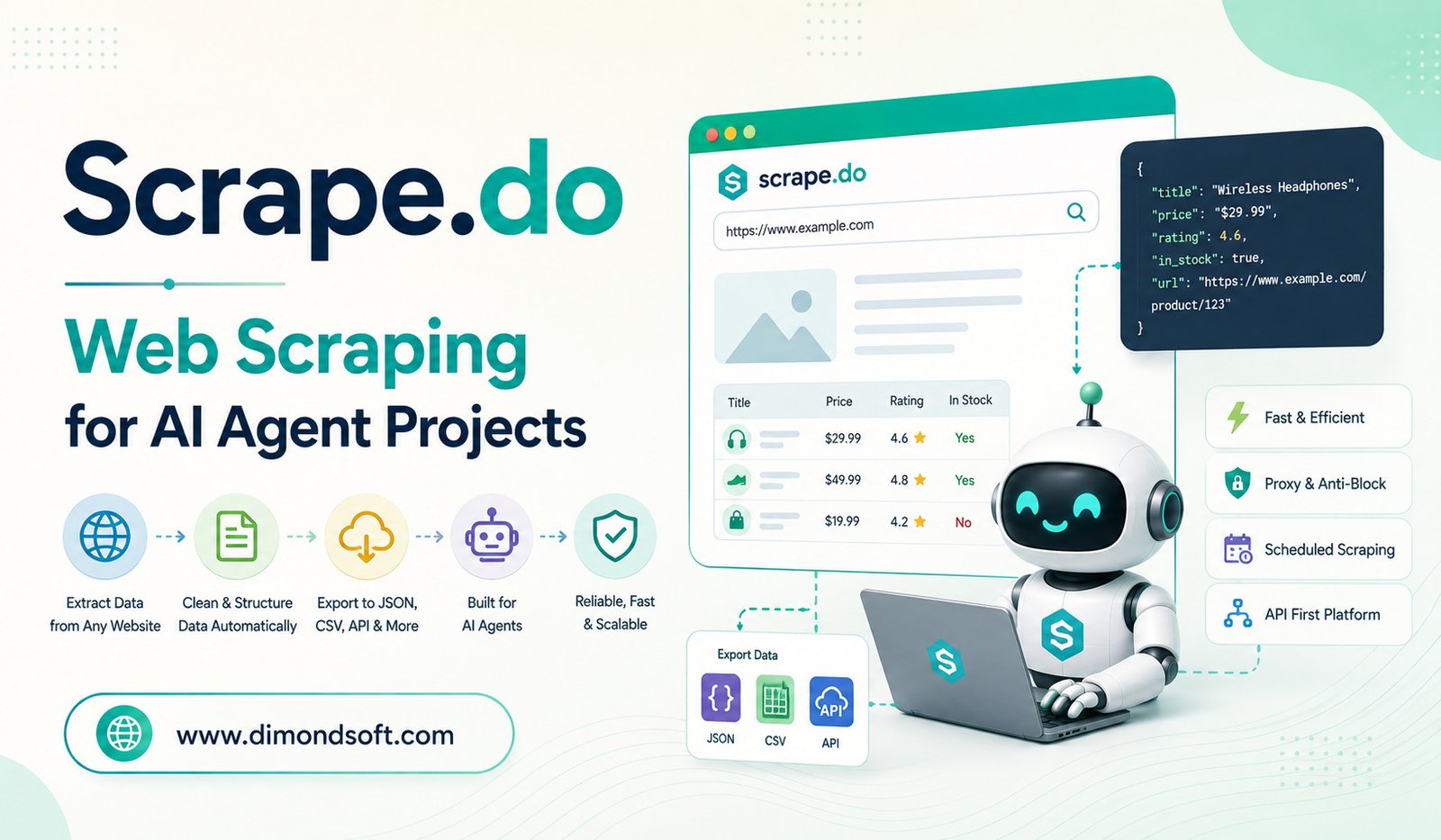
Scrape.do is a web scraping API designed to help developers collect information from websites programmatically. For teams building AI agents, data collection can be an important foundation because an agent may need current website information before it can analyze a topic, answer a question, or complete a task.
Rather than manually copying information from websites, developers can use web scraping technologies to retrieve web content automatically. When combined with AI, this can create powerful workflows for research, monitoring, data analysis, and automation.
What Is Scrape.do?
Scrape.do is a web scraping service that provides an API for retrieving web pages and website data.
In a traditional web scraping project, developers may need to manage infrastructure, proxies, browser behavior, request failures, anti-bot systems, and other technical challenges. A scraping API can simplify some of this infrastructure by providing developers with a service specifically designed for retrieving web content.
The basic concept is straightforward: an application sends a request to the scraping service, the service retrieves the requested web page, and the resulting content can then be processed by the application.
For AI developers, this creates a useful connection between the open web and AI-powered applications.
Why Web Data Matters for AI Agents
AI agents can reason and generate responses, but they often need external information to complete real-world tasks.
Imagine an AI agent designed to research products. It might need to collect information from multiple websites, compare prices, identify product specifications, and summarize the results.
Another agent might monitor industry news or track changes on selected websites.
A research agent could gather information from publicly accessible pages and organize it before an AI model analyzes the content.
In these examples, the AI is responsible for understanding and processing information, while web scraping provides a mechanism for collecting that information.
This creates a simple pipeline:
Website → Scraping → Data Processing → AI Model → Result
Scrape.do for AI Agent Development
AI agent projects frequently require information from multiple sources.
A developer building a research assistant, for example, might want the system to retrieve web pages automatically instead of depending entirely on manually uploaded documents.
A scraping API can become one component of this architecture.
The agent can identify a relevant webpage, request its content through the scraping layer, extract useful information, and provide that information to an AI model for analysis.
The AI can then summarize, classify, compare, or reason about the collected content.
This separation between data collection and AI reasoning can make an agent architecture more flexible.
Building AI Research Agents
Research is one of the clearest use cases for web scraping combined with AI.
Suppose a company wants an internal research agent that tracks developments in a particular industry.
The system could collect information from selected public websites, process the pages, remove irrelevant content, and send the useful text to an AI model.
The model could then identify important developments and produce a summary.
Instead of an employee manually visiting dozens of websites every morning, an automated workflow could perform much of the initial information gathering.
The human team can then focus on reviewing the most relevant findings.
Website Monitoring and Change Detection
Businesses often need to know when information on a website changes.
For example, a company may want to monitor:
- Product pages
- Public announcements
- Competitor information
- Documentation
- Job listings
- Market information
- Industry publications
A web scraping system can periodically retrieve relevant pages.
An AI model can then compare the new information with previous versions and explain what changed.
This is more useful than simply detecting that a page has changed. AI can potentially determine whether the change is significant and summarize its business implications.
Scraping Data for AI Knowledge Bases
Another potential application is building AI knowledge bases.
AI applications often use retrieval systems to provide models with relevant information when answering questions. Public web content can sometimes become one of the sources used in such systems, provided that the content can legally and appropriately be collected and used.
A scraping service can help retrieve the source material.
The content can then be cleaned, divided into smaller sections, indexed, and stored in a search or vector database.
When a user asks a question, the AI application can retrieve relevant information from the knowledge base and use it to generate a response.
This can help AI applications work with specialized information that may not be available directly from their underlying models.
Handling Dynamic Websites
Modern websites are not always simple HTML documents.
Many sites rely heavily on JavaScript to load content dynamically. In these cases, a basic HTTP request may not return all the information visible in a normal browser.
Modern scraping services can provide features intended to make retrieving web content from more complex websites easier.
For AI agent developers, this can be important because an agent may encounter different types of websites while completing a research task.
However, developers still need to test scraping workflows carefully because website structures, access requirements, and technical behavior can change over time.
Why APIs Are Useful for Developers
An API-based approach can make web scraping easier to integrate into an existing software architecture.
Instead of building an entire scraping infrastructure from the beginning, developers can connect their applications to a specialized service.
This can be useful for startups and small engineering teams that want to focus their resources on building the AI agent itself.
For example, a development team could create an application where:
- The user submits a research question.
- The AI determines which websites may contain relevant information.
- The application retrieves permitted web content.
- The content is cleaned and processed.
- The AI analyzes the information.
- The application presents the findings to the user.
The scraping layer becomes one part of a much larger AI workflow.
Data Quality Is Critical
Collecting web pages is only the beginning.
AI systems need clean and relevant information to produce useful results. Websites often contain navigation menus, advertisements, cookie notices, repeated content, scripts, and unrelated page elements.
Developers may therefore need to extract the meaningful content before passing it to an AI model.
Poor-quality scraped data can lead to poor AI results.
A good pipeline should consider content extraction, duplicate removal, formatting, metadata, timestamps, and source tracking.
Keeping the original source information is also valuable because it allows users to verify where information came from.
Legal and Ethical Considerations
Web scraping must be approached responsibly.
Not every website permits unrestricted automated collection or reuse of its content. Developers should review applicable laws, website terms, robots.txt guidance where relevant, copyright considerations, privacy requirements, and the specific purpose for which data is being collected.
Special care is necessary when websites contain personal or sensitive information.
AI developers should also avoid designing scraping systems that place unnecessary load on websites or attempt to bypass access controls.
The goal should be responsible data collection from appropriate sources.
Scrape.do and the Future of AI Agents
As AI agents become more capable, access to current information is likely to become increasingly important.
Language models can provide impressive reasoning and generation capabilities, but many applications need information that changes frequently.
Web data can provide an important source of current context.
A scraping service such as Scrape.do can therefore become part of the infrastructure behind AI-powered research assistants, monitoring systems, business intelligence tools, and automated workflows.
The future may involve agents that continuously collect information, analyze changes, and provide users with actionable insights.
However, the quality of those systems will depend on more than scraping technology. Developers will also need strong data processing, source verification, AI reasoning, security, and compliance practices.
Who Can Benefit From Scrape.do?
Scrape.do can be relevant to developers and businesses working on applications that require automated access to publicly available web information.
Potential users include AI startups, data teams, researchers, market intelligence companies, developers building monitoring systems, and organizations creating automated research workflows.
The most important question isn’t simply whether a company can scrape a website. It is whether collecting that information serves a legitimate purpose and can be done responsibly.
Final Thoughts
Scrape.do highlights an important part of the growing AI agent ecosystem: AI needs data to perform useful real-world tasks.
Web scraping can provide a bridge between online information and AI applications. Developers can use scraping infrastructure to retrieve website content, process it, and provide relevant information to AI models.
For AI agent projects, this can support applications ranging from research assistants and website monitoring to knowledge bases and business intelligence.
However, scraping should always be combined with careful data processing and responsible practices. Website permissions, privacy, copyright, security, and access policies should be considered before collecting information.
As AI agents become more autonomous, reliable access to fresh information could become one of their most important capabilities. Tools that simplify the connection between websites and software may therefore play an increasingly important role in the next generation of AI-powered applications.