Turning a website idea into a real online platform once required technical skills, coding knowledge, and often a professional development team. Today, AI-powered website-building tools are changing that process. One platform gaining attention in this space is See.io, which focuses on helping users turn an idea into a functional website without writing traditional code.
For entrepreneurs, creators, freelancers, small businesses, and first-time website owners, this approach can make website development much more accessible. Instead of starting with HTML, CSS, JavaScript, hosting configurations, and databases, users can focus on explaining what they want to build.
But how does See.io work, and what should you know before using an AI-powered website builder? Let’s explore how the platform fits into the changing world of no-code and AI-assisted web development.
What Is See.io?
See.io is an AI-focused platform designed to help users build websites and digital products from ideas or instructions rather than manually coding everything from scratch.
The basic concept is simple: you describe what you want to create, and the platform uses AI-assisted development capabilities to help turn that description into a website or application.
For example, someone might have an idea for a local service marketplace, portfolio website, online directory, business landing page, or simple web application. Traditionally, turning such an idea into a working product could involve hiring a developer or learning several programming technologies.
An AI website-building platform attempts to reduce that technical barrier.
This doesn’t necessarily mean that coding has disappeared completely. Instead, the coding process can happen behind the scenes while the user communicates their requirements in more natural language.
How See.io Can Turn an Idea Into a Website
The biggest attraction of AI website builders is the ability to start with an idea instead of a technical specification.
Imagine that you want to create a website for a small digital marketing agency. You could describe the business, target audience, services, preferred design style, and pages you need.
An AI-powered builder can use that information to create an initial structure.
The process generally follows a simple concept:
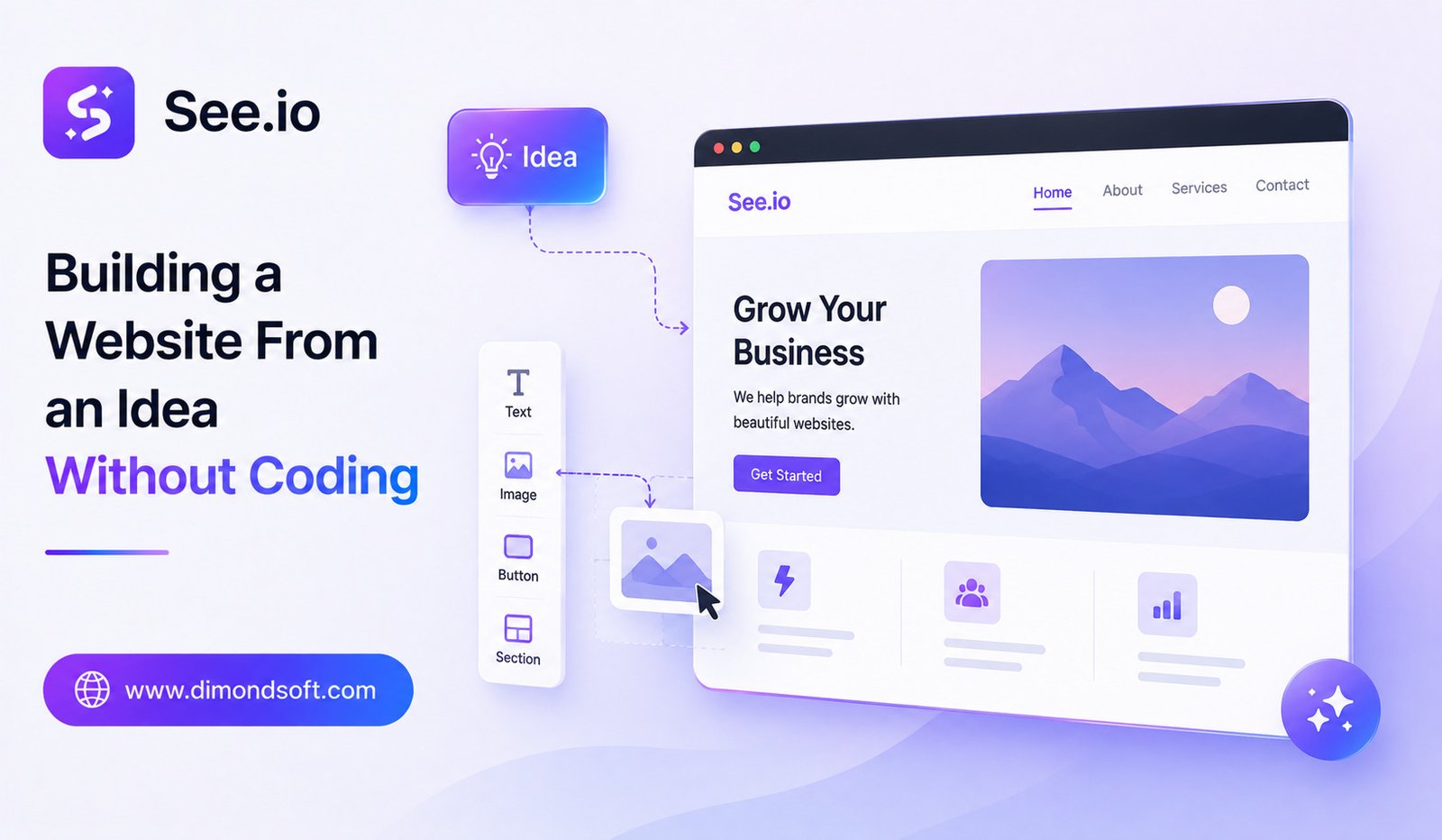
Idea → Description → AI-generated website → Customization → Testing → Launch
This approach is particularly useful during the early stages of a project. Instead of spending days creating a basic prototype, users can potentially create an initial version much faster and then improve it.
The quality of the final result still depends heavily on how clearly the requirements are explained and how much testing and editing are performed.
Why No-Code Website Development Is Growing
Traditional website development can be intimidating for beginners. Even a relatively simple website can involve multiple technical decisions, including hosting, responsive design, databases, security, integrations, and performance.
No-code platforms attempt to simplify this process by providing visual tools and pre-built functionality. AI takes the concept a step further by allowing users to describe requirements using ordinary language.
This creates an interesting opportunity for people who have business ideas but lack programming experience.
For example, a restaurant owner may know exactly what type of website they want but have no idea how to write JavaScript. A freelancer may want to quickly create a client prototype without spending hours coding. A startup founder may want to test an idea before investing heavily in development.
AI-assisted tools can help bridge that gap.
Who Can Benefit From See.io?
See.io and similar AI website-building platforms can be useful for several types of users.
Entrepreneurs and Startups
Startups often need to test ideas quickly. Instead of investing heavily in development before validating an idea, founders can use an AI-assisted platform to create an early prototype.
This can make it easier to demonstrate an idea to potential customers, partners, or investors.
Small Businesses
Small businesses may need professional websites but have limited budgets for custom development. An AI-powered website builder can provide a simpler starting point for business websites, landing pages, service pages, and other online projects.
Freelancers
Freelancers can potentially use AI tools to create initial website concepts more quickly. This can be particularly useful when clients need prototypes or simple websites on relatively short timelines.
Beginners
Perhaps the biggest audience is people who have never learned programming. Being able to explain a website idea in plain language can make web development feel considerably less complicated.
From Website Idea to MVP
One of the most interesting applications of AI website builders is creating a Minimum Viable Product (MVP).
An MVP is an early version of a product containing enough functionality to test whether an idea has potential.
Suppose someone wants to build a platform where users can discover local fitness trainers. Instead of immediately developing a complex application with advanced search, payment systems, user accounts, messaging, and mobile apps, the founder could begin with a simpler website.
The initial version might include trainer profiles, categories, contact forms, and basic search functionality.
Once users interact with the concept, the founder can determine which features are actually valuable.
This can reduce unnecessary development work and help businesses make decisions based on real feedback.
The Importance of Giving Clear Instructions
AI website builders are powerful, but they are not mind readers.
The quality of the output can depend on the quality of the instructions provided. A vague request such as “build me a business website” leaves many important decisions unanswered.
A better prompt might explain the business type, target audience, pages, desired features, design preferences, branding, and user actions.
For example, instead of saying:
“Create a website for my clothing business.”
You could describe the business, products, audience, pages, navigation, color preferences, product display requirements, contact options, and desired customer journey.
The more specific the requirements, the easier it becomes for an AI system to understand the intended result.
AI Website Builders Are Not Completely Hands-Off
One common misconception is that AI can create a perfect website automatically with no human involvement.
In reality, human review remains important.
After generating a website, users should check the content, layout, navigation, mobile responsiveness, forms, links, images, loading performance, and overall user experience.
Businesses should also make sure important information is accurate. AI-generated text may require editing to match a company’s actual services, policies, pricing, and brand voice.
For websites collecting customer information or handling payments, security and privacy considerations become even more important.
AI can accelerate development, but it does not eliminate the responsibility of testing and maintaining a website.
See.io vs Traditional Website Development
The biggest difference between an AI-assisted builder and traditional development is the starting point.
Traditional development usually begins with technical planning followed by design and programming. With AI-assisted development, users can begin with a natural-language description and gradually refine the result.
This can reduce the initial barrier to entry.
However, traditional development still has advantages for complex projects requiring highly customized functionality, advanced infrastructure, large databases, sophisticated integrations, or specialized security requirements.
Therefore, AI website builders should not necessarily be viewed as replacements for professional developers in every situation. They are better understood as tools that can make certain types of development faster and more accessible.
SEO Considerations for AI-Built Websites
Building a website is only the first step. If you want people to discover it through Google and other search engines, SEO needs to be considered from the beginning.
An AI-generated website should have clear page structures, useful content, descriptive titles, logical headings, fast loading times, mobile-friendly layouts, and appropriate internal links.
Content should also provide genuine value rather than simply filling pages with AI-generated text.
For businesses targeting competitive keywords, publishing useful supporting articles can help build topical relevance over time. Local businesses should also pay attention to location-specific content and business information.
In short, AI can help create the website, but a long-term SEO strategy is still necessary to attract organic traffic.
The Future of Building Websites With AI
The rise of platforms such as See.io reflects a broader change in how websites and software may be created.
In the past, knowing how to code was often the starting point for building digital products. Increasingly, understanding the problem, defining requirements, testing ideas, and communicating clearly with AI can become just as important.
This could encourage more people to experiment with digital businesses and online products.
A person with a strong business idea but limited technical knowledge may no longer have to wait until they can afford a development team just to create an initial version.
At the same time, professional developers are likely to remain important because complex products still require architecture, security, scalability, testing, and specialized technical expertise.
Final Thoughts
See.io represents the growing movement toward building websites and digital products from ideas rather than starting directly with code. For beginners, entrepreneurs, freelancers, and small businesses, this approach can make experimentation and website creation more accessible.
The biggest advantage is speed and simplicity. Users can begin with a concept, describe their requirements, generate an initial website, and then refine it.
However, an AI-generated website should not be treated as automatically finished. Content, SEO, performance, security, mobile usability, and functionality still need human attention.
As AI-powered development continues to evolve, the process of creating a website may become less about knowing every line of code and more about knowing what to build, why it matters, and how to improve it. For anyone with a strong online idea, that shift could make turning a concept into a real website significantly easier.