
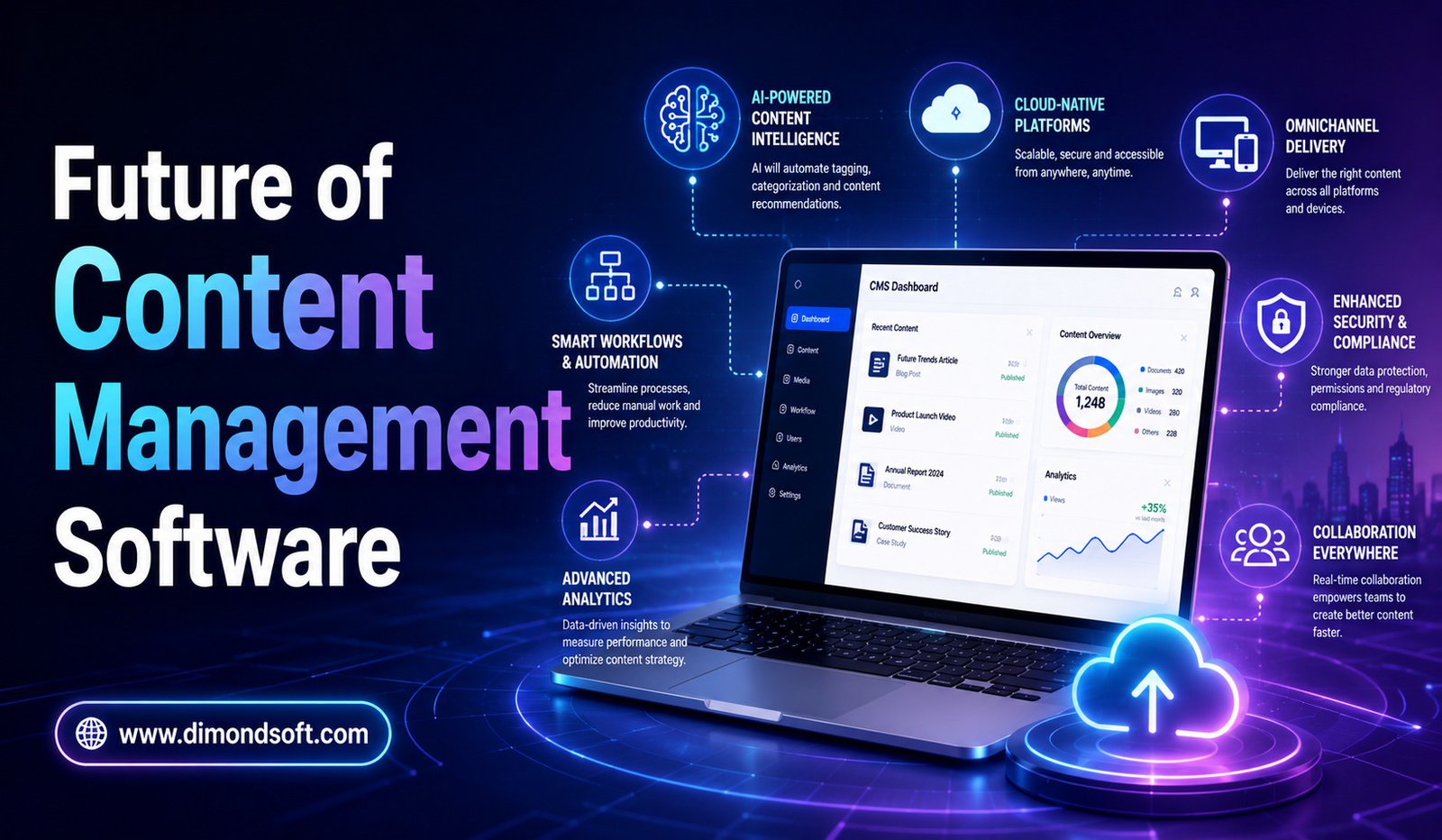
Content management software is entering a new phase. For years, businesses primarily used CMS platforms to create webpages, publish blogs, organize images, and manage documents. Today, these systems are becoming much more than publishing tools.
Businesses now manage content across websites, mobile applications, ecommerce platforms, customer portals, social channels, internal knowledge bases, and other digital environments. At the same time, artificial intelligence, automation, cloud computing, personalization, and data analytics are changing how content is created and delivered.
The future of content management software will therefore focus less on simply storing and publishing information and more on making content intelligent, connected, reusable, secure, and easier to manage.
From Publishing Platforms to Intelligent Content Hubs
Traditional CMS platforms were designed primarily around website publishing. A marketing employee could create a page, add images, edit text, and publish it without requiring a developer for every update.
Future platforms will increasingly function as centralized content hubs.
Instead of managing only website pages, businesses will use these systems to manage structured information that can be distributed across multiple digital experiences.
A product description, customer guide, company announcement, or knowledge article could be created once and delivered to several platforms.
This shift will make content management more strategic because organizations will be able to treat information as a reusable business asset.
Artificial Intelligence Will Become a Core CMS Capability
Artificial intelligence is likely to become one of the defining technologies in future content management software.
Current AI tools can already assist with writing, editing, summarization, translation, classification, and content recommendations. Future systems are likely to integrate these capabilities more deeply into everyday workflows.
A CMS could identify a topic that needs updating, prepare a content brief, recommend related resources, suggest metadata, and highlight information that requires human review.
AI may also help teams understand large content libraries and identify gaps or duplication.
The important change will be that AI will move from being an optional add-on to becoming part of the core content management experience.
AI Agents Could Automate Content Operations
The next stage of AI development could introduce more autonomous content workflows.
Instead of simply generating text when asked, AI agents may be able to perform sequences of tasks.
For example, an organization could define a workflow in which an AI system identifies outdated content, prepares an update recommendation, sends it to an editor, and moves the approved version into the publishing queue.
Other agents could monitor content performance, suggest improvements, organize digital assets, or identify missing information.
Human approval will remain important, especially for sensitive content, but AI agents could reduce the amount of manual coordination required.
Headless CMS Will Support More Digital Channels
The number of digital touchpoints continues to expand.
Businesses may communicate with customers through websites, applications, wearable devices, smart displays, chat interfaces, ecommerce platforms, and other technologies.
A traditional CMS may not be designed to handle all these experiences efficiently.
Headless CMS architecture separates content from presentation, allowing information to be delivered through APIs.
This makes it possible to create different front-end experiences while maintaining a centralized content repository.
As businesses become more omnichannel, headless and API-first approaches are likely to become increasingly important.
Composable Architecture Will Gain Importance
Another major development is the move toward composable technology.
A composable content platform allows businesses to combine different specialized services rather than relying on one system for every function.
An organization might use separate services for content management, search, ecommerce, personalization, analytics, and digital asset management while connecting them through APIs.
This approach can provide flexibility and allow companies to replace individual components without rebuilding their entire digital ecosystem.
However, composable systems require strong technical management because more integrations can also create additional complexity.
Content Will Become More Structured
Future content systems will increasingly treat information as structured data rather than simply pages.
Structured content separates information into reusable components.
For example, an article could contain separate fields for its title, summary, author, category, main content, images, related topics, and publication information.
This makes the information easier to deliver to different platforms.
Structured content also creates opportunities for AI because machines can process clearly organized information more effectively.
For businesses managing large catalogs or extensive knowledge bases, structured content can significantly improve scalability.
Personalization Will Become More Advanced
Customers increasingly expect digital experiences to be relevant to their interests.
Future CMS platforms will likely provide more sophisticated personalization capabilities.
A content system could use contextual information to determine which article, product recommendation, guide, or offer is most relevant to a particular visitor.
AI could help identify patterns and recommend content dynamically.
However, personalization will need to be balanced with privacy.
Businesses will need transparent data practices and responsible approaches to personalization to maintain customer trust.
Real-Time Content Delivery Will Expand
Many industries depend on information that changes frequently.
Examples include ecommerce inventory, financial information, travel availability, news, pricing, and event schedules.
Future CMS platforms will increasingly connect with real-time data sources.
Instead of manually updating information across multiple pages, businesses can connect content systems to operational databases and other applications.
This can reduce errors and ensure customers receive current information.
Intelligent Search Will Transform Content Discovery
Finding information inside a large content library can be difficult.
Traditional search depends heavily on keywords, while AI-powered search can interpret meaning and context.
Future CMS platforms will likely allow users to ask questions in natural language and receive direct, relevant results.
Employees could search an internal knowledge base using a conversational question instead of remembering the exact name of a document.
Customers could also receive more useful answers from website search systems.
This will make content discovery faster and more intuitive.
Automated Content Classification
Large organizations can have millions of digital assets.
Manually categorizing every document, image, video, and article is inefficient.
AI can automatically analyze content and assign categories, tags, metadata, and descriptions.
Image recognition can identify objects and subjects within photographs, while language models can classify written content according to topic.
Automation will help organizations maintain cleaner and more searchable content repositories.
Human review may still be necessary for important classifications, but routine tagging can become significantly faster.
Digital Asset Management Will Become Smarter
Visual content is becoming increasingly important for businesses.
Companies manage product photographs, promotional graphics, videos, presentations, illustrations, and other media.
Future content management platforms will likely connect more closely with digital asset management capabilities.
AI could automatically identify duplicate files, recommend suitable images, generate descriptions, detect outdated materials, and identify assets that do not meet brand standards.
This will help creative and marketing teams find approved materials without spending excessive time searching through folders.
Content Governance Will Become More Important
As content volumes increase, governance will become essential.
Organizations will need clear rules about who can create, edit, approve, publish, archive, and remove information.
AI will make governance even more important because businesses will need policies covering automated content generation, data privacy, copyright, accuracy, and human oversight.
Future CMS platforms may include built-in governance controls that automatically flag content requiring additional approval.
This can help organizations balance publishing speed with accountability.
Security Will Remain a Major Priority
Content management systems contain valuable business information, making them attractive targets for cyberattacks.
Future platforms will need stronger security capabilities, including advanced authentication, access controls, encryption, activity monitoring, and automated threat detection.
AI could help identify unusual behavior, such as unexpected access patterns or suspicious content changes.
Security will also become more complicated as CMS platforms connect with more external applications.
Organizations will need to evaluate not only the CMS itself but the entire ecosystem surrounding it.
Content Lifecycle Management Will Become Automated
Businesses cannot allow content to remain online forever without review.
Information becomes outdated, products change, policies are replaced, and links stop working.
Future CMS platforms will increasingly monitor content throughout its lifecycle.
AI could identify pages that have not been reviewed recently, detect outdated references, and recommend whether content should be updated, consolidated, archived, or removed.
This proactive approach will help organizations maintain healthier content libraries.
Voice and Conversational Interfaces
The way people consume information is changing.
Voice assistants, chatbots, conversational applications, and AI-powered interfaces are creating new ways for customers to interact with businesses.
CMS platforms will need to deliver content to these experiences as effectively as they deliver information to websites.
Structured and API-based content will be particularly useful because conversational applications can retrieve relevant information without depending on traditional webpage layouts.
This could make content management increasingly important for conversational digital experiences.
Greater Focus on Accessibility
Future content systems will also place more emphasis on accessibility.
Businesses need digital experiences that can be used by people with different abilities.
CMS platforms can support accessibility by encouraging appropriate headings, alternative text, readable structures, captions, keyboard navigation, and accessible components.
AI may assist by identifying potential accessibility problems before content is published.
Automated checks will be useful, but human testing will continue to be important for creating genuinely accessible experiences.
Low-Code and No-Code Content Operations
Future CMS platforms will likely become easier for non-technical teams to customize.
Low-code and no-code capabilities can allow marketers and business teams to create workflows, configure content structures, build landing pages, and connect services without extensive programming.
This can reduce pressure on development teams.
Developers will still be needed for complex architecture, integrations, security, and custom applications, but everyday content operations can become more accessible to business users.
Better Analytics and Predictive Insights
Analytics will move beyond reporting what happened.
Future CMS platforms may use AI to predict which content is likely to perform well, identify audiences that need additional information, and recommend improvements.
Instead of simply showing that a page received fewer visitors, a system could analyze possible reasons and suggest actions.
Content teams could use these insights to prioritize updates and improve future publishing decisions.
This will make content management increasingly data-driven.
Greater Integration With Business Systems
Content does not exist separately from other business operations.
Future CMS platforms will connect more closely with CRM, ERP, ecommerce, customer service, marketing automation, analytics, and product systems.
These connections can help businesses create more consistent customer experiences.
For example, product information stored in one system could automatically become available across websites, applications, sales tools, and customer support channels.
Integration will therefore become a fundamental requirement rather than an optional feature.
The Importance of Human Expertise
Despite rapid technological progress, humans will remain central to content management.
AI can generate text, identify patterns, organize information, and automate workflows, but it does not replace business judgment.
People will continue to establish brand strategy, evaluate accuracy, approve sensitive information, create original ideas, and determine what customers actually need.
The future CMS will therefore be less about replacing content professionals and more about giving them better tools.
How Businesses Should Prepare
Businesses do not need to completely replace their current CMS immediately.
Instead, organizations should evaluate their existing content operations and identify areas that create the most friction.
They can begin by improving content organization, establishing governance, adopting automation, and exploring AI-assisted workflows.
Companies should also consider whether their current platform can support APIs, structured content, integrations, personalization, and multiple digital channels.
The goal should be to create a flexible foundation that can evolve as technology changes.
Conclusion
The future of content management software will extend far beyond traditional website publishing.
AI, intelligent automation, headless architecture, structured content, personalization, real-time delivery, conversational interfaces, advanced analytics, and stronger governance will reshape how businesses manage digital information.
CMS platforms will increasingly become intelligent content hubs capable of organizing information, distributing it across channels, and helping teams make better decisions.
However, technology will only deliver value when supported by clear strategies and responsible processes. Businesses will need to balance automation with human oversight, flexibility with security, and personalization with privacy.
The organizations that prepare early will be better positioned to manage growing volumes of content and deliver consistent digital experiences.
Beyond 2026, content management will not simply be about publishing more information. It will be about making every piece of content easier to create, discover, reuse, personalize, secure, and maintain. That shift will make content management software an increasingly important part of the modern digital business.