
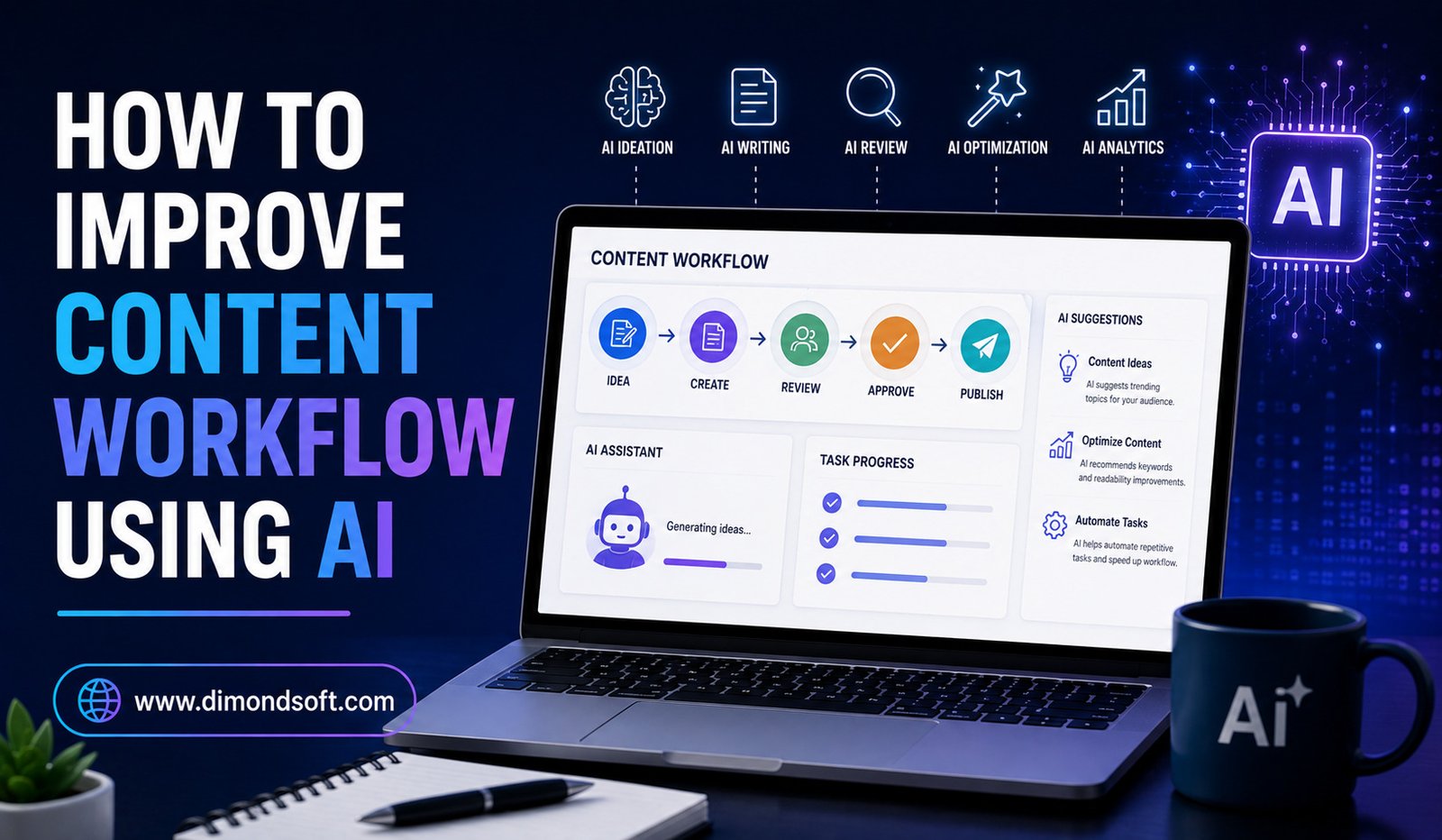
Creating high-quality content involves much more than writing an article and publishing it. Modern content teams often manage research, planning, writing, editing, SEO, approvals, design, publishing, distribution, and performance analysis. When these activities are handled manually, even a small content team can quickly become overwhelmed.
Artificial intelligence is changing how businesses manage these workflows. AI tools can automate repetitive tasks, organize information, assist writers, improve content quality, and provide useful insights. Instead of replacing content professionals, AI can help them spend less time on routine work and more time on strategy, creativity, and decision-making.
A successful AI-powered workflow is not about automating every step. It is about identifying where technology can remove unnecessary effort while keeping human expertise involved where it matters most.
What Is a Content Workflow?
A content workflow is the process a business follows from the initial content idea to final publication and ongoing maintenance.
A typical workflow may include topic research, content planning, assigning tasks, drafting, editing, SEO optimization, approval, design, publication, promotion, and performance tracking.
Without a structured workflow, teams may experience missed deadlines, duplicated work, unclear responsibilities, and inconsistent quality.
AI can support several stages of this process and help teams create a more organized publishing system.
1. Use AI for Topic Research
Finding useful content ideas can take considerable time.
AI can analyze existing content, audience questions, industry discussions, search patterns, and related subjects to help teams identify potential topics.
For example, a content team working in the software industry can use AI to group ideas into themes such as automation, cybersecurity, cloud computing, productivity, and digital transformation.
AI-generated ideas should not be accepted without research. Teams should verify demand, relevance, competition, and business value before adding a topic to the editorial calendar.
The best approach is to use AI as a research assistant rather than treating it as the final source of truth.
2. Build Better Content Briefs
A detailed content brief gives writers a clear understanding of what they need to create.
AI can help generate initial briefs containing potential headings, target audiences, questions to answer, related topics, and suggested content formats.
Editors can then refine the brief according to brand requirements and audience needs.
A strong brief reduces back-and-forth communication and helps writers begin with a clearer direction.
This can be particularly useful for teams producing large amounts of content across multiple departments.
3. Automate Content Assignments
Managing content tasks manually can create unnecessary administrative work.
AI-powered workflow systems can help assign tasks based on deadlines, team availability, content type, or specific responsibilities.
For example, once a writer completes a draft, the system can automatically move the task to an editor.
After editing, it can notify an SEO specialist or subject expert.
Automated routing creates a predictable process and reduces the need for employees to repeatedly check emails or project boards.
4. Accelerate Draft Creation
AI can help writers create first drafts, outlines, summaries, introductions, product descriptions, and other basic content elements.
This can reduce the time required to move from an idea to a workable draft.
However, an AI-generated draft should be treated as a starting point.
Writers should add original insights, examples, evidence, and expertise. They should also check factual claims and ensure the final content reflects the organization’s voice.
AI is most useful when it accelerates human creativity rather than replacing it.
5. Improve Editing and Proofreading
Editing is another area where AI can provide practical assistance.
AI tools can identify spelling mistakes, grammatical problems, awkward sentences, repetition, and readability issues.
They can also suggest clearer alternatives or help simplify complicated language.
Editors can use these recommendations as a first review before conducting a deeper editorial assessment.
Human editors remain important because AI may not understand context, industry terminology, humor, or the intended tone of a particular audience.
6. Maintain Brand Voice
Large content teams often struggle to maintain consistent communication.
Different writers may use different tones, vocabulary, sentence structures, and messaging styles.
AI can help compare content against predefined brand guidelines.
Businesses can establish instructions covering tone, terminology, formatting, audience, and messaging principles.
AI can then flag content that appears inconsistent.
This does not eliminate the need for editorial judgment, but it can make brand consistency easier to maintain across large content libraries.
7. Strengthen SEO Workflows
SEO can involve keyword research, content structure, internal linking, metadata, search intent, and performance monitoring.
AI can assist with many of these activities.
It can suggest related topics, identify questions users may ask, recommend internal links, create metadata drafts, and analyze content structure.
However, businesses should avoid using AI simply to insert large numbers of keywords.
Search engines increasingly reward useful, relevant content that satisfies user needs.
AI should therefore support SEO strategy rather than encourage automated keyword stuffing.
8. Automate Content Approvals
Content approval can become a bottleneck when several people need to review the same material.
AI-powered workflows can automate notifications and routing.
When an article is ready, the system can automatically send it to the appropriate reviewer. If approval is delayed, a reminder can be generated.
Once the content is approved, the workflow can move it to the next stage.
This makes the publishing process easier to monitor and reduces delays caused by manual coordination.
9. Improve Content Collaboration
Content projects often involve writers, editors, designers, marketers, SEO specialists, and managers.
AI-powered collaboration tools can summarize discussions, identify outstanding tasks, and organize project information.
For example, after a long team discussion, AI can create a summary containing decisions, responsibilities, and deadlines.
This helps employees understand what needs to happen next without reading every message.
10. Create Content Variations Faster
Businesses often need different versions of the same information.
An article may need to be adapted into a newsletter, social media post, video script, sales email, or short summary.
AI can help transform existing content into different formats.
This makes content repurposing faster and allows organizations to get more value from original research.
Each version should still be reviewed and adapted for its specific platform rather than published without changes.
11. Use AI for Content Translation
Businesses operating across different markets may need content in multiple languages.
AI-assisted translation can reduce the time required to create initial translations.
It can also help teams maintain consistent terminology across large content libraries.
However, machine translation may struggle with cultural context, regional expressions, technical terminology, and subtle meanings.
Important customer-facing content should receive human review before publication.
12. Improve Digital Asset Management
Content workflows include more than written material.
Teams also manage images, videos, presentations, PDFs, graphics, and audio.
AI can help classify these assets, generate descriptions, identify objects, and recommend tags.
This makes large digital libraries easier to search.
For example, a marketing employee could search for images associated with a particular product rather than manually browsing hundreds of folders.
Better asset organization can save considerable time.
13. Automate Content Publishing
Once content has passed the approval process, AI and automation can help prepare it for publication.
Systems can schedule posts, distribute content to connected platforms, update metadata, and notify relevant teams.
Automation is especially valuable for organizations that publish frequently.
However, businesses should include safeguards. Content should not automatically go live when it involves sensitive information, legal claims, financial details, or other high-risk subjects without appropriate human approval.
14. Identify Outdated Content
Content management does not end after publication.
Pages can become outdated because products change, statistics age, links break, or industry information evolves.
AI can analyze content libraries and identify potential maintenance issues.
It may flag articles with old dates, outdated terminology, broken references, or declining performance.
Editors can then prioritize pages that require updates.
This creates a more proactive content maintenance process.
15. Use AI for Content Analytics
Understanding content performance is essential.
AI can analyze large amounts of data to identify patterns in traffic, engagement, conversions, search visibility, and customer behavior.
It can help answer questions such as which topics perform best, which formats generate more engagement, and where users frequently leave a website.
These insights can influence future content planning.
However, businesses should connect analytics with actual goals. A page receiving significant traffic may still have little business value if it does not support the organization’s objectives.
16. Improve Content Personalization
AI can help businesses deliver more relevant information to different audiences.
For example, a software company might show different resources to new visitors, existing customers, and advanced users.
Personalization can improve the user experience by reducing irrelevant information.
However, businesses should use customer data responsibly and provide appropriate privacy protections.
Personalization should create value rather than make customers uncomfortable.
17. Build AI Governance Into the Workflow
AI introduces new risks that content teams must address.
Businesses should create clear policies covering how AI tools may be used.
These policies should address data privacy, factual accuracy, copyright, confidential information, human review, and disclosure requirements where appropriate.
Employees should know which information they can provide to AI systems and which information must remain confidential.
Governance ensures that AI improves productivity without creating unnecessary legal, security, or reputational risks.
18. Keep Humans in the Loop
The most effective AI content workflows combine automation with human expertise.
AI can process information quickly, identify patterns, generate drafts, and handle repetitive tasks.
Humans provide judgment, creativity, context, experience, and accountability.
High-risk content should receive additional human review.
Writers and editors should verify important claims, especially when content involves technical, financial, legal, medical, or regulatory information.
The goal is not to remove humans from the workflow. It is to give them better tools.
Common Mistakes When Using AI
Businesses can create problems by adopting AI without changing their processes thoughtfully.
One mistake is automating tasks simply because automation is possible.
Another is publishing AI-generated content without fact-checking.
Teams may also use too many disconnected AI tools, creating more complexity instead of reducing it.
A better approach is to identify specific workflow bottlenecks and select AI capabilities that address them.
Start with low-risk repetitive tasks, measure the results, and expand gradually.
How to Build an AI-Powered Content Workflow
A practical implementation can begin with a workflow audit.
Identify where employees spend the most time and where delays frequently occur.
Then determine which tasks can benefit from AI assistance.
For example, a business might begin with topic research, content briefs, proofreading, metadata generation, and content summaries.
Establish clear human review points before implementation.
Track results using metrics such as production time, approval speed, content quality, publishing frequency, and employee productivity.
The workflow should be refined continuously based on actual results.
The Future of AI and Content Workflows
AI-powered content management is likely to become increasingly sophisticated.
Future systems may coordinate multiple stages of the publishing process, from topic discovery to performance analysis.
AI agents could potentially identify content opportunities, prepare briefs, organize assets, route tasks, and recommend updates.
However, businesses will still need people to set objectives, establish standards, evaluate results, and make important decisions.
The future is likely to be a collaborative environment where AI handles routine operational work while humans focus on strategy and creativity.
Conclusion
AI can significantly improve content workflows by reducing repetitive tasks and helping teams manage content more efficiently.
From research and drafting to editing, SEO, approvals, publishing, analytics, and content maintenance, AI can support almost every stage of the content lifecycle.
However, successful implementation requires more than adding AI tools. Businesses need clear processes, strong governance, reliable information, and human oversight.
The best approach is to start with specific workflow problems and use AI where it provides measurable value.
When implemented thoughtfully, AI can help content teams work faster without sacrificing quality. It can reduce administrative effort, improve collaboration, accelerate publishing, and allow professionals to spend more time on the creative and strategic work that machines cannot fully replace.
The future of content management will not simply be about producing more content. It will be about creating better content, managing it intelligently, and building workflows where technology and human expertise work together.