
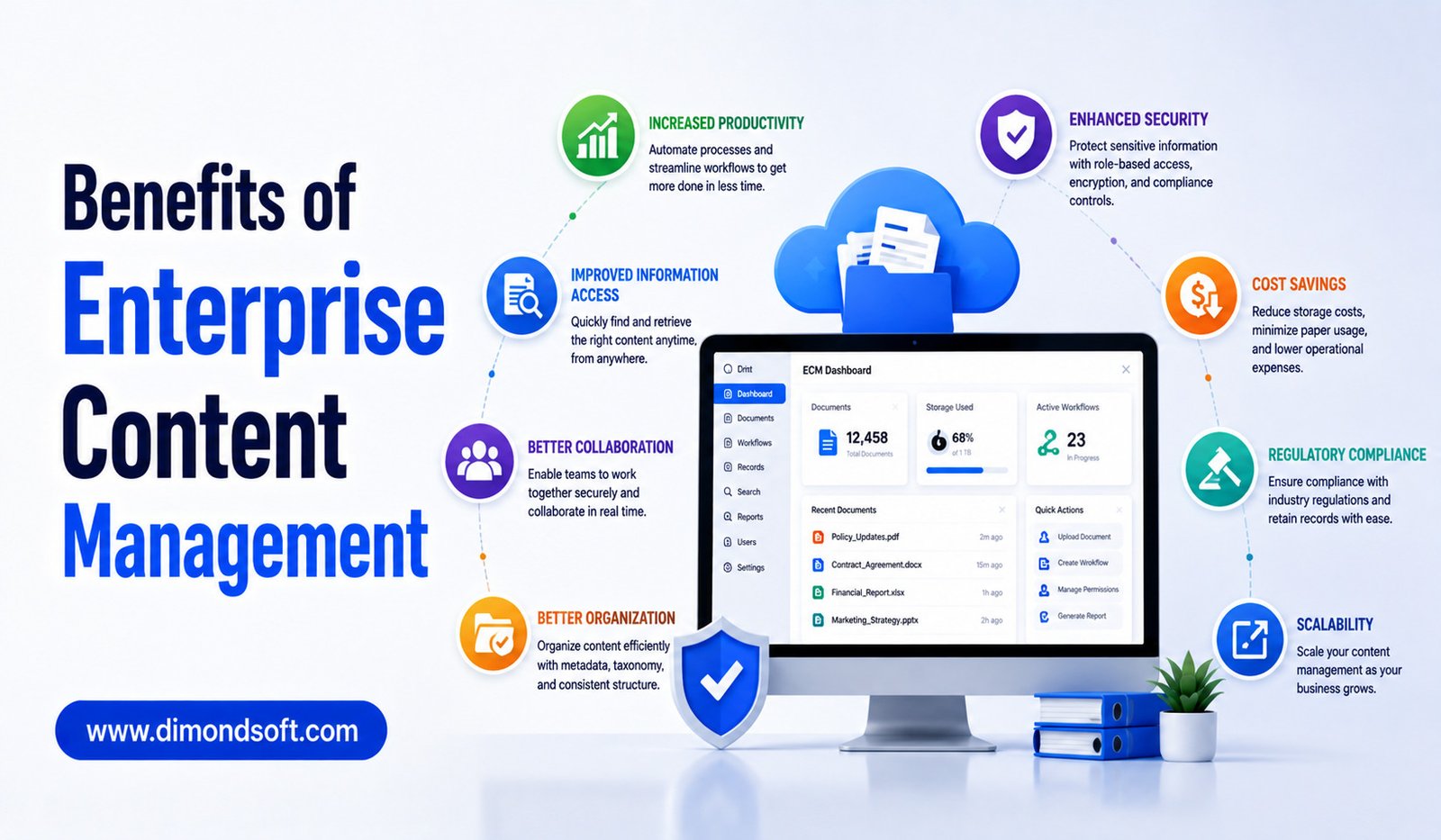
Modern enterprises create and manage enormous amounts of information every day. Contracts, reports, employee records, customer documents, marketing materials, product information, invoices, presentations, policies, and digital assets all become part of an organization’s information environment.
As companies grow, managing this content becomes increasingly complicated. Employees may store documents across email accounts, personal computers, shared drives, cloud applications, and different departmental systems. This fragmentation can make it difficult to find information, control access, collaborate effectively, and maintain accurate records.
Enterprise Content Management (ECM) provides a structured approach to managing business information throughout its lifecycle. It combines technology, processes, and policies to help organizations capture, organize, store, access, share, secure, and eventually archive or dispose of content.
An effective ECM strategy can improve productivity while reducing information-related risks. It can also help businesses build a more connected digital workplace.
What Is Enterprise Content Management?
Enterprise Content Management is a system for managing the large volume of information created and used throughout an organization.
Unlike a basic document storage solution, ECM can cover multiple stages of the content lifecycle. Information can be captured, classified, reviewed, stored, distributed, modified, archived, and eventually removed according to business policies.
ECM may include documents, emails, images, videos, contracts, scanned records, web content, employee resources, and other digital information.
Modern ECM platforms often include cloud storage, workflow automation, search, security controls, collaboration tools, analytics, and artificial intelligence.
The goal is to make business information easier to manage while ensuring that authorized employees can access the right content when they need it.
1. Centralized Information Management
One of the biggest benefits of ECM is centralization.
Without an organized content management strategy, employees may spend considerable time searching through email inboxes, shared folders, local computers, and multiple applications.
An ECM platform provides a structured environment where important information can be stored and managed.
Centralization makes it easier for employees to locate documents and reduces the risk of important information becoming isolated within individual departments.
It also gives organizations greater visibility into their information assets.
2. Improved Employee Productivity
Employees can waste significant amounts of time searching for documents or recreating information that already exists.
ECM can reduce this problem through organized repositories, advanced search, metadata, document classification, and version control.
An employee looking for a specific contract, policy, or project document can locate it more quickly instead of asking multiple colleagues or searching through old emails.
The time saved on information retrieval can be redirected toward more productive tasks.
This becomes particularly valuable in large organizations where thousands of employees access business information every day.
3. Faster Document Retrieval
Enterprise content repositories may contain millions of files.
Traditional folder structures can become difficult to manage at this scale.
ECM platforms often provide search tools that allow users to locate information using keywords, document types, dates, authors, categories, or other metadata.
Modern systems may also use AI-powered search to understand natural-language queries.
For example, instead of remembering the exact title of a document, an employee may search for information about a particular customer agreement and receive relevant results.
Better search capabilities can significantly improve workplace efficiency.
4. Better Collaboration
Enterprise employees frequently work across departments and locations.
Marketing teams may need information from sales, finance may require documents from procurement, and legal teams may review materials created by several departments.
ECM creates a shared environment where authorized employees can collaborate around the same information.
Version control helps prevent different teams from editing disconnected copies of the same document.
Comments, approval processes, notifications, and shared access can further improve collaboration.
This is particularly useful for remote and hybrid work environments.
5. Stronger Document Version Control
Working with outdated documents can cause serious business problems.
An employee may accidentally use an old contract, outdated product specification, or previous version of a policy.
ECM systems can maintain document histories and identify the latest approved version.
Authorized users can also review previous versions when necessary.
Version control improves accuracy and provides a clearer record of how important documents changed over time.
6. Improved Information Security
Enterprise content often contains sensitive information.
Financial records, employee information, customer details, contracts, intellectual property, and internal strategies all require appropriate protection.
ECM platforms can provide role-based access controls that determine who can view, edit, download, or share information.
Organizations can also use authentication, encryption, monitoring, and security policies to protect sensitive content.
Access controls should be regularly reviewed to ensure employees have only the permissions necessary for their responsibilities.
7. Regulatory Compliance
Many industries must follow rules governing how information is created, stored, accessed, and retained.
ECM can support compliance by providing structured retention policies, audit trails, access controls, and document histories.
Organizations can establish rules determining how long particular records should be retained and when they should be archived or disposed of.
An audit trail can also help demonstrate who accessed or modified certain information.
ECM does not automatically guarantee compliance, but it can provide important tools for supporting organizational compliance programs.
8. Automated Workflows
Many business processes involve repetitive document-related activities.
A document may need to be created, reviewed, approved, signed, distributed, and archived.
When these steps are handled manually, delays can occur.
ECM platforms can automate parts of these workflows.
For example, a new contract could automatically be sent to the appropriate manager for approval. Once approved, it could move to another department for processing.
Automation reduces manual coordination and helps employees understand where a document is within a process.
9. Reduced Paperwork
Enterprise organizations can generate large quantities of paperwork.
Printing, copying, scanning, storing, and transporting physical documents can consume time and resources.
ECM supports digital workflows that reduce dependence on physical records.
Electronic documents can be shared and reviewed without printing multiple copies.
Digital signatures can also reduce the need to print, sign, scan, and return documents.
Reducing paper can lower administrative costs while supporting more sustainable business practices.
10. Better Remote and Hybrid Work
The modern workplace is increasingly distributed.
Employees may work from offices, homes, client locations, or different countries.
ECM platforms can provide authorized employees with secure access to business information from different locations.
Cloud-based ECM is particularly useful because employees can access documents without depending entirely on office-based servers.
Remote access can improve continuity and allow teams to collaborate even when they are not physically together.
11. Improved Customer Service
ECM can also affect customer-facing operations.
Customer service representatives often need access to contracts, account records, product information, invoices, policies, and previous communications.
If information is difficult to find, customer responses may be delayed.
A centralized content environment can help employees locate relevant information faster.
This can lead to quicker responses and more consistent customer interactions.
In industries where customers frequently request documentation, efficient content retrieval can provide a significant service advantage.
12. Better Knowledge Management
Organizations accumulate valuable knowledge through years of projects, customer interactions, research, and employee experience.
Without proper management, this knowledge can become difficult to access.
ECM can help preserve important business information and make it available to employees.
Knowledge management becomes especially important when experienced employees leave the organization.
Instead of allowing valuable information to disappear with individuals, companies can document and organize important knowledge within shared systems.
13. Integration With Other Business Systems
ECM becomes more powerful when connected with other enterprise applications.
Organizations may integrate content management with CRM, ERP, accounting, HR, project management, customer service, and workflow platforms.
For example, a customer record in a CRM system could be connected with relevant contracts and documents stored within an ECM platform.
Integrations reduce duplicate data entry and allow employees to access related information from connected systems.
APIs and modern integration tools make these connections increasingly practical.
14. Better Content Lifecycle Management
Enterprise content should not remain in storage indefinitely without review.
Some documents need frequent updates, while others must eventually be archived or securely disposed of.
ECM supports content lifecycle management by providing processes for creation, review, publication, retention, archiving, and disposal.
This helps organizations avoid large collections of outdated or unnecessary information.
Regular content reviews can also improve data quality and reduce storage costs.
15. AI-Powered Enterprise Content Management
Artificial intelligence is becoming an important part of modern ECM.
AI can classify documents, extract information, summarize files, identify duplicates, improve search, and automate repetitive content-related activities.
For example, AI can analyze an uploaded document and automatically identify its type, date, subject, or relevant metadata.
AI-powered search can also help employees find information more naturally.
However, organizations should maintain human oversight for important decisions and sensitive information.
AI should improve information management without removing accountability.
16. Cost Savings
ECM can reduce costs in several ways.
Businesses can spend less on paper, printing, physical storage, manual document handling, and repetitive administrative tasks.
Improved search can also reduce the amount of employee time spent looking for information.
Automation can shorten approval processes and reduce unnecessary manual work.
The financial benefits vary depending on the size and complexity of an organization, but even small efficiency improvements can become significant when applied across thousands of employees.
17. Business Continuity and Disaster Recovery
Important business information needs protection against unexpected events.
Hardware failures, natural disasters, cyber incidents, and other disruptions can affect access to physical and digital records.
ECM platforms, particularly cloud-based systems with appropriate backup strategies, can support business continuity.
Organizations can maintain controlled copies of important information and restore access when problems occur.
A strong disaster recovery plan should be combined with regular backups, security controls, and testing.
How to Implement Enterprise Content Management
Successful ECM implementation requires more than purchasing software.
Businesses should first identify where information is currently stored and how employees use it.
They should determine which content is most important, identify security requirements, establish retention policies, and define user roles.
The organization should then select an ECM platform that fits its workflows.
Employee training is also essential. Even a powerful system will not deliver results if employees do not understand how to use it.
A gradual implementation can be effective. Businesses can begin with a specific department or document type before expanding the system across the organization.
Common Challenges of ECM
ECM can provide substantial benefits, but implementation may present challenges.
Migrating large amounts of legacy information can take considerable time. Employees may also resist changing familiar processes.
Poorly designed information structures can make a new system difficult to navigate.
Organizations should therefore focus on usability, training, governance, and change management.
It is also important to avoid moving unnecessary or outdated content into the new system. Migration provides an opportunity to clean up information before it becomes part of the new environment.
The Future of Enterprise Content Management
ECM is evolving from basic document storage into a more intelligent information management environment.
AI, automation, cloud computing, advanced search, analytics, and integrations are making enterprise systems more capable.
Future ECM platforms are likely to identify useful information automatically, recommend actions, detect outdated content, and support more intelligent workflows.
Businesses may also use AI agents to perform routine content-related tasks while employees focus on decisions requiring expertise and judgment.
The organizations that benefit most will be those that combine technology with clear governance and well-designed processes.
Conclusion
Enterprise Content Management provides businesses with a structured way to manage information throughout its lifecycle.
From centralized document storage and faster search to improved collaboration, stronger security, automated workflows, compliance support, and better knowledge management, ECM can deliver significant operational benefits.
It can also reduce paperwork, support remote employees, improve customer service, and help organizations protect valuable business information.
However, successful ECM depends on more than software. Businesses need clear ownership, appropriate permissions, consistent processes, employee training, and regular content reviews.
As organizations continue producing larger volumes of digital information, effective content management will become increasingly important. By adopting a well-planned ECM strategy, businesses can turn scattered information into an organized resource that supports productivity, security, collaboration, and long-term growth.