
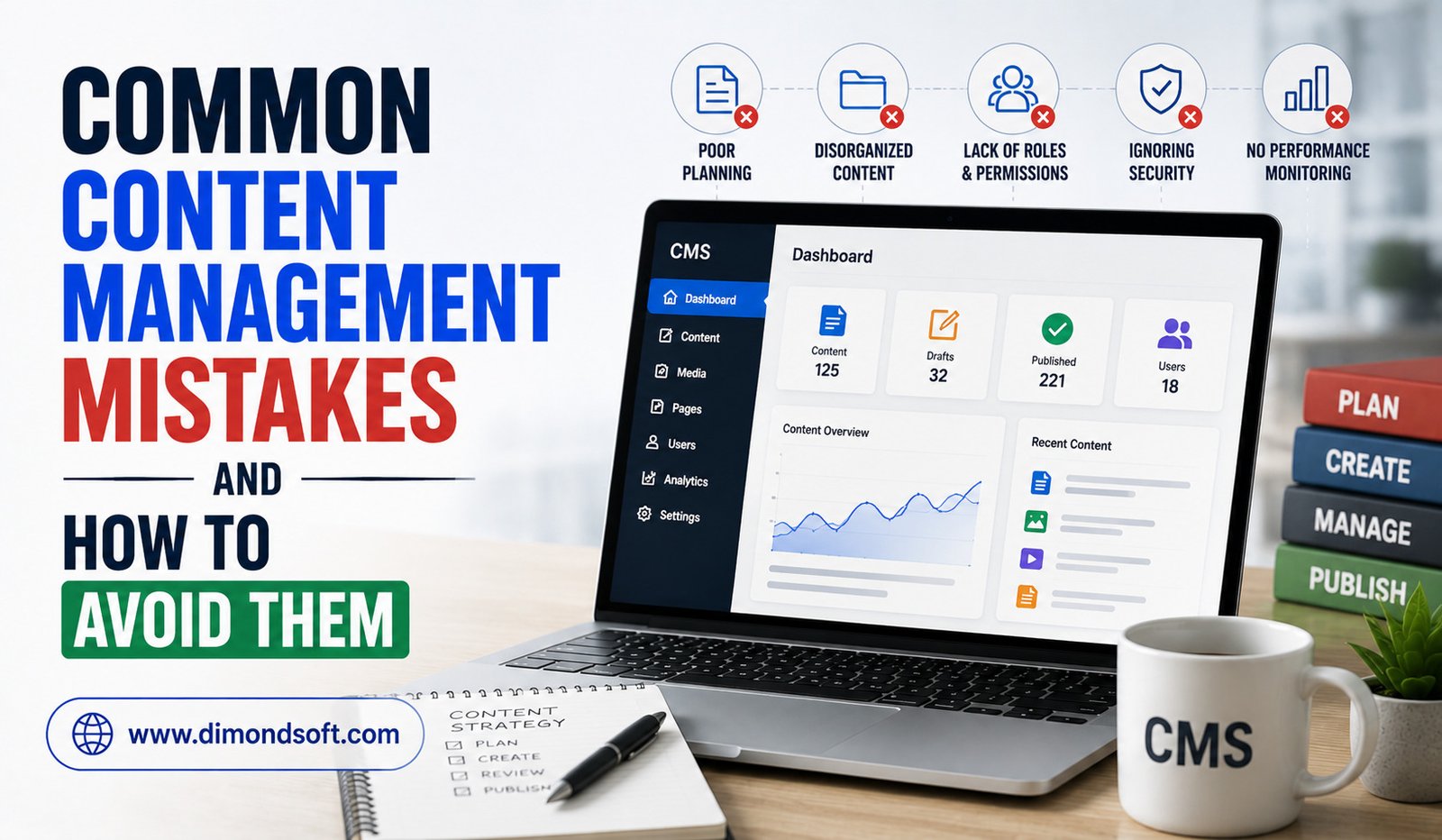
Content is one of the most valuable digital assets a business can create. Websites, blogs, product descriptions, videos, guides, case studies, images, documents, and customer resources all contribute to how people discover and understand a brand. However, creating content is only one part of successful content management.
Businesses also need effective systems for organizing, updating, securing, publishing, and measuring their content. Without a clear process, even a large content library can become difficult to manage. Outdated pages may remain online, duplicate files can create confusion, and employees may struggle to find the information they need.
Content management mistakes can affect productivity, customer experience, SEO, security, and brand reputation. Fortunately, most of these problems can be avoided with better planning and consistent processes.
1. Creating Content Without a Clear Strategy
One of the most common mistakes is producing content simply because a business believes it needs to publish regularly.
Without a strategy, teams may create articles that target the same topics, fail to address customer needs, or provide little long-term value.
A content strategy should define the audience, business goals, topics, formats, publishing priorities, and distribution channels.
Before creating a piece of content, teams should understand why it is needed and what purpose it serves.
A clear strategy helps businesses focus resources on content that supports measurable objectives.
2. Poor Content Organization
A large content library can quickly become difficult to navigate.
Files may have inconsistent names, unclear categories, duplicate versions, or confusing folder structures.
This makes it harder for employees to find the correct information.
Businesses should establish consistent naming conventions and content categories. A well-structured content management system can also use tags, metadata, folders, and filters to improve organization.
Good organization saves time and reduces the risk of employees using incorrect or outdated information.
3. Ignoring Content Updates
Publishing content once does not mean the work is finished.
Statistics change, products are discontinued, links stop working, regulations are updated, and customer expectations evolve.
Leaving outdated information online can damage credibility.
Businesses should create a regular content review process. High-value pages should be reviewed periodically to confirm that the information remains accurate.
Older content can be updated, consolidated, redirected, archived, or removed depending on its current value.
4. Creating Duplicate Content
Duplicate content can appear when teams create multiple pages covering nearly identical information.
This can happen when different departments publish similar articles or when old pages are copied instead of updated.
Duplicate content also creates unnecessary maintenance work.
Businesses should maintain a central content inventory to identify similar materials.
Before creating a new page, employees should check whether an existing resource can be updated or expanded.
This approach keeps the content library cleaner and reduces duplication.
5. Using Inconsistent Brand Voice
When multiple people create content, the tone and writing style can become inconsistent.
One page may sound highly professional while another uses a casual tone that does not match the brand.
Inconsistent communication can make a business appear less organized.
A brand style guide can define tone, terminology, formatting, spelling preferences, messaging principles, and audience expectations.
Writers should use these guidelines when creating and editing content.
6. Neglecting SEO During Content Management
Search engine optimization should not be treated as something added after content is published.
Businesses can lose search opportunities when pages have poor titles, weak headings, unclear URLs, missing image information, or inadequate internal linking.
SEO should be considered throughout the content lifecycle.
Content teams should research search intent, create useful information, optimize important page elements, and review performance over time.
However, SEO should support users rather than encourage keyword stuffing or low-quality content.
7. Not Using Metadata Properly
Metadata helps organizations understand and manage their content.
Without appropriate metadata, finding specific files or pages becomes more difficult.
Businesses should use relevant titles, categories, tags, authorship information, dates, content types, and other useful attributes.
Consistent metadata is particularly important for large organizations with thousands of digital assets.
AI-powered tools can help automate some metadata creation, but important information should still be reviewed for accuracy.
8. Poor Version Control
Multiple versions of the same document can create serious confusion.
Employees may edit files named “Final,” “Final Updated,” or “Latest Version,” without knowing which one is actually current.
A CMS with version control can maintain a history of changes and identify the active version.
Teams should avoid storing important content across numerous personal devices and email attachments.
Centralized version management makes collaboration more reliable.
9. Giving Everyone Too Much Access
Content management systems often contain sensitive business information.
Giving every employee administrative access increases security risks.
A better approach is role-based access.
Employees should receive permissions based on their responsibilities. Writers may create drafts, editors may review content, and administrators may control publishing and system settings.
Access should also be reviewed regularly, especially when employees change roles or leave the organization.
10. Ignoring Content Security
Content platforms can become targets for cyberattacks.
Weak passwords, outdated software, insecure plugins, and poorly configured permissions can expose valuable information.
Businesses should use strong authentication, regular updates, backups, access controls, and security monitoring.
Security should be part of the content management process rather than treated as a separate technical issue.
Employees should also receive basic security training so they understand common risks.
11. Relying Too Heavily on Manual Processes
Manual content management can consume significant employee time.
A team may manually send approval emails, rename files, update metadata, schedule publications, or notify colleagues about changes.
Many of these tasks can be automated.
Modern CMS platforms can support automated approvals, notifications, scheduling, tagging, publishing, and content reviews.
Automation should be applied carefully, particularly where human judgment is required.
The goal is not to automate everything but to eliminate unnecessary repetitive work.
12. Failing to Define Content Ownership
Content without an owner can quickly become outdated.
If nobody is responsible for reviewing a webpage or document, problems may remain unnoticed.
Every important content asset should have a clear owner or responsible team.
Ownership does not necessarily mean one person must perform every task. It means someone is accountable for ensuring the content remains accurate and useful.
Clear ownership makes content maintenance more consistent.
13. Poor Content Approval Workflows
Publishing content without proper review can lead to errors.
Typos, incorrect information, broken links, missing images, and inaccurate claims can damage credibility.
A structured approval workflow can reduce these problems.
Depending on the content type, the process might include writing, editing, subject-matter review, legal approval, SEO review, and final publication.
Not every piece of content needs a complicated process. Businesses should create workflows appropriate to the level of risk.
14. Ignoring Mobile Users
A significant amount of digital content is consumed on smartphones and tablets.
Content that looks good on a desktop may be difficult to read on a smaller screen.
Businesses should ensure that pages are responsive and that text, images, buttons, videos, and forms work properly across different devices.
Mobile usability should be tested before and after major website changes.
15. Failing to Optimize Digital Assets
Large images and unnecessary media files can affect website performance.
Businesses often upload high-resolution files without optimizing them for online use.
This can increase loading times and create unnecessary storage requirements.
Teams should use suitable file formats, compress large assets, and avoid uploading multiple unnecessary copies.
A well-organized digital asset library also makes it easier to find and reuse approved materials.
16. Not Having a Content Lifecycle
Some businesses focus heavily on content creation but overlook what happens afterward.
Every important piece of content should have a lifecycle that includes planning, creation, review, publication, maintenance, and eventual retirement.
A lifecycle prevents websites from becoming filled with old and irrelevant information.
Businesses can establish review dates for important content and automatically flag assets that require attention.
17. Measuring the Wrong Metrics
Traffic is often treated as the primary indicator of content success.
However, large visitor numbers do not necessarily mean content is achieving business goals.
Depending on the objective, businesses may need to measure engagement, leads, conversions, downloads, customer retention, search visibility, or assisted sales.
Metrics should be connected to the purpose of the content.
This allows teams to understand what is actually working.
18. Publishing Without Understanding the Audience
Another common mistake is creating content based entirely on what the business wants to say.
Successful content management starts with understanding what the audience needs.
Businesses should research customer questions, pain points, interests, search behavior, and preferred formats.
Content should solve problems or provide useful information rather than simply promoting the company.
Audience-focused content is more likely to attract attention and build trust.
19. Using AI Without Human Review
AI can improve productivity, but relying on it without oversight can create new problems.
AI-generated content may contain inaccurate statements, outdated information, repetitive language, or inappropriate wording.
Businesses should establish clear guidelines for AI use.
AI can help with brainstorming, summarizing, editing, classification, and other repetitive tasks, but humans should remain responsible for important decisions and final content quality.
20. Failing to Plan for Content Migration
Businesses often redesign websites or switch CMS platforms.
During migration, important information can be lost if there is no proper plan.
Before migrating, teams should inventory existing content and determine what should be transferred, updated, combined, redirected, archived, or removed.
URL structures, metadata, images, internal links, and SEO information should also be reviewed.
A careful migration prevents unnecessary traffic losses and broken user experiences.
How to Build Better Content Management Practices
Avoiding content management mistakes requires a combination of technology, processes, and people.
Businesses should establish clear ownership, use a centralized CMS, create consistent naming and metadata standards, implement approval workflows, and schedule regular content audits.
Employees should also receive training so they understand how to use the CMS and follow organizational guidelines.
Automation can reduce repetitive work, while analytics can show which content needs improvement.
Most importantly, businesses should treat content as an ongoing business asset rather than a one-time publishing task.
The Role of Modern CMS Technology
Modern content management platforms can help businesses address many of these challenges.
Features such as version control, permissions, automated workflows, intelligent search, analytics, content scheduling, digital asset management, and AI assistance can make content operations more efficient.
Cloud-based systems can also support remote collaboration and centralized access.
However, software alone cannot solve poor processes.
A powerful CMS will still produce disorganized content if employees do not follow clear standards.
Technology should support a well-defined content strategy rather than replace one.
Conclusion
Content management mistakes can create problems that extend far beyond an untidy website. Poor organization, outdated information, weak security, inconsistent branding, duplicate content, unclear ownership, and inefficient workflows can waste time and affect customer trust.
The solution is to create a structured approach to content management.
Businesses should organize information carefully, establish ownership, use appropriate permissions, maintain version control, review content regularly, optimize digital assets, measure meaningful results, and introduce automation where it adds value.
AI and modern CMS platforms can make these processes more efficient, but human oversight remains essential.
The most successful content operations are built around a simple principle: the right content should be easy to create, easy to find, easy to maintain, and easy for the right audience to access.
By avoiding common content management mistakes and continuously improving their processes, businesses can turn their content libraries into valuable long-term assets that support productivity, customer experience, and sustainable digital growth.