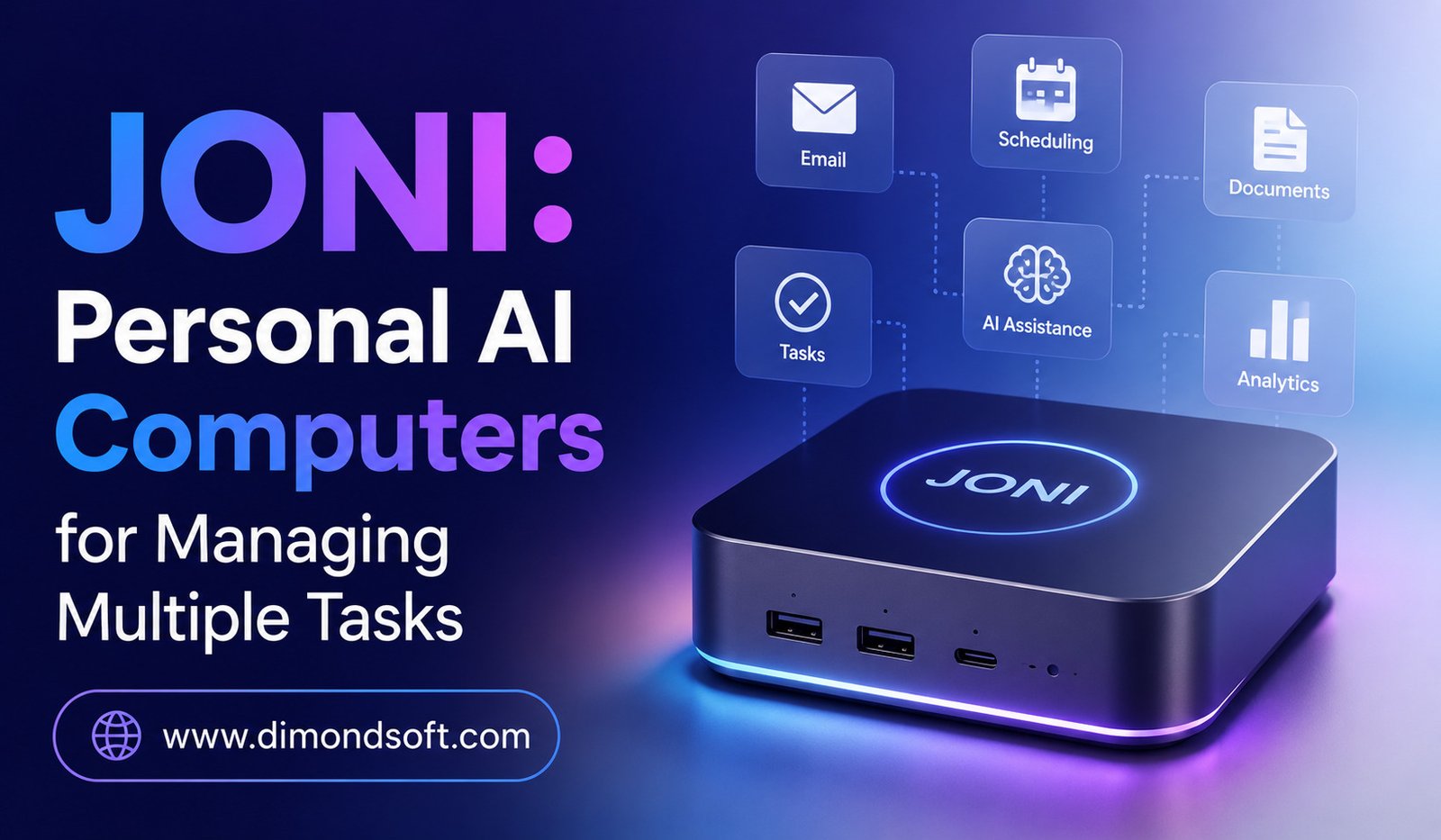
Artificial intelligence is rapidly moving beyond chatbots and search assistants. The next stage of AI is increasingly focused on systems that can help people complete tasks, organize information, and manage multiple activities with less manual effort. JONI, described as a personal AI computer concept, fits into this emerging category of AI-powered computing.
Instead of simply answering questions, personal AI computers aim to become more capable digital assistants that can work across different tasks. The idea is particularly interesting for professionals, entrepreneurs, students, creators, and anyone who regularly switches between multiple applications and responsibilities.
But what exactly does a personal AI computer mean, and how could a system like JONI change the way people interact with technology?
What Is JONI?
JONI can be understood as part of the emerging concept of personal AI computers—systems designed to give individuals more direct access to AI-powered computing and task management.
Traditional computers provide applications and tools, but users are generally responsible for deciding which application to open, what information to enter, and how to move data between different services.
A personal AI computer changes that interaction model.
Instead of manually performing every step, users can communicate their objectives to an AI system. The AI can then help break the objective into smaller actions, organize information, and potentially coordinate different tasks.
For example, a user working on a business project might need to research a topic, organize notes, prepare a document, create a task list, and review information. A personal AI system could potentially assist with several parts of this workflow from one central interface.
Why Personal AI Computers Matter
Modern digital work often involves constant switching between applications.
A typical professional may use email, messaging applications, spreadsheets, project management software, cloud storage, browsers, calendars, and document editors throughout the day.
Although each application solves a specific problem, moving information between them can consume considerable time.
Personal AI computers aim to reduce this friction.
Rather than requiring users to operate every tool individually, an AI assistant could become a central layer connecting different activities. The user focuses more on the desired outcome while the AI helps coordinate the process.
This represents a significant change from the traditional computer interface.
JONI and the Rise of AI Agents
One reason personal AI computing is attracting attention is the development of AI agents.
A conventional chatbot generally waits for a question and produces an answer. An AI agent can be designed to handle a sequence of related actions.
Imagine asking an AI:
“Help me prepare for tomorrow’s client meeting.”
A more agent-oriented system could potentially organize relevant documents, summarize previous notes, identify outstanding tasks, prepare an agenda, and help draft follow-up material.
The important difference is that the AI is not simply generating text. It is helping manage a workflow.
Personal AI computers such as the JONI concept fit naturally into this direction.
Managing Multiple Tasks With AI
One of the strongest potential benefits of personal AI computing is multitasking.
People often have several activities running simultaneously. A business owner might be answering customer messages while checking sales numbers and preparing social media content. A student might be researching an assignment while organizing notes and managing deadlines.
An AI system can potentially act as an additional layer of organization.
For example, users could divide work into categories such as:
- Research
- Writing
- Communication
- Scheduling
- Data analysis
- Personal organization
Instead of repeatedly switching between applications, the user could use an AI interface to coordinate different tasks.
The goal isn’t necessarily to eliminate applications. Rather, AI can potentially make them easier to manage.
A More Natural Way to Use Computers
For decades, interacting with computers has required users to learn interfaces.
You need to know where files are stored, which buttons perform specific actions, and which applications are responsible for particular jobs.
AI introduces another possibility: intent-based computing.
With intent-based computing, the user explains what they want to accomplish rather than describing every individual computer operation.
For example, instead of manually searching through files for information, a user could ask the AI to locate relevant documents and summarize them.
Instead of opening multiple documents to compare information, an AI system could potentially organize the relevant details into one view.
This could make computing more accessible to people who are not particularly comfortable with complicated software.
Potential Benefits for Businesses
Personal AI computers could have significant applications in business.
Small business owners frequently handle multiple roles themselves. They may manage customer communication, marketing, finances, research, operations, and administration.
An AI assistant that can help coordinate these responsibilities could become a valuable productivity tool.
For larger organizations, AI systems could potentially help employees find information faster, summarize internal documents, automate repetitive workflows, and organize daily tasks.
The biggest opportunity may not come from one dramatic AI feature. Instead, productivity gains could accumulate from dozens of small improvements throughout the workday.
Personal AI for Research and Information
Another important application is information management.
The amount of digital information people encounter every day continues to grow. Emails, documents, messages, articles, reports, presentations, and files can quickly become difficult to organize.
A personal AI computer could potentially function as an intelligent information layer.
Instead of remembering exactly where something was stored, users could ask questions about their information.
For example:
“Find the documents related to this project and summarize the latest decisions.”
A capable personal AI system could potentially identify relevant information and present it in a useful format.
This could save time and reduce the frustration associated with searching across multiple platforms.
Privacy Will Be a Major Issue
Personal AI computers also raise an important question: Where does personal information go?
An AI assistant that manages emails, documents, calendars, files, and other personal information could have access to extremely sensitive data.
Therefore, privacy and security will be critical to the future of personal AI.
Users will want to understand what information an AI system can access, where that information is processed, whether data is stored, and which applications can communicate with the AI.
Local or on-device AI processing could become particularly important because it may allow certain tasks to be handled without sending all personal information to remote servers.
Trust will likely become just as important as performance.
Will Personal AI Computers Replace Traditional PCs?
It is unlikely that personal AI computers will immediately replace conventional computers.
Instead, the more realistic scenario is that AI becomes an additional layer on top of existing computing systems.
People will continue using browsers, applications, operating systems, and traditional interfaces. AI could increasingly sit between the user and those tools, helping coordinate activities.
Over time, however, the relationship could become much deeper.
The computer may become less of a collection of individual applications and more of an intelligent environment where users describe objectives and AI helps determine the best way to accomplish them.
Challenges Ahead
Despite the potential, personal AI computing faces several challenges.
AI systems can make mistakes, misunderstand instructions, or produce incorrect information. When AI begins taking actions rather than simply answering questions, those errors could have greater consequences.
Another challenge is reliability. Users need systems that work consistently across different applications and situations.
There are also questions around permissions, security, compatibility, cost, and user control.
For AI to become a trusted personal computer assistant, users must be able to understand and control what the system is doing.
The Future of Personal AI Computing
JONI and similar concepts highlight an important direction in technology: the computer is becoming more proactive and personalized.
The traditional model requires users to operate software. The emerging AI model allows users to describe goals and have intelligent systems assist with the work.
This could eventually transform everyday computing.
Instead of opening ten different applications to complete a project, users may increasingly rely on a personal AI layer that coordinates information and tasks across those applications.
For professionals and entrepreneurs, this could mean less time spent on repetitive digital work. For individuals, it could mean better organization and a more natural relationship with technology.
Conclusion
JONI represents the broader idea of personal AI computers designed to help people manage multiple tasks. While the technology is still developing, the concept points toward a future where AI becomes deeply integrated into everyday computing.
The biggest change may not be faster computers or more powerful applications. It could be the shift from operating a computer to communicating with one.
If personal AI systems can become reliable, private, secure, and capable of handling complex workflows, they could fundamentally change how people work with technology. The future computer may not simply be a machine that waits for instructions—it could become an intelligent partner that helps users organize, execute, and complete their digital tasks.