
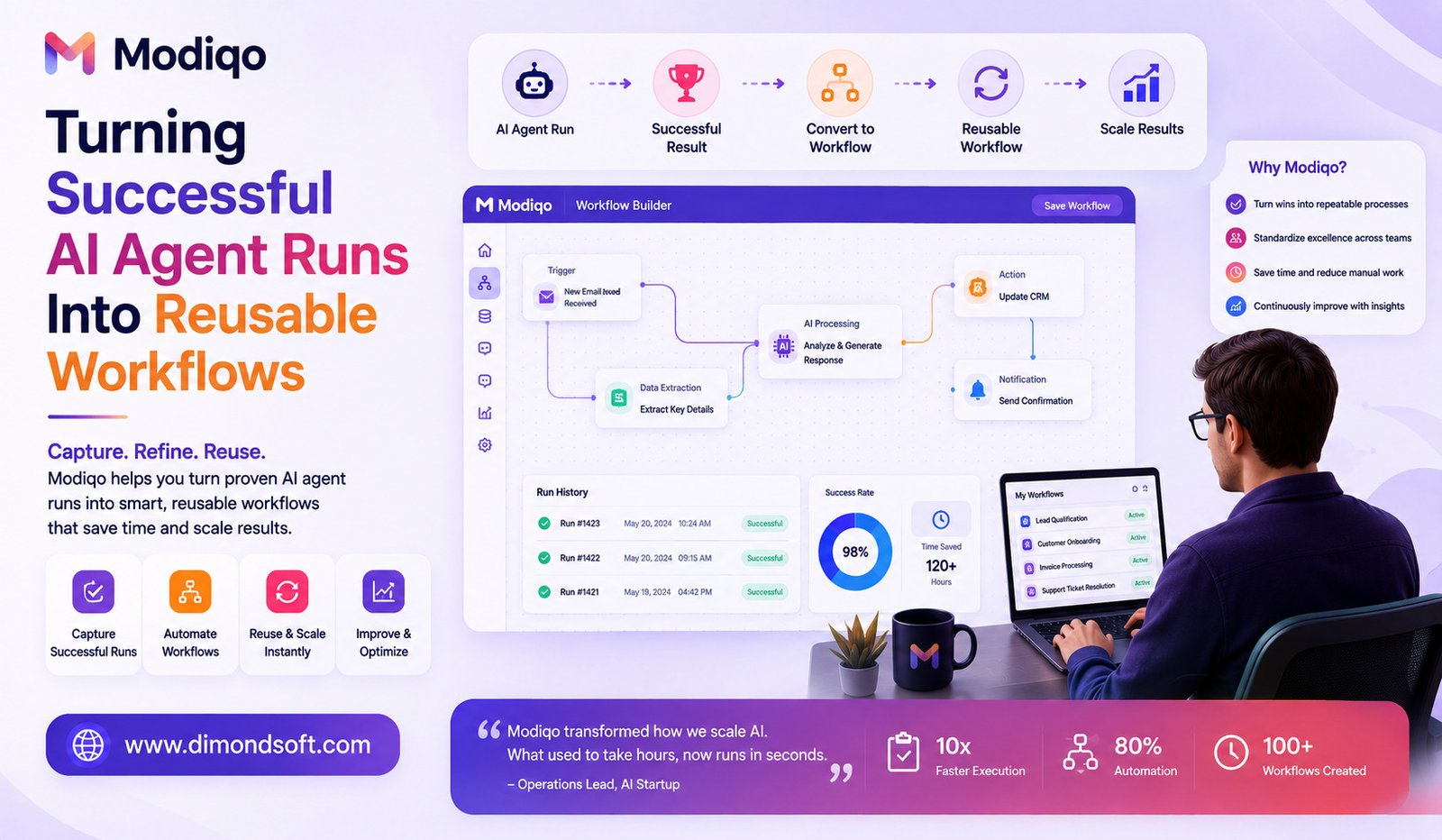
AI agents are becoming more capable of handling complex, multi-step tasks. Instead of simply answering questions, modern agents can research information, analyze data, interact with software, generate content, and complete workflows with limited human intervention.
However, there is an important challenge: what happens when an AI agent successfully completes a task that needs to be repeated?
Running the same process from scratch every time can be inefficient. Teams need ways to capture successful AI workflows, improve them, and reuse them. Modiqo represents this emerging approach of turning successful AI agent runs into reusable workflows.
The concept is particularly relevant for businesses that want to move from experimenting with AI agents to building repeatable and scalable automation.
What Is Modiqo?
Modiqo can be understood in the context of tools designed to help transform successful AI agent executions into repeatable workflows.
An AI agent may complete a task through several steps. It might gather information, make decisions, call different tools, process data, and produce an outcome.
If the process works well, the next logical step is to capture that process so it can be reused.
Instead of asking an AI agent to independently figure out the same task every time, a reusable workflow can provide a more structured path.
This can make AI automation more predictable and easier to scale.
Why Reusable AI Workflows Matter
AI agents are powerful partly because they can adapt to different situations. But that flexibility can also introduce unpredictability.
Two runs of an agent may approach the same task differently.
For experimentation, that may be acceptable. For business operations, consistency is often more important.
Consider a company that uses an AI agent to research potential customers.
The agent might successfully identify prospects, collect relevant information, classify them, and prepare a report.
If the same process needs to happen every week, repeatedly asking the agent to recreate the entire workflow may not be the most efficient approach.
Capturing the successful process as a reusable workflow can create a repeatable system.
From Experiment to Automation
AI projects often begin with experimentation.
A user gives an agent a task and observes what happens. The agent may try different tools and approaches before reaching a successful result.
This experimental process can be valuable because it reveals what works.
The next step is turning that successful experience into something more structured.
The process can be thought of as:
Experiment → Successful Run → Workflow Capture → Refinement → Reuse
This is an important transition for businesses adopting AI.
Instead of treating every successful AI interaction as a one-time event, organizations can potentially turn successful processes into reusable assets.
What Is an AI Agent Run?
An agent run is a particular execution of a task.
For example, a research agent might receive the instruction:
“Find five potential suppliers, compare their services, and prepare a summary.”
The agent could search information, evaluate sources, organize results, and create a report.
The entire sequence of actions represents an agent run.
If the result is successful, the process may contain valuable information about how the task should be performed.
Capturing that process can help developers or business users create a more repeatable workflow.
Turning Successful Runs Into Workflows
A reusable workflow takes the useful elements of an agent run and organizes them into a defined sequence.
For example, a customer research workflow might look like:
- Receive customer information.
- Search approved sources.
- Collect relevant data.
- Analyze customer characteristics.
- Assign a category.
- Generate a summary.
- Store the result.
Once the workflow is established, it can potentially be executed repeatedly with different inputs.
The AI can still perform intelligent operations within the workflow, but the overall process becomes more structured.
This balance between automation and flexibility is one of the most interesting aspects of AI workflow design.
Benefits for Business Teams
Reusable AI workflows can provide several benefits.
Greater Consistency
A structured workflow can reduce unnecessary variation between executions.
This can be especially important for business processes where outputs need to follow a particular format.
Faster Execution
Once a successful process has been captured, teams don’t have to recreate the same instructions repeatedly.
Easier Scaling
A workflow that works for ten tasks may potentially be adapted to handle hundreds or thousands of similar tasks.
Better Collaboration
Teams can share successful workflows rather than keeping effective AI techniques inside individual conversations.
Easier Improvement
A reusable workflow can be tested and refined over time.
These advantages make workflow reuse particularly relevant to organizations moving beyond AI experimentation.
AI Workflows for Marketing
Marketing teams perform many repetitive activities that can potentially be supported by AI workflows.
For example, a business might create a workflow for analyzing customer feedback.
The workflow could collect feedback, classify comments, identify common themes, summarize important issues, and produce a report.
Once the workflow is tested and refined, the marketing team can reuse it regularly.
Similarly, AI workflows could assist with campaign research, content analysis, lead qualification, and competitor monitoring.
The goal is not simply to generate more content. It is to create repeatable processes that reduce manual work.
AI Workflows for Sales
Sales teams can also benefit.
A reusable workflow could help analyze incoming leads, collect relevant company information, categorize prospects, and prepare briefing notes for sales representatives.
Instead of having each salesperson manually perform the same research, an AI workflow could standardize the initial process.
Sales professionals can then focus on conversations and relationship building.
Again, AI should support the team’s judgment rather than automatically making high-impact decisions without oversight.
AI Workflows for Customer Support
Customer support is another strong use case.
Support teams frequently handle similar categories of questions.
An AI workflow could classify an incoming request, search approved documentation, identify relevant troubleshooting steps, draft a response, and route complicated cases to a human employee.
Once a workflow has been validated, it can potentially be reused across many support interactions.
This can reduce repetitive work while helping maintain consistent processes.
The Importance of Human Review
Turning an AI run into a reusable workflow should not mean automatically assuming that every successful run is perfect.
AI can occasionally reach the correct result through an unreliable process.
For example, an agent might accidentally use an inappropriate source but still produce an answer that looks reasonable.
Before turning an agent run into a repeatable workflow, teams should review the steps involved.
They should ask:
- Were the data sources reliable?
- Were the decisions appropriate?
- Were any steps unnecessary?
- Could the process produce incorrect results in another situation?
- Does the workflow require human approval?
- What happens when something goes wrong?
This review process helps transform experimentation into reliable automation.
Building Guardrails Into AI Workflows
Business automation requires boundaries.
A reusable workflow can include guardrails that limit what an AI agent is allowed to do.
For example, an organization could specify which websites the agent can access, which tools it can use, what information it can modify, and when a human must approve an action.
Guardrails are particularly important for workflows involving financial transactions, customer information, confidential data, or external communications.
The more autonomy an AI system receives, the more important these controls become.
Measuring Workflow Performance
A reusable AI workflow should be evaluated like any other business process.
Teams can monitor metrics such as accuracy, completion time, error rates, cost, human intervention, and customer outcomes.
Suppose an AI workflow processes customer inquiries.
A company could measure how often the workflow produces an acceptable answer, how frequently employees need to correct it, and how much time it saves.
This data can then be used to improve the workflow.
AI automation should therefore be treated as an ongoing process rather than a one-time implementation.
The Future of AI Workflow Automation
The idea behind Modiqo points toward an important evolution in AI development.
Early AI adoption often involves individual prompts and experiments.
The next stage is turning those successful experiments into repeatable systems.
Businesses may increasingly build libraries of AI workflows for common tasks.
Employees could select an approved workflow, provide the necessary inputs, and let the system execute the process.
Over time, these workflows could become valuable organizational assets.
Instead of relying on individual employees to remember how to prompt an AI effectively, companies can capture successful processes and make them available across teams.
AI Agents and Process Standardization
Traditional automation relies heavily on predefined rules.
AI agents introduce more flexibility because they can interpret natural language and adapt to changing information.
Reusable AI workflows combine elements of both approaches.
The workflow provides structure, while AI provides flexibility within individual steps.
This hybrid approach could be useful for processes that are repetitive but still require some interpretation.
For example, an AI workflow can establish how a research task should be performed while allowing the AI to interpret different types of documents and information.
Final Thoughts
Modiqo represents an important idea in the development of AI automation: successful AI agent runs can become reusable workflows.
AI agents are excellent for experimentation because they can explore different ways of completing complex tasks. But businesses need repeatability if they want to scale automation.
Capturing successful runs and converting them into structured workflows can help organizations create more consistent, efficient, and manageable AI processes.
The key is not to automate blindly. Teams should review successful agent runs, validate their results, add appropriate guardrails, and continuously monitor performance.
As AI agents become more capable, the ability to turn one successful experiment into a repeatable business process could become one of the most valuable parts of AI automation.
The future of AI may therefore be less about writing the perfect prompt every time and more about building reliable workflows that can learn from what already works.