
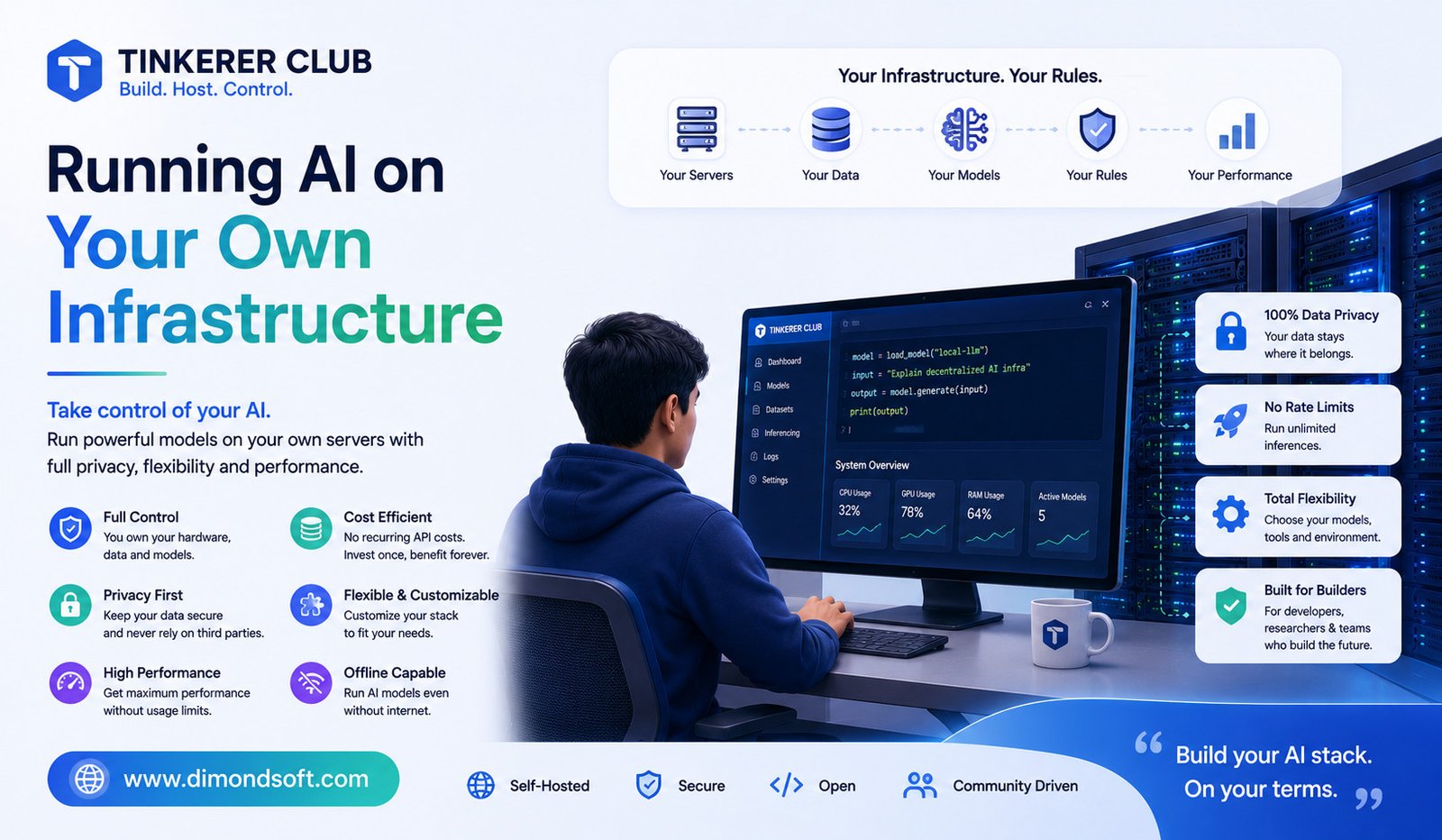
Artificial intelligence is often associated with cloud-based platforms. Users send a request to an online AI service, the provider processes it on remote servers, and the result comes back through the internet. This model is convenient, but it is not always ideal for developers, businesses, researchers, and technology enthusiasts who want greater control over their AI systems.
Tinkerer Club represents an interesting part of the growing movement toward running AI on your own infrastructure. Instead of depending entirely on external AI platforms, users can explore self-hosted or locally operated AI systems using their own computers, servers, or private infrastructure.
This approach can provide greater control over data, software, hardware, and deployment. At the same time, running AI independently comes with technical challenges that users need to understand.
What Is Tinkerer Club?
Tinkerer Club can be viewed in the context of the growing community and ecosystem around experimenting with AI infrastructure, local models, and self-hosted artificial intelligence.
The idea behind this approach is simple: instead of treating AI as a service that exists somewhere else, users can experiment with running AI themselves.
This could involve operating open-weight AI models on a personal computer, setting up a dedicated server, deploying models inside a private network, or experimenting with AI applications on locally controlled hardware.
For developers and technology enthusiasts, this provides an opportunity to understand how AI systems work beyond simply using a web interface.
Why Run AI on Your Own Infrastructure?
Cloud AI services are convenient because most of the difficult infrastructure is handled by the provider.
However, some users have different priorities.
A business may not want confidential information sent to external systems. A developer may want to experiment without depending on an external API. A researcher may want complete control over a model and its environment.
Running AI locally or on private infrastructure can address some of these requirements.
The major advantages generally include greater control, potential privacy benefits, customization, and independence from a single cloud provider.
Local AI vs Cloud AI
The difference between local and cloud-based AI is primarily about where the computation takes place.
With cloud AI, an application sends requests to remote infrastructure operated by a third party.
With local AI, the model runs on hardware controlled by the user or organization.
For example, a developer could run an AI model on a powerful desktop computer and interact with it through a local application.
A business could also deploy an AI system on private servers so that certain internal workloads remain within its own environment.
Neither approach is universally better.
Cloud AI can provide access to powerful computing resources without requiring users to purchase and maintain hardware. Local AI can provide more control but requires users to handle infrastructure themselves.
Privacy and Data Control
Privacy is one of the strongest reasons organizations explore self-hosted AI.
Companies often work with confidential documents, internal communications, customer information, financial records, and proprietary research.
Sending such information to an external AI service may create additional privacy and compliance considerations.
With a properly configured private AI deployment, organizations can keep more of their data within their own infrastructure.
However, local deployment does not automatically guarantee privacy.
The operating system, network, applications, access controls, logs, and storage systems all need to be secured.
A poorly configured private AI server can still create security risks.
Hardware Requirements for Local AI
Running AI locally requires appropriate hardware.
The requirements depend heavily on the model being used.
Smaller models may run on consumer computers, while larger models can require substantial amounts of memory and specialized hardware.
Graphics processing units, or GPUs, are commonly used for AI workloads because they can perform many mathematical operations in parallel.
However, hardware requirements continue to evolve as models become more efficient.
Tech enthusiasts can experiment with different combinations of CPUs, GPUs, RAM, storage, and model sizes to find a setup that meets their needs.
This experimentation is one of the reasons the local AI community is attracting developers and hobbyists.
Running Smaller AI Models
Not every AI application requires the largest available model.
Smaller models can be useful for tasks such as text classification, summarization, coding assistance, document analysis, and local chat applications.
Running a smaller model can make local AI more practical because it requires fewer computing resources.
Developers can experiment with different models and compare their performance, speed, memory requirements, and accuracy.
This allows users to understand the trade-offs involved in AI deployment rather than simply selecting a model from a cloud provider’s menu.
Customization and Experimentation
Another benefit of running AI yourself is the ability to experiment.
Developers can modify the surrounding software environment, connect AI models to local applications, build custom interfaces, and experiment with different workflows.
For example, someone might create a local assistant that can search personal documents.
Another developer could build a private coding assistant connected to a local development environment.
A business could experiment with an internal knowledge system without exposing all its information to a public-facing application.
This flexibility can be particularly attractive to developers who want to learn how AI applications are built.
Building Private AI Assistants
Self-hosted AI can be particularly useful for private assistants.
Imagine a company with thousands of internal documents. Instead of relying exclusively on a general-purpose online chatbot, the organization could create a private AI assistant that searches approved internal information.
Employees could ask questions about company policies, technical documentation, product information, or internal processes.
The AI system could retrieve relevant information from a private knowledge base and generate an answer.
This type of architecture can provide organizations with greater control over where their information is stored and processed.
AI for Developers
Developers can also use local AI infrastructure as a programming assistant.
A local model could potentially help explain code, generate functions, summarize files, suggest debugging approaches, or assist with documentation.
One advantage is that developers can experiment with connecting AI directly to their development environment.
For companies working with proprietary code, keeping AI workloads inside controlled infrastructure can also be attractive.
However, developers should still evaluate the quality of local models carefully. A smaller local model may be more private but less capable than a larger cloud-based model.
The Cost Question
Running AI independently can appear cheaper because users don’t necessarily pay for every API request.
But local AI has other costs.
Hardware must be purchased, electricity must be consumed, storage must be maintained, and systems may need upgrades.
Businesses also need to account for administration, security, monitoring, backups, and maintenance.
For occasional AI usage, cloud services may be more economical.
For heavy, predictable workloads, private infrastructure can potentially become more attractive depending on the hardware and operational requirements.
The right choice depends on usage patterns.
Challenges of Self-Hosted AI
Running AI on your own infrastructure isn’t always easy.
Users may encounter problems involving drivers, model compatibility, memory limitations, performance optimization, networking, software dependencies, and system maintenance.
Large models can require significant hardware resources.
There is also the challenge of keeping everything updated and secure.
Cloud providers handle much of this complexity for their customers. With self-hosted AI, the responsibility moves to the user or organization.
This is an important consideration before choosing a private deployment.
Open Models and the Growth of Local AI
The availability of increasingly capable open and openly available AI models is helping drive interest in local AI.
Developers can experiment with models without building an AI system entirely from scratch.
They can download appropriate model files, run them through compatible software, and integrate them into applications.
This creates a growing ecosystem of tools for local inference, model management, optimization, and AI application development.
Communities such as Tinkerer Club fit naturally into this culture of experimentation.
Who Should Consider Running AI Locally?
Self-hosted AI can be particularly interesting for developers, researchers, technology enthusiasts, startups, and organizations with strong privacy or customization requirements.
It can also be useful for people who want to learn about AI infrastructure.
However, beginners shouldn’t feel that they need to build a large private AI server immediately.
Starting with a small model on an existing computer can be a practical way to understand the basics before investing in more powerful hardware.
The Future of Personal AI Infrastructure
The future of AI may not be exclusively cloud-based.
Cloud platforms will remain extremely important because they provide enormous computing resources and make advanced models accessible to millions of users.
At the same time, local and private AI deployments are likely to grow.
Some applications may use a hybrid model, with smaller or sensitive tasks running locally while more demanding workloads are processed in the cloud.
This could create a flexible AI environment where users choose where each task should run.
Final Thoughts
Tinkerer Club reflects the growing interest in running AI on your own infrastructure.
Self-hosted AI gives developers and organizations greater control over models, data, hardware, and applications. It can support private assistants, local development tools, document analysis, experimentation, and many other use cases.
However, local AI also requires hardware, technical knowledge, maintenance, and security practices.
The decision between cloud and self-hosted AI should therefore depend on the specific requirements of the project.
As AI models become smaller, more efficient, and easier to run locally, the barrier to entry will likely continue to fall. The result could be a future where powerful AI isn’t only something people access through a cloud platform—it can also be something they run, customize, and control themselves.