
The way people interact with websites is changing. For years, websites were primarily designed for human visitors who navigate menus, click buttons, fill out forms, and read content. But the rise of AI agents is introducing a new type of visitor: software that can browse websites, understand information, and potentially take actions on behalf of users.
This creates a new question for website owners and developers: Is your website ready for AI agents?
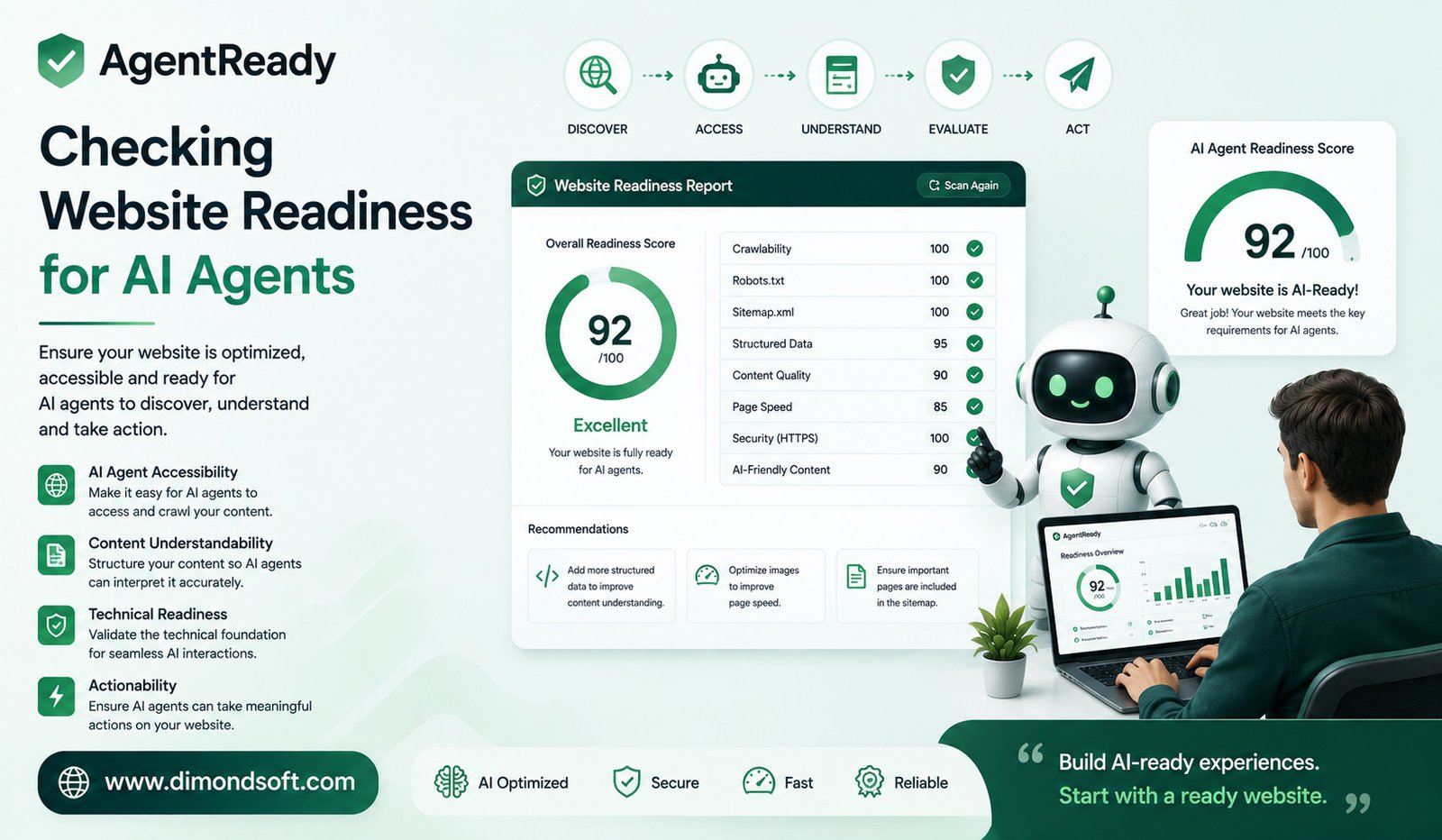
AgentReady represents the growing idea of evaluating websites for their ability to work effectively with AI agents. Just as businesses have traditionally optimized websites for search engines, accessibility, mobile devices, and human users, they may increasingly need to consider how easily AI systems can understand and interact with their online services.
What Is AgentReady?
AgentReady can be understood as an approach or toolset focused on assessing whether a website is prepared for interaction with AI agents.
An AI agent doesn’t necessarily use a website in the same way as a human.
A person can visually interpret a page, understand its layout, identify a button, and decide what to do next. An AI agent needs machine-readable information, predictable interfaces, clear instructions, and appropriate ways to interact with the site’s content or functionality.
An agent-readiness assessment can therefore help identify potential barriers.
These might include poorly structured content, unclear navigation, inaccessible information, complicated forms, missing machine-readable data, or a lack of suitable APIs.
Why Website Agent Readiness Matters
AI agents are becoming increasingly capable of performing tasks for users.
A user might eventually ask an agent to:
- Find a suitable product
- Compare available options
- Book an appointment
- Research a service
- Check delivery information
- Complete a form
- Monitor changes
- Contact a business
If an AI agent cannot understand or interact with a website effectively, that website could become less useful in agent-driven workflows.
This doesn’t mean traditional website optimization is becoming irrelevant. Human visitors and search engines remain important.
Instead, agent readiness represents another layer of digital accessibility.
How AI Agents Interact With Websites
A human visitor typically interprets visual design and follows the site’s interface.
An AI agent may need to identify the purpose of a page, understand available actions, extract relevant information, and determine whether an action can safely be performed.
For example, imagine an online store.
A human might see a product page and immediately understand the product name, price, availability, shipping information, and purchase button.
An AI agent needs that information to be clearly represented in a way its systems can reliably interpret.
Structured information, semantic HTML, descriptive labels, and predictable page behavior can all contribute to better machine understanding.
Structured Data Becomes More Important
Structured data can help machines understand what information means.
A webpage containing a price is useful, but a machine-readable representation can make the meaning of that price clearer.
Similarly, structured information can describe products, organizations, events, locations, reviews, and other entities.
For websites expecting increased interaction with AI systems, using appropriate structured data can be an important consideration.
This doesn’t guarantee that an AI agent will understand a website perfectly, but it can reduce ambiguity.
Clear Website Content
AI systems need clear information.
A website that uses vague headings, inconsistent terminology, and poorly organized content can be harder for both humans and machines to understand.
Website owners should consider whether important information is easy to identify.
For example, a service page should clearly explain:
- What the service provides
- Who it is intended for
- Pricing or pricing conditions
- How to get started
- Important requirements
- Contact information
Clear content improves the experience for human users while potentially making the website easier for AI systems to interpret.
APIs and Machine-Friendly Access
For some businesses, simply making webpages readable may not be enough.
If an AI agent needs to interact with a service, an API can provide a more reliable way to access specific functions.
For example, a travel company might provide APIs for checking availability and making reservations.
A financial platform could provide controlled APIs for retrieving account information.
A retail business might offer structured access to product inventory.
Instead of forcing an AI agent to navigate a visual interface, an API can provide a defined way for software to communicate with the underlying service.
This can make automation more reliable.
Forms Can Be a Major Challenge
Many websites depend on forms.
Users enter names, addresses, dates, preferences, search terms, and other information.
Forms designed primarily for human interaction may create problems for AI agents if field labels are unclear or required information isn’t properly identified.
Website developers should make forms semantically clear.
Labels should describe the information being requested, error messages should be understandable, and input requirements should be predictable.
These improvements are also valuable for accessibility and general usability.
Website Accessibility and AI Readiness
There is considerable overlap between accessibility and agent readiness.
Websites designed with semantic HTML, descriptive labels, meaningful headings, keyboard navigation, and clear content structures can be easier for assistive technologies to interpret.
The same characteristics can potentially benefit AI systems.
This creates an important principle:
Improving machine readability should not come at the expense of human accessibility.
Instead, good web standards can support both.
AI Agents Need Reliable Navigation
AI agents may need to move between pages to complete a task.
Complicated navigation structures can make this difficult.
A website should have logical links, descriptive anchor text, predictable URLs, and clear relationships between pages.
For example, an e-commerce website might organize information around categories, product pages, shipping policies, returns, and checkout.
A logical structure helps users understand the site and gives software systems a clearer map of the available information.
Trust and Security Are Essential
Making a website accessible to AI agents doesn’t mean allowing unlimited automated access.
Website owners need to determine what agents are allowed to do.
Reading public information is very different from placing an order, submitting a form, changing account information, or accessing private data.
Sensitive actions should require appropriate authentication and authorization.
Businesses may also need to distinguish between trusted agents and unknown automated traffic.
Security controls should remain in place even as websites become more machine-friendly.
Agent Permissions and Human Approval
One important part of agent-ready websites could be permission management.
An AI agent acting on behalf of a user may need to perform certain actions but not others.
For example, an agent might be permitted to search products but require human approval before purchasing one.
Similarly, it might be allowed to schedule an appointment but require confirmation before cancelling an existing appointment.
Clear permission boundaries can help prevent unintended actions.
This becomes increasingly important as AI agents move from simply reading information to taking real-world actions.
Agent-Ready Websites and SEO
Agent readiness does not replace SEO.
In many cases, the same fundamentals can support both.
Clear content, logical page structures, useful information, descriptive headings, structured data, good performance, and mobile-friendly design can benefit traditional search visibility as well as machine understanding.
However, AI agents may introduce additional requirements.
A website could be highly optimized for search engines but still be difficult for an autonomous agent to interact with.
For businesses, this means future digital strategies may need to consider three audiences:
Humans, search systems, and AI agents.
How Businesses Can Prepare
Businesses don’t necessarily need to redesign their entire websites immediately.
A practical starting point is to identify important customer journeys.
Ask questions such as:
Can an AI agent understand what our business offers?
Can it identify important product or service information?
Can it find the correct contact or booking process?
Are important actions clearly defined?
Are APIs available where automated interaction would be useful?
Are sensitive actions protected by appropriate permissions?
These questions can help identify areas where a website could become more machine-friendly.
The Future of Agent-Ready Websites
As AI agents become more common, website design could increasingly evolve from being human-only to being human-and-agent accessible.
Websites may expose structured information specifically designed for automated systems.
Businesses may create agent-specific interfaces, APIs, permission systems, and machine-readable policies.
AI agents could become another major channel through which customers discover and interact with businesses.
Imagine telling an AI assistant:
“Find me a laptop under my budget and order the best option.”
The agent could potentially search multiple stores, compare products, check delivery information, and present the user with a recommendation.
For this to work reliably, websites need to make their information and actions understandable to software.
Final Thoughts
AgentReady represents a growing digital concept: checking whether websites are prepared for AI agents.
As autonomous AI systems become more capable, websites may increasingly need to serve not only human visitors but also software agents acting on behalf of those visitors.
Clear content, structured data, semantic website design, accessible forms, reliable APIs, logical navigation, and strong permission controls can all contribute to better agent readiness.
The goal isn’t to build websites exclusively for machines. It is to create digital experiences that are understandable, accessible, and safe for different types of users.
Just as mobile optimization became essential when smartphones transformed the web, AI-agent readiness could become another important part of website development as agent-driven computing grows.