
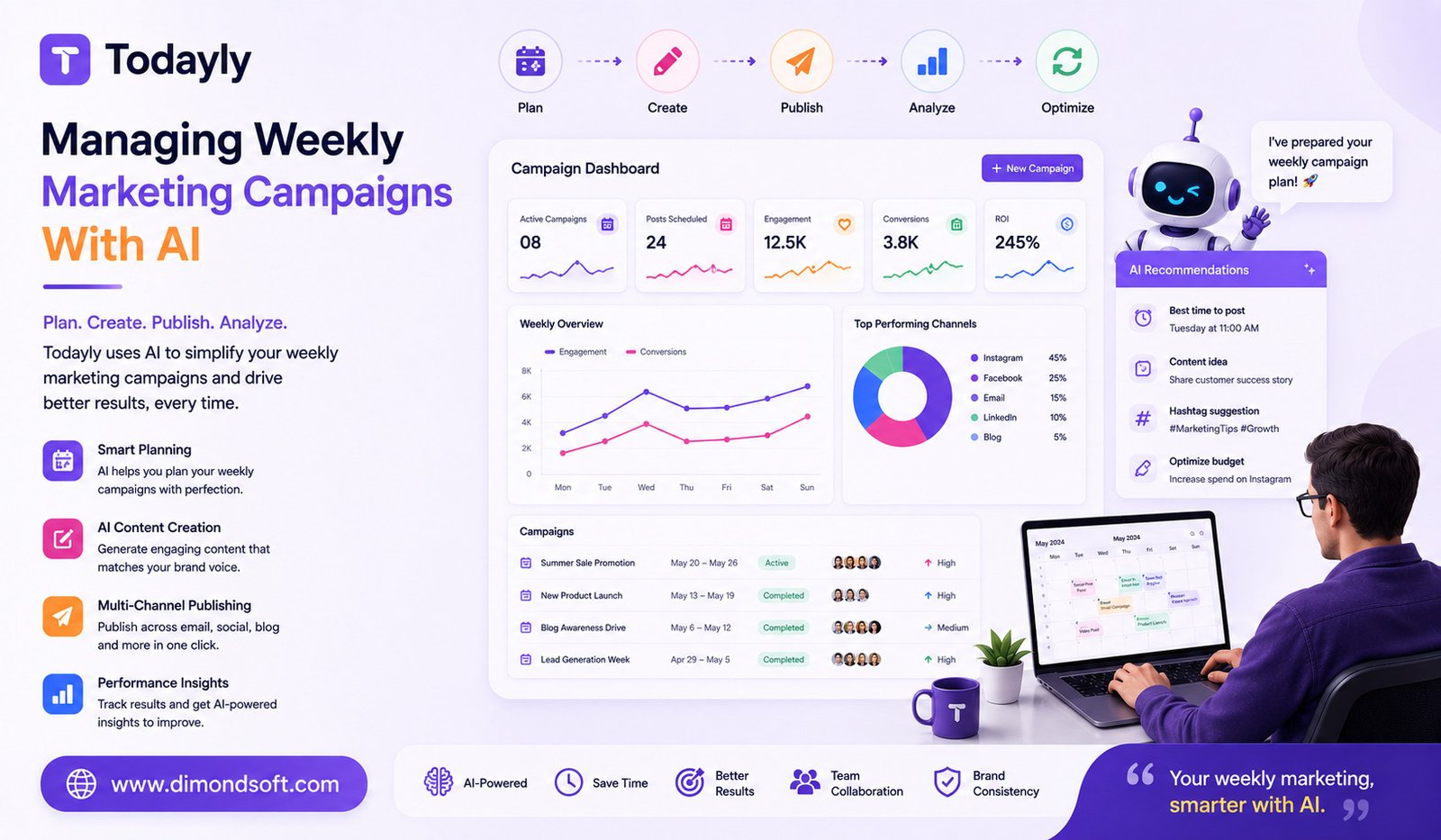
Marketing teams are under constant pressure to create content, launch campaigns, analyze performance, engage customers, and keep up with changing trends. For small businesses and lean marketing teams, managing all these responsibilities every week can become overwhelming.
This is where AI-powered marketing workflow tools are becoming increasingly useful. Todayly represents the idea of using artificial intelligence to organize and manage recurring weekly marketing campaigns, helping teams move from planning to execution with less manual effort.
Instead of treating every campaign as a completely new project, businesses can use AI to structure repetitive marketing activities, generate ideas, organize tasks, and monitor campaign progress.
The result can be a more consistent marketing process that allows teams to spend more time on strategy and less time on repetitive administration.
What Is Todayly?
Todayly can be understood as an AI-powered approach to managing recurring marketing activities.
Weekly marketing requires coordination across multiple channels. A campaign might involve social media posts, email newsletters, blog content, advertisements, promotional offers, customer engagement, and performance tracking.
Without a clear workflow, teams can easily lose track of deadlines or spend too much time deciding what to do next.
An AI-assisted marketing system can help organize these activities into a repeatable process.
The basic concept is:
Plan → Create → Schedule → Publish → Analyze → Improve
By repeating this cycle every week, businesses can create a more predictable marketing operation.
Why Weekly Marketing Is Difficult
Marketing sounds simple until you have to do it consistently.
A company might publish one social media post today, send an email tomorrow, create a blog later in the week, and launch a promotional campaign over the weekend.
Each activity requires planning and coordination.
There is also the question of what content should be created.
Marketing teams need to balance promotional material with educational content, customer stories, product information, industry insights, and engagement-focused posts.
AI can help reduce some of the planning burden by organizing these activities into a structured weekly campaign.
AI for Marketing Planning
Planning is one of the most useful applications of AI in marketing.
Instead of starting each week with a blank calendar, a business can define its marketing goals and let AI help develop a campaign structure.
For example, a business goal might be:
Increase awareness of a new product.
An AI-assisted workflow could turn that goal into a series of activities, such as educational posts, product-focused content, email communication, customer FAQs, and performance tracking.
Human marketers can then review the plan and make adjustments based on brand requirements and business priorities.
The AI provides the starting point, while humans remain responsible for strategic decisions.
Creating a Weekly Content Calendar
A content calendar helps marketing teams understand what should be published and when.
AI can help generate potential content ideas based on a company’s audience, products, industry, and campaign objectives.
For example, a weekly schedule could include:
- Monday: Educational social post
- Tuesday: Blog or article
- Wednesday: Customer-focused content
- Thursday: Email campaign
- Friday: Product or promotional post
The exact schedule will vary by business.
The important benefit is having a consistent framework.
Instead of repeatedly deciding what to publish, teams can work from an established system and adjust it when necessary.
AI-Powered Content Creation
Once a campaign plan exists, AI can help create initial content.
It can generate social media drafts, email outlines, blog ideas, advertising concepts, headlines, product descriptions, and other marketing material.
This can significantly speed up the first stage of content production.
However, AI-generated content should not automatically be published without review.
Marketing content needs to reflect the company’s brand voice and accurate product information. It should also sound natural rather than repetitive or generic.
Human editing remains important for quality, originality, tone, and accuracy.
Personalizing Marketing Campaigns
Modern customers increasingly expect relevant communication.
Sending exactly the same message to every customer may not always produce the best results.
AI can help marketing teams organize audiences into segments based on available customer information.
For example, a company could separate audiences into new customers, returning customers, inactive customers, and highly engaged customers.
Different campaign messages can then be developed for each group.
Personalization should always respect privacy requirements and customer expectations. Businesses should only use customer information appropriately and transparently.
Managing Social Media Campaigns
Social media marketing requires consistency.
Businesses need to plan content, prepare captions, choose suitable visuals, schedule posts, respond to engagement, and evaluate results.
AI can assist with several parts of this process.
A marketing workflow might begin with a weekly theme and automatically generate content ideas around that theme.
For example, a fitness business could focus one week on beginner workouts, another on nutrition education, and another on customer success stories.
The marketing team can then review the AI-generated suggestions and select the strongest ideas.
AI for Email Marketing
Email remains an important marketing channel for many businesses.
Weekly email campaigns may include newsletters, product announcements, educational content, promotions, or customer updates.
AI can help with subject-line ideas, email structures, personalization, and content drafts.
It can also help teams experiment with different messaging approaches.
However, marketers should avoid sending excessive or irrelevant emails simply because AI makes content creation easier.
The objective should be to create useful communication rather than increasing the number of messages.
Tracking Campaign Performance
Marketing doesn’t end when a campaign is published.
Teams need to know whether their efforts are producing results.
Important metrics can include website traffic, email open rates, click-through rates, conversions, engagement, leads, and revenue.
AI can help summarize campaign performance and identify patterns.
For example, it might highlight that certain content consistently generates more engagement or that one audience segment responds better to a particular type of message.
These insights can then influence the following week’s campaign.
This creates a continuous improvement cycle.
Turning Weekly Marketing Into a Repeatable System
One of the biggest advantages of AI-assisted campaign management is repeatability.
Instead of treating every week as a separate project, businesses can create a reusable marketing framework.
For example:
Monday: Review previous performance and define the week’s goal.
Tuesday: Develop content and campaign assets.
Wednesday: Review and refine messaging.
Thursday: Launch selected campaigns.
Friday: Analyze early performance and prepare improvements.
The exact workflow can be customized according to the business.
Once the process becomes familiar, AI can assist with many repetitive steps.
Benefits for Small Businesses
Small businesses often have limited marketing resources.
A business owner may be responsible for marketing alongside sales, customer service, finance, and daily operations.
AI can help reduce some of the workload involved in campaign planning and content production.
Instead of hiring a large marketing team immediately, a small company can use AI tools to support its existing employees.
This doesn’t mean AI replaces marketing professionals. Strategic thinking, creativity, customer understanding, and brand positioning remain important.
AI works best as a productivity layer that helps small teams accomplish more.
AI Does Not Replace Marketing Strategy
Automation can make execution easier, but it cannot automatically create a successful marketing strategy.
Businesses still need to understand their customers.
They need to know what problem they solve, what makes their product different, which audience they want to reach, and what business outcome they are trying to achieve.
AI can generate hundreds of content ideas, but more content doesn’t necessarily mean better marketing.
A smaller number of relevant, high-quality campaigns can be more effective than publishing large amounts of generic material.
Common Challenges
AI-powered marketing workflows also have limitations.
AI-generated content may sound repetitive. Campaign recommendations may lack industry context. Automated scheduling can cause mistakes if information isn’t reviewed.
There is also the risk of over-automation.
If every interaction feels machine-generated, customers may become less engaged.
Businesses should therefore keep humans involved in important parts of the marketing process.
Brand strategy, campaign approval, sensitive communications, and major customer decisions should receive appropriate human oversight.
The Future of AI Marketing Management
The future of marketing may involve increasingly intelligent campaign systems.
Instead of simply generating individual posts, AI could help manage complete marketing cycles.
A system could analyze previous campaign results, suggest a new weekly strategy, create initial content, organize tasks, identify the best publishing times, and summarize performance.
Marketing professionals would then review the recommendations and make strategic decisions.
This could turn AI into a continuous marketing assistant rather than a simple content-generation tool.
Final Thoughts
Todayly represents the growing idea of using AI to manage weekly marketing campaigns.
From planning content calendars and generating ideas to organizing social media, email campaigns, and performance analysis, AI can help businesses make recurring marketing work more structured and efficient.
The biggest advantage is consistency.
When marketing becomes a repeatable process, teams can spend less time figuring out what needs to happen and more time improving the quality of their campaigns.
However, successful AI marketing still requires human judgment. AI should support strategy, creativity, and decision-making rather than replace them.
As artificial intelligence continues to improve, businesses may increasingly rely on AI-assisted workflows to plan, execute, measure, and optimize their marketing every week—creating a more efficient and data-driven approach to digital growth.