Businesses generate and store enormous amounts of knowledge every day. Company policies, product documents, customer information, meeting notes, technical guides, sales material, project files, and internal communications all contribute to an organization’s knowledge base.
The challenge is making this information useful when AI agents become part of everyday business operations.
An AI agent can perform tasks, analyze information, communicate with users, and interact with software. But to work effectively inside an organization, it needs access to the right company knowledge. If every AI agent operates with a separate collection of information, businesses may end up with fragmented AI systems that produce inconsistent results.
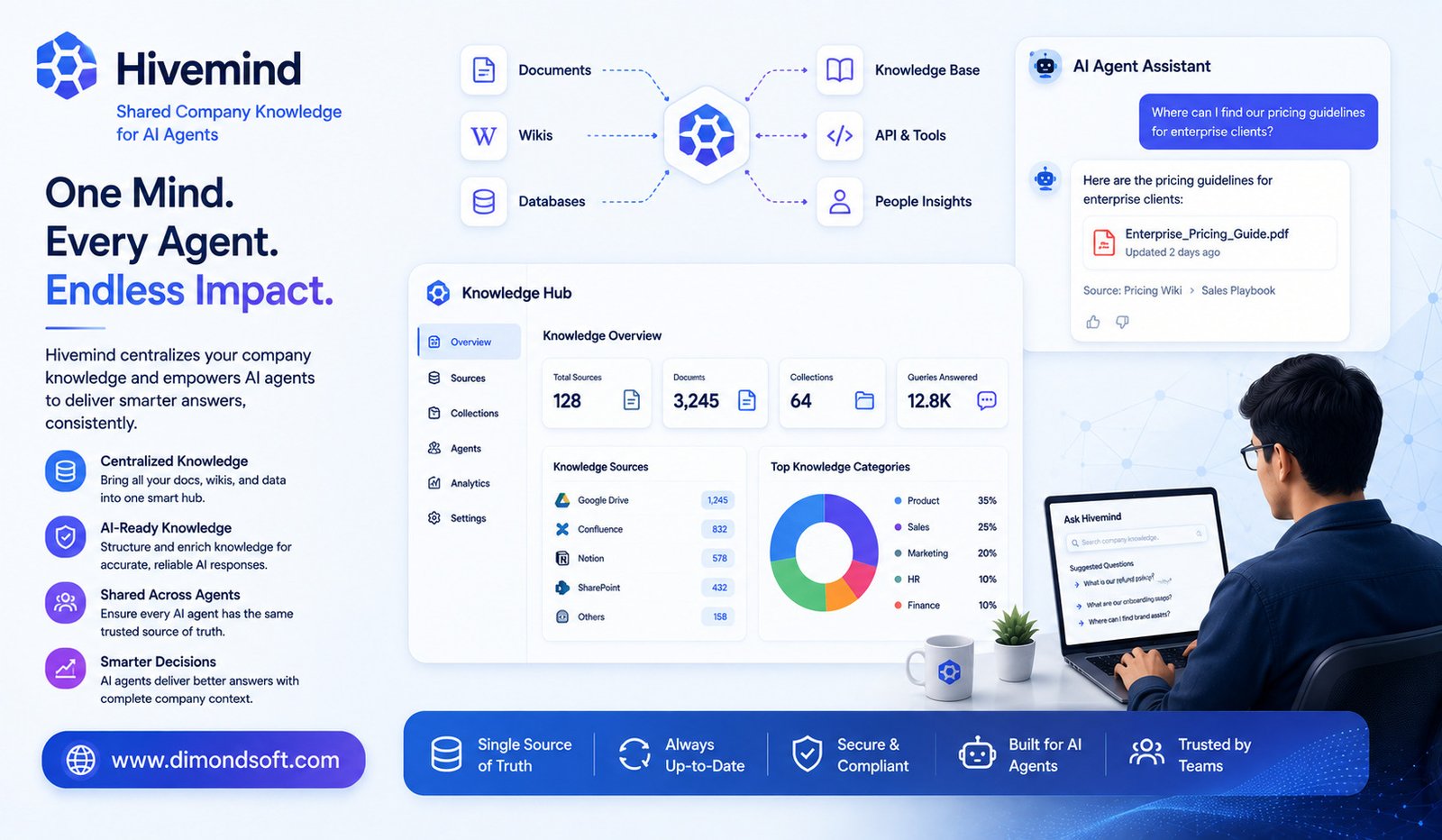
This is where the idea of Hivemind becomes interesting. The concept focuses on creating shared company knowledge that can be made available to multiple AI agents, allowing them to work from a common source of information.
What Is Hivemind?
Hivemind can be understood as a shared knowledge layer for AI agents working within a company.
Instead of giving every AI system its own isolated information, an organization can create a centralized knowledge environment containing approved business information.
An AI agent could then access relevant information when completing a task.
For example, a sales agent might need product specifications, while a customer support agent needs troubleshooting instructions. Both agents can potentially access the same approved company knowledge while applying it to different tasks.
The goal is to create shared intelligence across AI systems.
Why Shared Knowledge Matters
AI agents are becoming more specialized.
A company might use one agent for customer support, another for sales research, another for employee onboarding, and another for data analysis.
Each agent may have a different role, but they often need access to overlapping information.
Without a shared knowledge layer, businesses may have to repeatedly provide the same information to different AI systems.
This can create duplication and inconsistency.
For example, if a company’s product pricing changes but only one AI agent receives the updated information, other agents may continue providing outdated answers.
A centralized knowledge system can help reduce this problem.
How a Shared AI Knowledge System Works
A company knowledge layer generally starts with information from existing business resources.
These might include:
- Product documentation
- Internal policies
- Training materials
- Standard operating procedures
- Customer support guides
- Sales documents
- Technical documentation
- Meeting notes
- Frequently asked questions
The information can be organized and indexed so AI agents can retrieve relevant content when needed.
When an agent receives a task, it can search the shared knowledge environment for information related to that task.
The retrieved information can then be used to generate a response or guide an action.
This approach helps connect AI agents to the organization’s current knowledge.
Hivemind and AI Agent Collaboration
The most interesting aspect of shared knowledge is that it can allow different AI agents to work from a common understanding.
Imagine a customer purchases a software product.
A sales agent may record important customer information. A customer support agent later needs that information to answer a question. An account management agent may use it to prepare a follow-up.
If all three systems have access to the appropriate shared information, they can potentially work more consistently.
The agents don’t necessarily need to communicate directly with one another. They can communicate indirectly through a shared knowledge layer.
This resembles the idea of a digital organizational memory.
Reducing Information Silos
Information silos are a common problem in businesses.
Different departments often store information in different systems.
Marketing may have campaign data, sales may have customer information, and product teams may have technical documentation.
Employees can struggle to find information outside their department.
AI agents can face the same problem.
A shared company knowledge system can potentially connect relevant information across teams while maintaining appropriate access controls.
This creates a more connected digital environment.
AI Agents for Customer Support
Customer support is one area where shared knowledge can be particularly valuable.
Support agents need accurate information about products, policies, troubleshooting procedures, and customer accounts.
If this information changes frequently, keeping AI systems updated becomes important.
A shared knowledge layer can provide support agents with access to the latest approved documentation.
For example, when a company releases a new product version, updated documentation can become part of the knowledge base.
Support agents can then retrieve the new information when responding to customer questions.
This can help reduce inconsistent answers.
Shared Knowledge for Sales Teams
Sales teams also rely heavily on company knowledge.
Sales representatives need information about products, pricing, features, target customers, competitors, and common objections.
An AI sales agent could use shared company information to prepare customer briefings or answer internal questions.
For example, a salesperson could ask:
“Which product is most suitable for a small business with this requirement?”
The AI could search approved product information and provide a recommendation based on available documentation.
The salesperson can then use that information as part of the sales process.
AI-Powered Employee Onboarding
Employee onboarding generates another opportunity.
New employees often need to learn a large amount of information about a company.
Instead of relying exclusively on training sessions and document folders, businesses could provide an AI assistant connected to the company’s knowledge base.
Employees could ask questions about processes, policies, tools, and responsibilities.
A shared knowledge system also means the same source can potentially support different onboarding agents or departmental assistants.
This can make organizational knowledge easier to access.
Keeping Company Knowledge Updated
A shared AI knowledge system is only useful if its information remains accurate.
Businesses change constantly.
Products are updated. Policies change. Employees move between roles. Pricing changes. New procedures are introduced.
If old information remains in the knowledge base, AI agents may produce outdated answers.
Organizations therefore need processes for updating and reviewing information.
It can be useful to identify document owners and establish rules for version control.
AI systems should ideally know which information is current and which material has been replaced.
Security and Access Control
Shared knowledge doesn’t mean that every AI agent should have access to everything.
Companies may have highly confidential information that only specific departments should see.
For example, an HR-related AI agent may need employee policy information but should not automatically access confidential sales contracts.
A financial agent may need access to accounting data but not private employee records.
Strong permissions are therefore essential.
Organizations should determine which agents can access which information and what actions they are allowed to perform with it.
The goal is to create shared knowledge without creating unrestricted access.
Reducing AI Hallucinations
AI systems can sometimes generate information that isn’t supported by reliable sources.
Connecting AI agents to a trusted company knowledge base can help reduce this risk by giving them relevant source material.
Instead of relying entirely on a model’s general knowledge, the agent can retrieve business-specific information before generating an answer.
However, retrieval does not automatically guarantee accuracy.
If the knowledge base contains incorrect or outdated information, the AI may still provide a wrong answer.
Companies should therefore combine knowledge retrieval with source validation, content governance, and human oversight where appropriate.
Hivemind and Business Automation
Shared knowledge becomes particularly powerful when combined with automation.
Consider an automated customer onboarding process.
One AI agent could collect customer information. Another could prepare account documentation. A third could help answer customer questions.
All of them could access the same approved company information.
This creates a coordinated AI environment rather than a collection of isolated assistants.
As businesses deploy more AI agents, this type of architecture could become increasingly important.
Building an Organizational Memory
One of the most interesting possibilities is the creation of an organizational memory.
Companies lose knowledge when employees leave, projects end, or information becomes scattered across different systems.
A shared AI knowledge environment can help preserve useful organizational information.
For example, project documentation, lessons learned, standard processes, and frequently asked questions can remain accessible to future employees and AI agents.
This doesn’t mean AI replaces human organizational knowledge. Instead, it creates another way of preserving and accessing it.
Challenges of Shared AI Knowledge
Creating a company-wide AI knowledge system isn’t completely straightforward.
Organizations must determine which information should be included, how documents should be structured, how frequently information should be updated, and which users or agents can access it.
There can also be technical challenges involving data integration, document processing, search quality, permissions, and system reliability.
Companies should avoid putting every available document into an AI system without first considering its quality and relevance.
A smaller collection of accurate information can often be more useful than a huge collection of outdated material.
The Future of Company Knowledge and AI
As AI agents become more common, businesses may increasingly move toward shared knowledge architectures.
Instead of creating dozens of isolated AI assistants, organizations could build a common knowledge foundation that different agents can access according to their roles.
This could support sales, customer service, marketing, operations, human resources, and technical teams.
The result could be an organization where AI systems have access to a consistent source of business knowledge while still operating within carefully defined permissions.
Final Thoughts
Hivemind represents an important idea for the future of enterprise AI: shared company knowledge for AI agents.
AI agents can be powerful individually, but their usefulness can increase when they have access to accurate, centralized, and well-managed organizational information.
A shared knowledge layer can help different agents work with consistent information, reduce duplication, support employees, improve customer service, and make business automation more coordinated.
However, businesses must pay close attention to information quality, privacy, security, access controls, and ongoing updates.
The future of enterprise AI may not simply involve deploying more intelligent agents. It may involve giving those agents access to a shared digital memory that allows them to understand the organization they are working for and perform their tasks more effectively.