Artificial intelligence is no longer limited to chatbots, content generation, or simple question-answering tools. Businesses are increasingly using AI to automate repetitive tasks, analyze information, manage workflows, and support employees across different departments.
However, every business operates differently. A solution that works perfectly for one company may not fit another organization’s processes. This is creating demand for custom AI automation, where artificial intelligence is designed around a company’s specific operations rather than forcing the business to adapt to a generic tool.
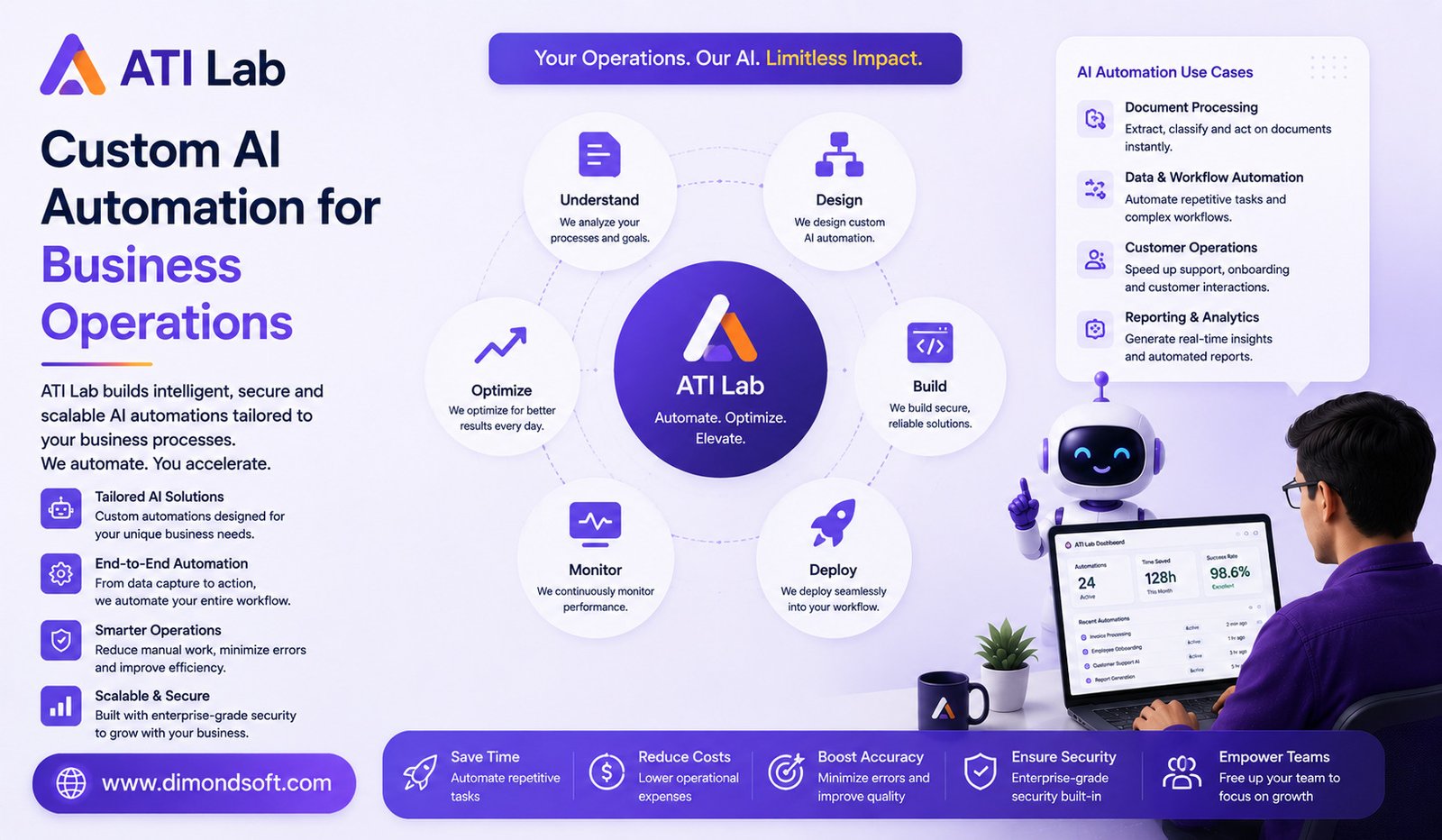
ATI Lab represents this emerging approach to building customized AI automation for business operations. The focus is on using AI to improve existing workflows, reduce repetitive work, connect business systems, and help organizations operate more efficiently.
What Is ATI Lab?
ATI Lab can be understood in the context of customized AI solutions designed for business automation.
Many businesses use multiple software systems every day. Employees may move information between spreadsheets, email platforms, customer relationship management systems, accounting tools, project management software, and internal databases.
When these systems don’t communicate efficiently, employees often become the connection between them.
This creates repetitive work.
Custom AI automation can help connect these processes and allow software to handle certain routine activities.
Instead of simply giving employees another AI chatbot, a customized system can be designed around the actual workflow of the organization.
Why Businesses Need Custom AI Automation
Off-the-shelf AI tools are useful for many common tasks.
For example, a company can use a general AI assistant to write emails or summarize documents.
But business operations often involve specialized processes.
A company may have a unique way of handling customer inquiries, approving invoices, qualifying leads, processing orders, or managing internal requests.
Generic software may not understand these processes.
Custom automation allows businesses to define how AI should work within their existing operations.
The objective isn’t necessarily to replace an entire workflow. Often, the goal is to automate the repetitive parts while keeping humans involved in important decisions.
Identifying Repetitive Business Tasks
The first step in AI automation is understanding where time is being spent.
Employees may perform tasks such as:
- Copying information between applications
- Sorting incoming emails
- Creating routine reports
- Entering customer information
- Checking documents
- Scheduling meetings
- Updating databases
- Preparing summaries
- Following up with leads
Some of these activities require human judgment, while others are highly repetitive.
AI automation is particularly useful when a process involves predictable steps combined with information that AI can interpret.
AI Automation for Customer Support
Customer service is one area where custom AI automation can provide significant value.
Businesses receive questions through email, websites, messaging platforms, and other channels.
An AI system can help classify incoming requests and determine what type of assistance is needed.
For example, it might identify whether a customer is asking about billing, delivery, product information, or technical support.
The system can then retrieve relevant information and prepare a response for an employee to review.
More straightforward requests could potentially be handled automatically when appropriate.
Complex or sensitive issues can be escalated to human representatives.
This creates a hybrid model in which AI handles routine work while people focus on cases requiring judgment.
Automating Sales Operations
Sales teams also perform many repetitive activities.
A sales representative may receive a new lead, research the company, update a CRM system, prepare notes, send an introductory email, and schedule follow-ups.
Custom AI automation can potentially connect these steps.
For example, when a new lead enters a system, an AI workflow could organize the available information, classify the lead, prepare a summary, and suggest the next action.
A salesperson can then review the information before contacting the prospect.
This can reduce administrative work and give salespeople more time to focus on relationships and closing opportunities.
AI for Back-Office Operations
AI automation isn’t limited to customer-facing departments.
Back-office operations can contain significant amounts of repetitive administrative work.
Finance teams may process invoices and receipts.
Human resources departments may manage employee documents and onboarding workflows.
Operations teams may monitor requests and coordinate tasks between departments.
AI can assist with document classification, data extraction, workflow routing, and information summarization.
The exact automation depends on the organization’s processes and risk requirements.
Connecting Different Business Systems
One of the biggest opportunities for custom automation is connecting disconnected systems.
Imagine a business using one application for sales, another for accounting, and another for customer support.
Employees may have to manually transfer information between them.
An automated workflow can potentially move approved information from one system to another.
AI can add an intelligence layer when the information requires interpretation.
For example, a system could read an incoming request, determine which department should handle it, and then create the appropriate task in a project management platform.
This goes beyond simple automation because the system can interpret unstructured information.
AI-Powered Document Processing
Businesses generate large numbers of documents.
Invoices, contracts, forms, applications, reports, and customer communications may contain information that needs to be extracted and processed.
AI can help identify relevant information within these documents.
For example, an automated finance workflow could extract invoice details and send them to an accounting system for review.
Human approval can remain part of the workflow for important financial decisions.
This combination of AI extraction and human verification can improve efficiency without removing necessary controls.
Personalized AI Workflows
Custom AI automation becomes particularly valuable when workflows need to match a company’s specific requirements.
A business might have unique approval rules.
Another organization may have several levels of customer escalation.
A manufacturing company could require specialized operational checks.
Instead of redesigning the company’s processes around a generic AI product, customized automation can be built around existing requirements.
This makes AI more closely connected to the way the organization actually operates.
AI Agents and Business Operations
The development of AI agents is expanding what business automation can do.
Traditional automation generally follows predefined instructions.
AI agents can interpret information and determine which actions may be appropriate within a defined environment.
For example, an operations agent could receive a request, search internal information, identify the appropriate workflow, use connected business tools, and prepare an outcome.
However, autonomous behavior should always operate within clear permissions.
Businesses need to establish what an AI agent can access, what it can modify, and when human approval is required.
Human Oversight Remains Important
Custom AI automation should not be viewed as completely removing humans from business operations.
Some decisions are too important to delegate entirely to an AI system.
Financial transactions, employment decisions, legal matters, sensitive customer issues, and strategic business choices may require human review.
A strong automation system therefore creates clear points where people remain involved.
For example, AI can prepare a recommendation while a manager makes the final decision.
This allows businesses to benefit from AI efficiency while maintaining accountability.
Data Security and Privacy
Custom AI automation often requires access to business information.
This can include customer data, employee information, financial documents, and proprietary company knowledge.
Security should therefore be considered from the beginning.
Businesses should implement appropriate access controls and determine which systems the AI can access.
Sensitive information should only be available to authorized workflows and users.
Organizations should also understand how their chosen AI infrastructure handles data storage, processing, logging, and retention.
Measuring the Value of AI Automation
AI automation should be evaluated based on business outcomes rather than simply the number of automated tasks.
Companies can measure:
- Time saved
- Processing speed
- Error rates
- Employee productivity
- Customer response times
- Operating costs
- Workflow completion rates
For example, if an automated process reduces the time employees spend processing customer requests from several hours to a few minutes, the business can quantify the improvement.
These measurements can help organizations determine which automation projects are worth expanding.
Common Challenges
Custom AI automation can also introduce challenges.
AI systems may make mistakes, particularly when information is incomplete or ambiguous.
Integrating different software systems can require technical work.
Poorly designed automation can also create new problems rather than solving existing ones.
This is why businesses should begin with clearly defined workflows.
Instead of attempting to automate everything simultaneously, organizations can select one repetitive process, test the automation, measure its performance, and improve it before expanding.
The Future of AI-Powered Business Operations
AI automation is moving toward more intelligent and flexible workflows.
In the future, businesses may have AI systems that continuously monitor processes, identify bottlenecks, summarize information, recommend actions, and execute approved tasks.
Rather than interacting with AI only through a chatbot, employees could work alongside AI systems integrated directly into their everyday business tools.
Custom solutions will remain important because businesses have different customers, processes, systems, and requirements.
The organizations that benefit most may be those that focus on solving specific operational problems instead of adopting AI simply because it is popular.
Final Thoughts
ATI Lab represents the broader movement toward custom AI automation for business operations.
AI can help businesses automate repetitive administrative tasks, process documents, organize customer information, support sales teams, connect software systems, and improve operational workflows.
The greatest value often comes from combining AI with existing business infrastructure.
Instead of replacing every system, companies can add an intelligent automation layer that helps existing tools work together more efficiently.
However, successful AI automation requires careful planning, reliable data, strong security, and human oversight.
As AI agents and automation technologies continue to develop, businesses may increasingly move from using AI as an individual productivity tool to integrating it directly into their operations.
The future of business automation is therefore likely to be custom, connected, and increasingly intelligent, with AI handling routine work while people remain responsible for the decisions that matter most.