
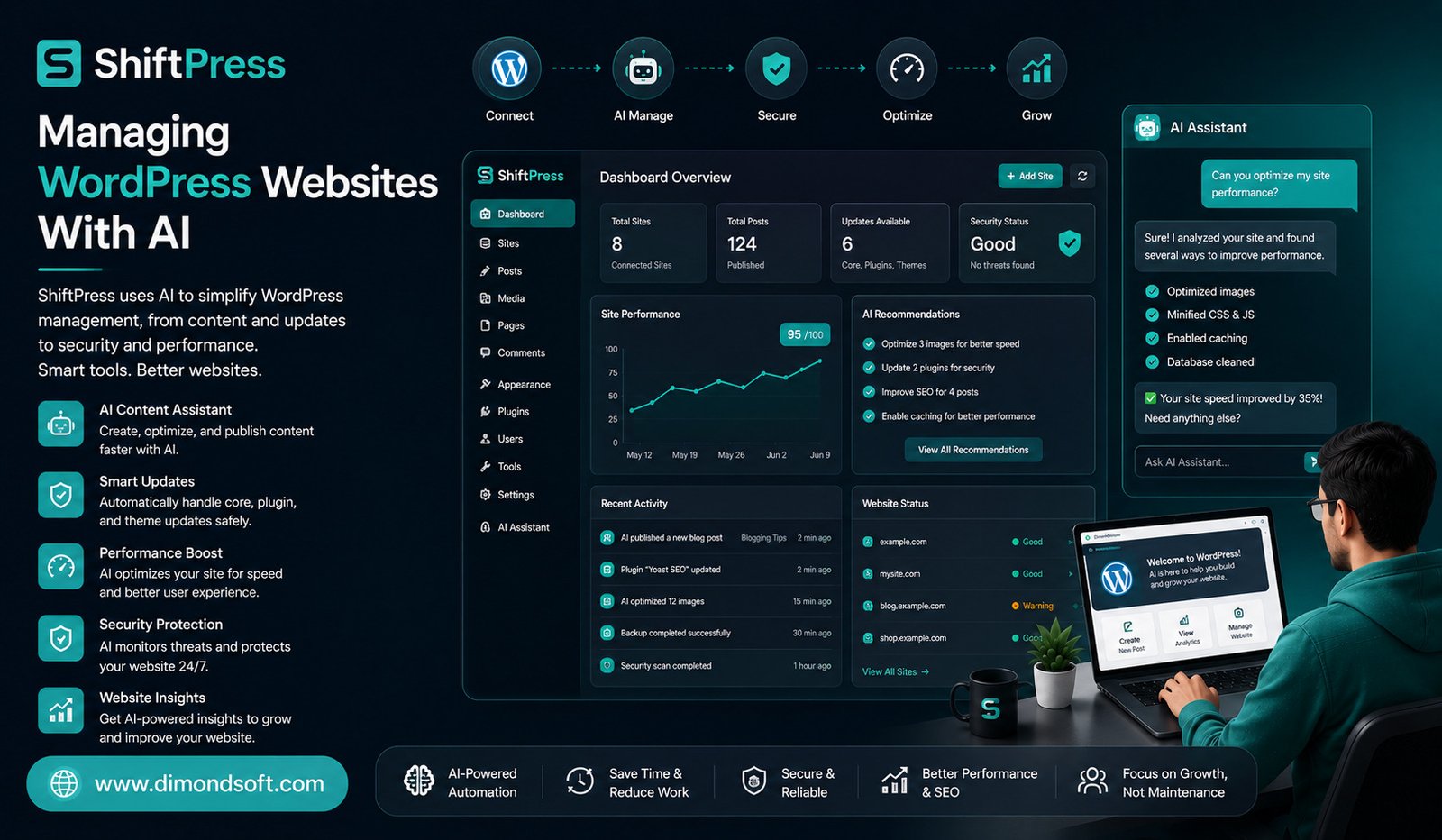
WordPress powers millions of websites, from personal blogs and small business websites to online stores and large publishing platforms. Managing a WordPress website, however, involves much more than publishing articles. Website owners need to update content, monitor performance, maintain plugins, improve SEO, check security, and keep their websites running smoothly.
Artificial intelligence is beginning to change how these tasks are handled. Instead of manually managing every part of a website, AI can assist with content operations, maintenance, optimization, and routine website administration.
ShiftPress represents this emerging approach to managing WordPress websites with AI, giving website owners and teams a way to think about WordPress management as an increasingly automated workflow.
What Is ShiftPress?
ShiftPress can be understood in the context of AI-powered WordPress management.
Traditional WordPress administration requires users to work through dashboards and individual tools. A website owner might manually create posts, edit pages, check plugins, review analytics, optimize content, and troubleshoot problems.
AI introduces a different possibility.
Instead of treating each activity as a separate manual task, AI can help understand the website as a complete system and assist with recurring operations.
For example, an AI-powered workflow could help identify outdated content, suggest improvements, organize publishing tasks, or assist with routine website maintenance.
The goal isn’t simply to add a chatbot to WordPress. It is to make website management more intelligent and efficient.
Why WordPress Management Can Be Time-Consuming
Running a website involves many small responsibilities.
A publisher may need to create several articles each week. A business owner might update service pages and product information. An e-commerce website may require frequent changes to inventory and product descriptions.
At the same time, technical maintenance continues in the background.
Plugins need updates, themes need maintenance, backups need monitoring, and website performance needs to be checked.
When these responsibilities are handled manually, website management can consume significant time.
AI can help automate or simplify some of these repetitive activities.
AI for WordPress Content Management
Content is one of the most obvious areas where AI can help.
Website owners can use AI to brainstorm article topics, create outlines, summarize information, improve readability, and assist with editing.
For a WordPress publisher, this could make the content production process more efficient.
An AI workflow might start with a topic idea and help transform it into an article outline, draft, headline options, and supporting content.
However, automatically publishing AI-generated content without human review can create quality problems.
Human editors should verify facts, originality, tone, and usefulness before content goes live.
AI should support the publishing process rather than eliminate editorial responsibility.
Managing Existing Content With AI
AI can be useful for older content as well.
Many WordPress websites contain hundreds or thousands of pages and articles.
Some may contain outdated information, broken links, weak introductions, old statistics, or content that no longer matches the website’s current goals.
Manually reviewing every page can take considerable time.
AI can help identify content that may need attention.
For example, it could flag articles that haven’t been updated recently or suggest ways to improve their structure.
Website owners can then decide which pages deserve an update.
This can be particularly useful for websites with large content libraries.
AI and WordPress SEO
Search engine optimization requires ongoing work.
Website owners need to optimize titles, headings, internal links, content structure, and other on-page elements.
AI can assist with identifying potential optimization opportunities.
For example, it could suggest alternative headings, identify missing topics, recommend internal links, or help improve the readability of an article.
AI can also help organize large content libraries around related topics.
However, SEO isn’t simply about inserting keywords into articles.
Useful content, search intent, website quality, technical performance, and user experience remain important.
AI should therefore be used as an optimization assistant rather than a shortcut to rankings.
Automating WordPress Publishing Workflows
AI can also help organize recurring publishing tasks.
A website might follow a weekly schedule that includes researching topics, writing articles, editing drafts, adding images, publishing content, and promoting new posts.
A structured AI workflow can help coordinate these steps.
For example:
Topic selection → Content creation → Review → SEO check → Publishing → Promotion
The exact process depends on the website.
By making the workflow repeatable, website owners can reduce the amount of administrative work involved in maintaining a regular publishing schedule.
AI for Website Updates
Websites frequently require small changes.
A business may need to update contact information, modify service descriptions, change announcements, or refresh product details.
AI can potentially help identify where information needs to be updated across a WordPress website.
For example, if a business changes its opening information, an AI-assisted system could identify pages where the old information appears.
Human review can then ensure that updates are applied correctly.
This can be especially useful for large websites where the same information appears in multiple locations.
Managing Plugins and Themes
WordPress websites often rely on plugins and themes to provide additional functionality.
Keeping these components updated is an important part of website maintenance.
AI can assist administrators by summarizing available updates, identifying potential compatibility concerns, or helping explain technical messages.
However, AI should not blindly update everything.
A plugin update can sometimes cause compatibility problems.
Website owners should maintain backups and test important changes when appropriate.
AI can support maintenance decisions, but website administrators remain responsible for protecting the site.
AI for Website Security
Security is another area where automation can help.
WordPress websites can face threats such as malicious login attempts, outdated software vulnerabilities, spam, and suspicious activity.
Security plugins and monitoring systems can detect many problems automatically.
AI can potentially add another layer by helping analyze unusual patterns and summarize security events.
For example, instead of reviewing large amounts of technical information manually, an administrator could receive a simplified explanation of unusual activity.
Security decisions should still be based on reliable monitoring systems and appropriate technical controls.
Improving Website Performance
Website speed affects user experience and can influence how people interact with a site.
AI can assist with analyzing performance information and identifying potential areas for improvement.
These may include oversized images, unnecessary plugins, inefficient scripts, or other technical issues.
AI can explain technical problems in simpler language, which can be useful for website owners who aren’t developers.
However, performance optimization should be tested carefully because changes intended to improve speed can sometimes affect website functionality.
AI for WordPress Analytics
Website analytics can generate large amounts of information.
Traffic sources, page views, engagement, conversions, and other metrics can be difficult to interpret without experience.
AI can help summarize analytics data and identify notable changes.
For example, a website owner could ask:
“Which pages performed better this month?”
or
“Which content categories are attracting the most visitors?”
An AI system can potentially turn raw analytics into easier-to-understand summaries.
This allows website owners to spend more time deciding what to do with the information rather than manually examining every metric.
AI-Powered Customer Support
WordPress websites can also use AI to improve customer communication.
Businesses may add AI-powered assistants that answer common questions using approved information from their website.
For example, an online service provider could use an AI assistant to explain pricing, services, policies, or basic troubleshooting steps.
More complicated issues can be transferred to a human representative.
This can help reduce repetitive support requests while keeping human assistance available when needed.
The Importance of Human Oversight
AI-powered WordPress management doesn’t mean websites should become completely autonomous.
There are important decisions that should remain under human control.
Publishing sensitive information, deleting content, changing security settings, modifying payment systems, or installing major software updates can have serious consequences.
A strong AI management system should therefore include permissions and approval steps.
AI can recommend an action, prepare a change, or identify a problem. A human can then approve the action when necessary.
Challenges of AI-Based WordPress Management
There are several challenges to consider.
AI can misunderstand website requirements or make incorrect recommendations.
Plugins can interact in unexpected ways.
Automatically generated content may lack originality or accuracy.
Security automation can also create risks if AI is given excessive permissions.
For these reasons, website owners should start with low-risk tasks and gradually introduce automation.
Backups, access controls, testing, and monitoring remain essential.
Who Can Benefit From AI WordPress Management?
AI-powered WordPress management can be useful for several groups.
Bloggers can use AI to organize content and publishing workflows.
Small businesses can automate routine website updates and customer support.
Publishers can manage large content libraries more efficiently.
Marketing teams can use AI for SEO analysis and content planning.
Developers and agencies can use AI to assist with website maintenance and repetitive administrative work.
The level of automation should depend on the complexity and risk of the website.
The Future of WordPress Management
WordPress management could become increasingly AI-assisted.
Instead of navigating through multiple dashboard screens, website owners may eventually be able to describe what they want to accomplish in natural language.
For example:
“Find outdated articles from the last two years and create an update list.”
“Identify pages with broken links.”
“Prepare this week’s publishing schedule.”
“Show me which posts received the most traffic.”
AI could interpret the request, analyze the website, and suggest or perform appropriate actions based on available permissions.
This would make website administration more conversational and potentially more accessible to non-technical users.
Final Thoughts
ShiftPress represents the broader movement toward managing WordPress websites with AI.
Artificial intelligence can assist with content creation, SEO, publishing workflows, website updates, analytics, maintenance, security monitoring, and customer support.
The biggest opportunity lies in connecting these capabilities into repeatable workflows instead of using AI only for individual tasks.
However, automation should be introduced carefully. Website owners need to maintain backups, security controls, appropriate permissions, and human review for important actions.
As AI becomes more integrated into website management, WordPress administration may gradually move from manual dashboard-based work toward intelligent, conversational workflows.
For bloggers, businesses, publishers, and agencies, the future could mean spending less time on repetitive website administration and more time focusing on content, customers, growth, and strategy.