
Customer data is one of the most valuable assets a business owns. Names, contact details, purchase histories, support records, preferences, account information, and other customer records help companies understand their audiences and operate efficiently.
However, customer data is often scattered across different platforms. A business may use one CRM for sales, another system for customer support, spreadsheets for older records, and separate tools for marketing or billing.
When companies change software or consolidate systems, moving this information can become a complicated and time-consuming project.
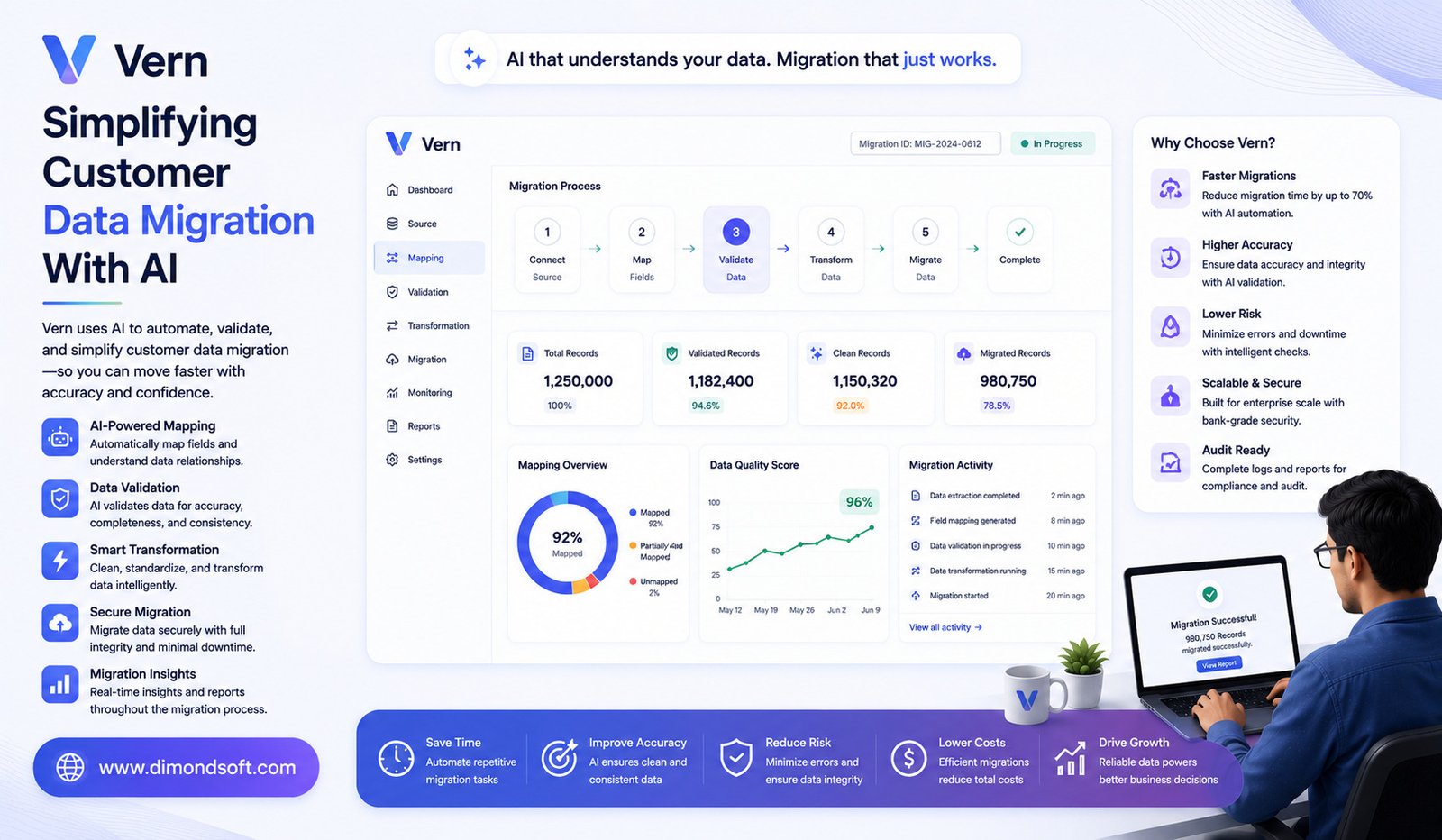
This is where artificial intelligence can play an increasingly useful role. Vern represents the emerging approach of using AI to simplify customer data migration, helping businesses organize, map, transform, validate, and move customer information between systems more efficiently.
What Is Vern?
Vern can be understood in the context of AI-assisted customer data migration.
Data migration involves moving information from one system to another. Although the basic concept sounds simple, real-world customer databases are rarely perfectly organized.
Different systems may use different field names, formats, structures, and data standards.
For example, one platform might store a customer’s full name in a single field, while another separates the first and last names.
One system may record phone numbers with country codes, while another uses a local format.
AI can help identify these differences and assist in creating mappings between old and new systems.
Why Customer Data Migration Is Difficult
Businesses often underestimate the complexity of moving customer information.
A database may contain thousands or millions of records accumulated over many years.
Some records may be incomplete. Others may contain duplicates, outdated information, inconsistent formatting, or missing fields.
There may also be custom fields created specifically for the old software.
Moving this data manually can introduce errors.
A successful migration therefore involves much more than copying information from one database to another.
The data needs to be understood, cleaned, mapped, transformed, and validated.
AI Can Help Understand Different Data Structures
One of the advantages of AI is its ability to work with patterns and unstructured information.
Suppose a company is moving customer information from an older CRM into a new platform.
The old system might contain fields called:
Cust_Name, Tel_No, Client_Type, Last_Purchase
The new CRM might use:
Customer Name, Phone, Customer Segment, Most Recent Order
An AI-assisted system can help identify that these fields may represent similar concepts.
This can speed up the mapping process.
However, mappings should be reviewed before migration, especially when the information is sensitive or business-critical.
Data Mapping Explained
Data mapping is the process of determining how information in one system corresponds to information in another.
It is one of the most important parts of a migration.
For example:
Old System: Customer_Email
New System: Email_Address
Or:
Old System: Mobile
New System: Phone_Number
Some mappings are straightforward.
Others are more complicated.
A source system may combine several pieces of information into one field, while the destination system requires those values to be separated.
AI can assist by analyzing field names, sample records, formats, and relationships.
This can reduce the amount of manual mapping required.
Cleaning Customer Data Before Migration
Data quality problems can become more visible during migration.
A customer database may contain duplicate records, invalid email addresses, inconsistent capitalization, missing phone numbers, or outdated addresses.
Moving all of this information without cleaning it can simply transfer the problem to the new system.
AI can help identify potential data-quality issues.
For example, it may recognize that two customer records appear to represent the same person even though their names are formatted differently.
It can flag these records for review.
The final decision about merging or deleting customer records should generally remain controlled by appropriate business rules and human oversight.
Detecting Duplicate Customers
Duplicate data is a common issue.
A customer might appear several times because they registered with different email addresses, changed their phone number, or were entered manually by different employees.
AI can help identify possible duplicates by comparing multiple attributes.
For example, two records may have similar names and addresses but different email addresses.
Rather than automatically merging them, the system can assign a confidence score or flag them for human review.
This reduces the risk of accidentally combining information belonging to different people.
Transforming Data for the New System
Different platforms often require different data formats.
Dates are a simple example.
One system might store a date as:
09/01/2026
Another might require:
2026-09-01
Customer data migration may involve thousands of such transformations.
AI-assisted tools can help identify patterns and generate transformation rules.
These rules can then be applied consistently across large datasets.
Automation can significantly reduce repetitive manual work.
Validating Migrated Data
Moving data isn’t the end of the process.
Businesses need to verify that the information arrived correctly.
Validation can involve comparing records before and after migration.
Teams may check:
- Number of customer records
- Required fields
- Duplicate records
- Data formats
- Relationships between records
- Missing information
- Sample customer profiles
AI can help identify anomalies in the migrated dataset.
For example, if thousands of customer records contain a particular field but only a small percentage appear correctly in the new system, that may indicate a migration problem.
Reducing Migration Time
Traditional migration projects can require substantial manual effort.
Employees may need to inspect databases, create mapping documents, clean records, and test imports.
AI can automate parts of this work.
Instead of manually examining every field, teams can use AI to identify likely relationships and highlight unusual data.
This can allow migration specialists to focus on exceptions and important decisions.
The goal is not necessarily to eliminate humans from the process but to reduce the amount of repetitive work they need to perform.
AI for CRM Migration
CRM migration is one of the most common examples.
Companies may move from one customer relationship management platform to another because of growth, pricing changes, new features, or a change in business strategy.
A CRM can contain valuable information about customers, leads, deals, communications, and sales activities.
Losing or corrupting this information during migration can disrupt business operations.
AI can assist with analyzing the old CRM structure and preparing data for the new environment.
Careful testing remains essential before the new CRM becomes the primary system.
Supporting Marketing Data Migration
Marketing teams also depend on customer data.
Email platforms, advertising systems, customer databases, and analytics tools may each contain different versions of customer information.
When these systems change, data migration can become complicated.
AI can help identify fields, standardize formats, and detect inconsistencies.
This can support smoother transitions while reducing the amount of manual data preparation.
Businesses should still ensure that customer information is transferred and used according to applicable privacy requirements and customer permissions.
Data Privacy and Security
Customer data migration involves significant privacy considerations.
Businesses may handle names, contact information, purchase histories, account information, and other potentially sensitive data.
AI systems used during migration should therefore be carefully controlled.
Organizations need to understand where data is processed, who can access it, how it is stored, and how long it is retained.
Access should be limited to authorized people and systems.
Encryption, logging, permissions, and secure data-transfer methods can also be important.
AI may make migration faster, but speed should never come at the expense of data security.
Human Oversight Remains Essential
AI can identify patterns, but not every decision should be automated.
For example, merging two customer records may appear obvious to an AI system but could have serious consequences if the records belong to different people.
Similarly, deleting outdated information may conflict with business retention requirements.
A strong migration workflow should therefore separate low-risk automation from decisions requiring human review.
AI can handle routine transformations while specialists review ambiguous cases.
Common Challenges
AI-assisted data migration still has limitations.
Poor-quality source data can make automated mapping difficult.
Custom business fields may not have obvious equivalents in the new system.
AI can also misunderstand unusual abbreviations or company-specific terminology.
There may also be compatibility issues between systems.
For these reasons, organizations should use testing environments and migration trials before moving their complete customer database.
A phased approach can reduce the risk of major problems.
The Future of Data Migration
As businesses adopt more software platforms, data migration will remain an important operational challenge.
AI could make these projects increasingly intelligent.
Instead of requiring teams to manually document every relationship between systems, AI could analyze schemas, identify potential mappings, detect anomalies, suggest transformations, and help generate validation reports.
This could turn migration from a heavily manual project into a more automated workflow.
Human experts would still supervise important decisions and verify the final results.
Why Vern Represents an Important Trend
The broader idea behind Vern reflects a growing shift in enterprise technology.
AI isn’t only being used to generate text or answer questions. It is increasingly being applied to the complex operational work that businesses perform behind the scenes.
Data migration is a good example.
It involves large volumes of information, repetitive transformations, pattern recognition, and exception handling—all areas where AI-assisted automation can potentially provide value.
Final Thoughts
Vern represents the broader concept of simplifying customer data migration with AI.
Moving customer information between systems can be complicated because databases contain different structures, formats, field names, duplicates, and data-quality problems.
AI can help businesses analyze these differences, map fields, clean information, identify duplicates, transform formats, and validate migrated records.
The technology can significantly reduce repetitive work, but it should not remove human oversight from critical decisions.
Data privacy, security, accuracy, and validation remain essential throughout the migration process.
As businesses continue to adopt new CRM, marketing, analytics, and customer-service platforms, AI-assisted migration could become an increasingly valuable part of digital transformation.
The future of customer data migration may therefore involve fewer spreadsheets and manual mapping exercises and more intelligent automation that helps businesses move their data accurately, securely, and efficiently.