
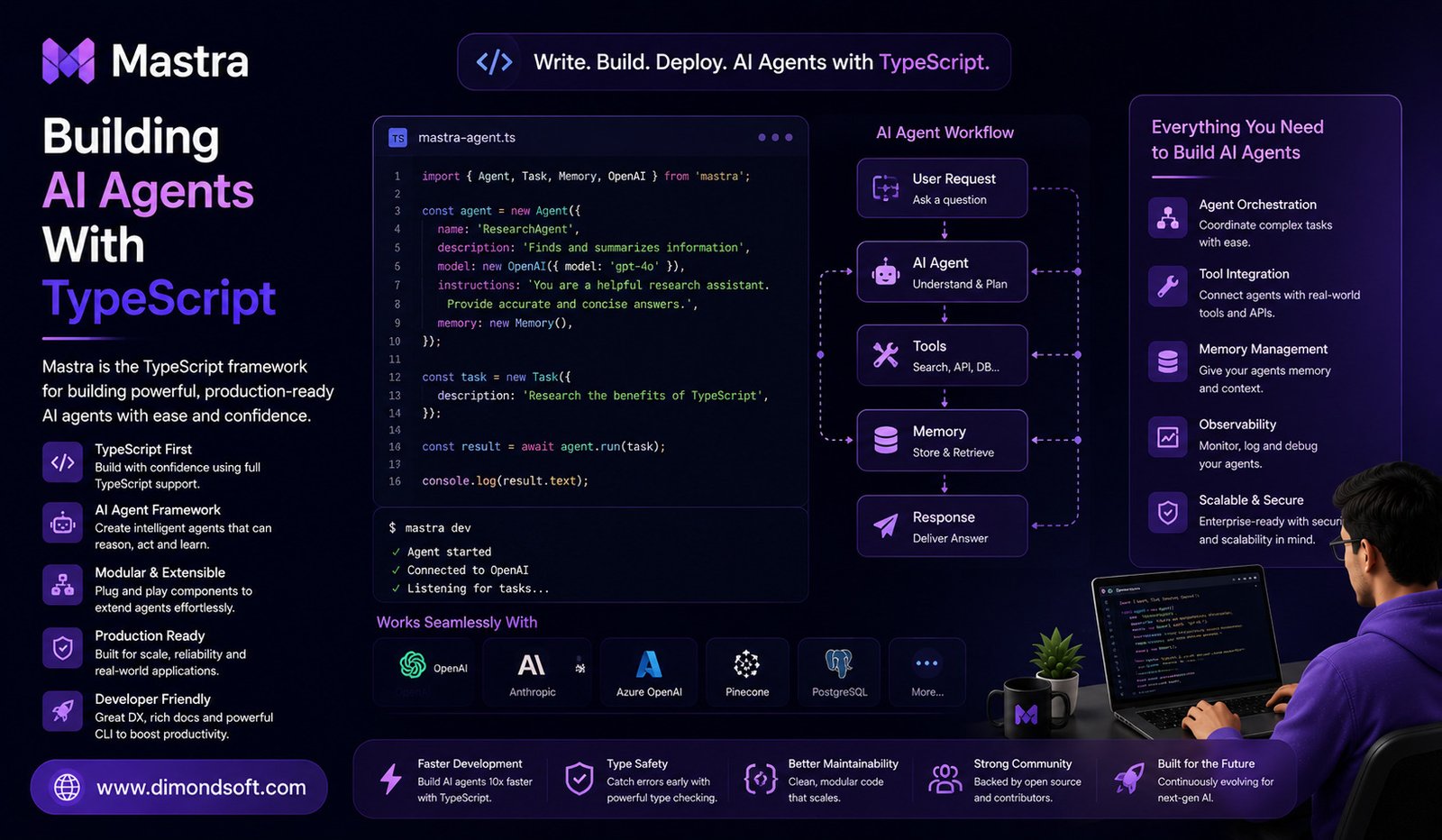
Artificial intelligence is rapidly moving from simple chatbots to intelligent agents capable of planning tasks, using tools, accessing information, and completing multi-step workflows. As businesses and developers explore these applications, there is growing demand for frameworks that make it easier to build reliable AI agents.
For JavaScript and TypeScript developers, Mastra has emerged as a framework focused on building AI-powered applications and agents with TypeScript. It provides developers with tools and abstractions for creating workflows, connecting models and external services, managing agent behavior, and developing AI applications within a familiar TypeScript environment.
This makes Mastra an interesting option for developers who want to move beyond basic AI API calls and build more structured agent-based applications.
What Is Mastra?
Mastra is a TypeScript-based framework for developing AI applications and agents.
Rather than building every component of an AI application from scratch, developers can use a framework to organize common requirements such as agents, workflows, tools, memory, model integration, and application logic.
TypeScript is widely used for modern web development, particularly in applications built around JavaScript ecosystems.
By using TypeScript for AI development, developers can combine familiar programming practices with modern AI capabilities.
The result is an environment where AI agents can become part of regular software applications rather than existing as isolated experiments.
Why TypeScript Matters for AI Development
TypeScript adds static typing to JavaScript.
For small scripts, this may not seem particularly important. But as applications become larger and more complicated, clearly defined data structures can make development easier to manage.
AI applications often involve multiple components.
An agent may receive a user request, call a tool, retrieve information, pass that information to a model, execute another action, and return a final response.
When many components communicate with each other, strong development practices become increasingly valuable.
TypeScript can help developers catch certain errors during development and make complex codebases easier to maintain.
Building AI Agents With Mastra
An AI agent generally combines a language model with instructions, tools, context, and the ability to take actions.
For example, a customer-service agent might be able to:
Receive a question → Search company information → Check customer data → Prepare an answer → Escalate when necessary
A framework such as Mastra can help developers organize these capabilities into an application.
Instead of treating the AI model as the entire application, developers can build a structured system around it.
This is important because real-world AI agents often require much more than text generation.
Connecting AI Models
AI applications may need access to different language models depending on the use case.
A development framework can make model integration easier by providing a consistent structure for working with AI providers.
This can be useful when developers want flexibility in choosing models for different applications.
For example, one model may be appropriate for complex reasoning while another may be more suitable for high-volume, lower-cost tasks.
The ability to structure an application independently from a single model provider can give developers more flexibility as AI technology changes.
AI Agents That Use Tools
One of the most important characteristics of modern AI agents is tool usage.
A language model can generate text, but an agent can potentially use external tools to accomplish tasks.
A tool might allow an agent to:
- Search a database
- Retrieve information from an API
- Access business systems
- Calculate information
- Send a message
- Create a task
- Search documents
The agent decides when a tool is useful based on its instructions and available capabilities.
A framework can provide a structured way for developers to define and connect these tools.
Workflows and AI Automation
Not every AI task needs a fully autonomous agent.
Sometimes a predefined workflow is more reliable.
For example, an invoice-processing application might follow a predictable sequence:
Receive invoice → Extract information → Validate data → Check business rules → Request approval → Store result
AI can be used for specific steps, while the overall process remains structured.
This combination of AI and deterministic workflows can be useful for business applications where reliability matters.
Mastra’s focus on workflows provides a way for developers to build these structured processes alongside more flexible agents.
Memory and Context
AI applications often need to remember information.
A chatbot may need to understand previous messages.
A customer-service agent may need information about a customer’s previous interactions.
A business assistant may need access to relevant documents and organizational information.
Memory and context management therefore become important when developing more sophisticated AI applications.
A framework can help developers organize how information is stored, retrieved, and passed to an agent.
This can make applications more useful than systems that treat every request as a completely new conversation.
Building Multi-Step AI Tasks
Many useful AI applications involve multiple steps.
Consider a research assistant.
A user might ask it to investigate a topic.
The application could:
- Understand the request.
- Search relevant sources.
- Collect information.
- Analyze the results.
- Organize the findings.
- Produce a final report.
A framework can help developers define how these steps interact.
This is particularly important when an application needs both AI reasoning and predictable software logic.
Mastra for Web Developers
Mastra is especially interesting for developers already working in the TypeScript ecosystem.
Instead of learning an entirely different programming environment for AI development, developers can use familiar technologies.
This can lower the barrier to experimenting with AI agents.
Developers building web applications can also integrate AI functionality into existing products.
For example, a SaaS application could add an AI assistant that understands customer questions and performs actions within the application.
An internal company dashboard could include an agent that retrieves business data and generates summaries.
The possibilities extend beyond standalone chat interfaces.
AI Agents for Business Applications
Businesses are increasingly interested in AI agents because they can potentially automate repetitive knowledge work.
Consider a sales application.
An AI agent could help research leads, summarize customer information, prepare meeting notes, or suggest follow-up actions.
A support application could use an agent to retrieve documentation and prepare responses.
An operations application could use AI to analyze requests and route them to the appropriate workflow.
A TypeScript framework can provide the development foundation needed to integrate these capabilities into existing software.
Observability and Testing
Building an AI agent is only the beginning.
Developers also need to understand how the agent behaves.
An agent may choose an unexpected tool, generate an incorrect answer, or follow an inefficient workflow.
Testing and observability are therefore important.
Developers need ways to examine what happened during an AI interaction.
For example, they may want to know which tools were called, what information was retrieved, and how long individual steps took.
Monitoring these interactions can help teams improve reliability.
Reliability and AI Guardrails
AI systems are probabilistic.
The same request may not always produce exactly the same output.
This creates challenges when AI is used for business-critical operations.
Developers can introduce guardrails to limit what an agent is allowed to do.
For example, an agent might be allowed to prepare a financial transaction but require human approval before executing it.
Similarly, an AI support agent could answer routine questions but escalate sensitive cases to employees.
Frameworks can help developers structure these boundaries into applications.
Why Frameworks Matter for AI Agents
Developing an AI agent directly from raw APIs is possible.
However, as applications become more complex, developers may need to build their own systems for managing tools, workflows, memory, logging, testing, and application state.
Frameworks can reduce some of this development effort.
They provide building blocks that allow developers to focus more on the application’s purpose rather than repeatedly implementing foundational infrastructure.
This is especially useful as AI applications move into production environments.
Challenges of Building AI Agents
AI agent development still involves significant challenges.
Developers need to understand prompt design, model behavior, tool permissions, data privacy, error handling, and cost management.
An agent that works perfectly in a demonstration may behave differently when exposed to real users and unpredictable requests.
Applications also need protection against problems such as incorrect tool usage, sensitive-data exposure, and poorly controlled autonomous actions.
AI frameworks can simplify development, but they do not eliminate these engineering responsibilities.
The Future of TypeScript and AI Agents
The JavaScript ecosystem is likely to remain important as AI applications become part of websites, SaaS platforms, internal tools, and consumer applications.
TypeScript’s popularity among developers makes it a natural environment for building these systems.
As AI agents become more capable, frameworks may increasingly combine traditional software engineering with AI-specific capabilities.
Developers may build applications where deterministic code handles critical business logic while AI manages tasks that require language understanding, reasoning, or flexible decision-making.
This hybrid approach could become a common pattern for production AI software.
Who Can Benefit From Mastra?
Mastra can be particularly relevant for:
TypeScript developers who want to build AI-powered applications.
Web developers adding AI capabilities to existing products.
Startups developing AI-first SaaS applications.
Enterprise teams building internal AI assistants and automation.
AI developers looking for structured approaches to agents and workflows.
The most useful applications will depend on the problem being solved rather than simply the availability of AI.
Final Thoughts
Mastra highlights the growing importance of TypeScript frameworks for building AI agents.
Modern AI applications require much more than connecting a language model to a text box. Developers increasingly need tools for agents, workflows, external tools, memory, model integration, testing, and observability.
A TypeScript-based framework can make these capabilities more accessible to developers already working in the JavaScript ecosystem.
The real opportunity is building AI systems that can interact with software and complete useful tasks rather than simply generate text.
As AI agents become more integrated into websites, SaaS products, and business applications, development frameworks such as Mastra can help developers turn experimental AI ideas into structured software applications.
The future of AI development may therefore involve a combination of powerful language models, reliable software engineering, structured workflows, and intelligent agents—all working together inside applications built for real-world users.