Coming up with a great software idea is often easier than turning that idea into a working product. A founder may know exactly what problem they want to solve, but building the application requires planning, coding, testing, deployment, authentication, databases, payments, and ongoing maintenance.
Artificial intelligence is changing this process.
Modern AI development platforms are moving beyond simple code generation and focusing on the complete journey from an idea to a usable application. Ideavibes AI is part of this shift, offering an idea-to-product approach where users can describe what they want in natural language and use AI agents to help plan, build, review, deploy, and improve the resulting application.
This makes Ideavibes AI particularly interesting for founders, creators, small teams, and people who have product ideas but may not have a full engineering team.
What Is Ideavibes AI?
Ideavibes AI is an AI-powered platform designed to help users turn product ideas into real applications.
Instead of starting with a blank code editor, users can begin by explaining their idea in their own words. The platform’s Idea Designer and Intent Engine can help transform that initial concept into more structured requirements, user stories, and tasks.
From there, AI agents can work on the application, review changes, and help move the project toward deployment.
The important distinction is that the goal isn’t simply to produce a prototype. Ideavibes AI positions itself around building and shipping products that can actually be used by customers.
From Idea to Application
Traditional software development usually involves several stages.
First comes product planning. Then designers and developers create the interface and underlying systems. Engineers build the application, testers check it, and another team may eventually handle deployment and infrastructure.
For a non-technical founder, this can be a major barrier.
Ideavibes AI attempts to bring many of these stages into one continuous workflow.
The general process is:
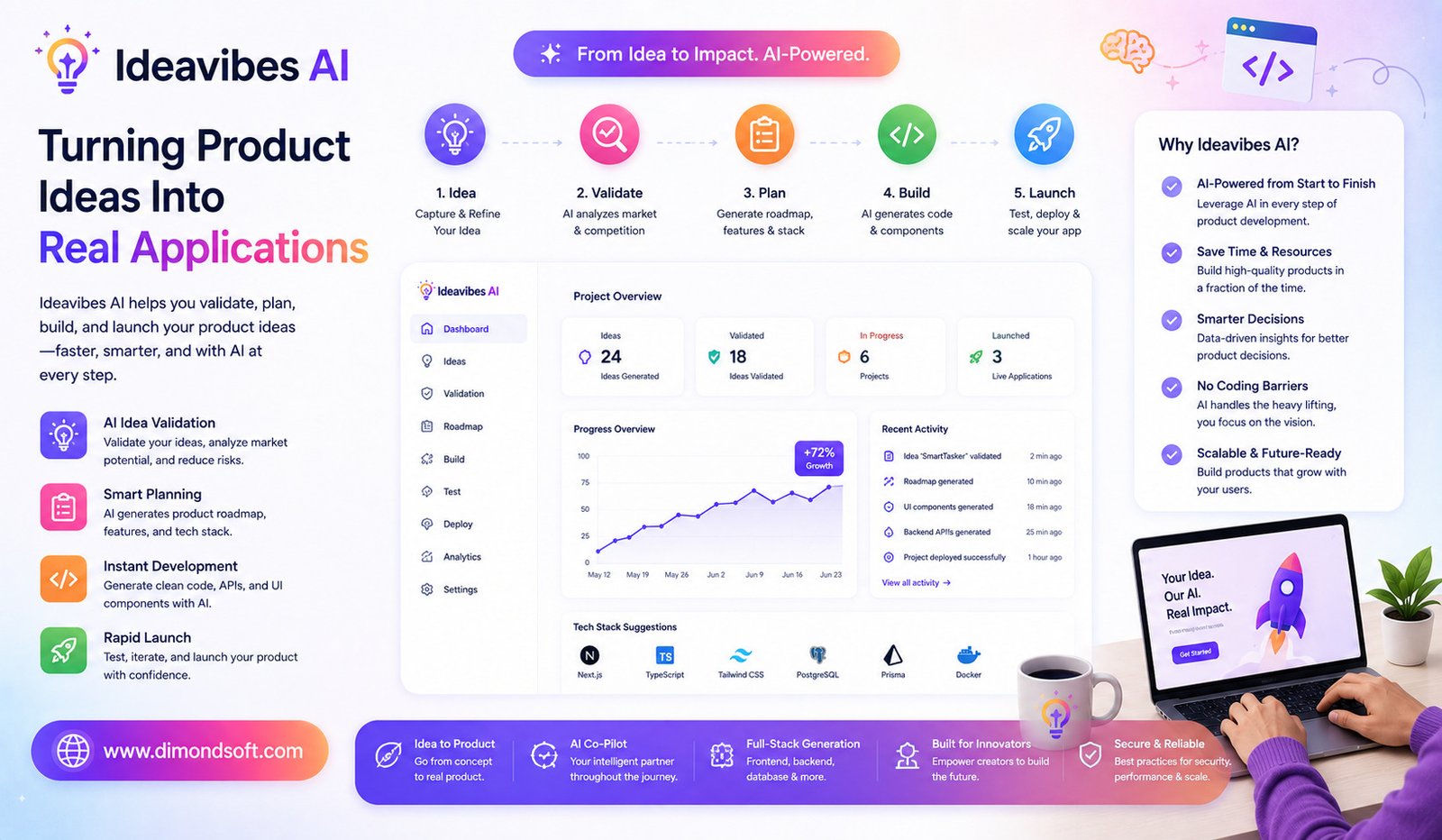
Describe → Refine → Plan → Build → Review → Deploy → Improve
This approach allows users to focus more on the product they want to create rather than learning every technical detail required to build it.
Starting With a Simple Product Idea
One of the platform’s key ideas is that users don’t need to begin with a perfectly written technical specification.
A person can start with a simple description of what they want to build.
For example:
“I want an online platform where local businesses can create profiles and customers can compare their services.”
From there, the concept can be refined through conversation.
The AI can help clarify the target users, features, workflows, and product requirements.
This is useful because many early-stage ideas are incomplete.
The ability to discuss an idea before development begins can help turn a vague concept into something more actionable.
The Intent Engine
A major part of Ideavibes AI’s approach is its Intent Engine.
The purpose of this system is to translate a user’s goal into structured work that AI agents can understand and execute. Instead of requiring users to provide highly technical instructions, the platform attempts to interpret what they want and break it into actionable steps.
This can be important for non-technical users.
A founder may understand the business problem without knowing the terminology developers normally use.
An intent-based system can help bridge that gap.
The user explains the desired outcome, while the AI translates the idea into a development plan.
Multiple AI Agents Working Together
Ideavibes AI isn’t based only on a single AI assistant.
The platform describes a multi-agent approach involving different roles such as planners, builders, reviewers, and shippers. These agents can hand work between one another and evaluate the results as the product develops.
This resembles the structure of a software development team.
A planning agent can focus on requirements.
A building agent can work on implementation.
A reviewer can check the result.
A shipping-oriented agent can help move the application toward deployment.
The advantage of this model is specialization.
Instead of asking one AI system to perform every responsibility, different agents can focus on different parts of the product lifecycle.
Building Real Full-Stack Applications
Creating an attractive interface is only one part of developing software.
A real application may require databases, authentication, file storage, email services, payments, and other backend capabilities.
Ideavibes AI highlights integrations for these types of full-stack services, allowing applications to move beyond simple visual prototypes.
For example, an e-commerce application may need:
User accounts + Product database + Shopping cart + Payments + Order management
A simple AI-generated interface isn’t enough to operate such a system.
Connecting these components is what turns an idea into a functioning product.
Supporting Different Technology Stacks
Another interesting aspect of the platform is its support for multiple programming languages and technology stacks.
Ideavibes AI states that its AI crew can work across languages such as Python, TypeScript, Rust, and Go, rather than forcing every project into a single development environment.
This flexibility can be valuable for developers and businesses that already have technical preferences.
It can also make the platform useful for improving existing applications rather than only creating completely new projects.
Your Code and GitHub
For businesses and serious creators, ownership of the resulting code is important.
Ideavibes AI states that the code remains in the user’s own GitHub repository, rather than being locked inside the platform. The company also describes GitHub Issues as an audit trail for decisions, progress, and outcomes.
This approach can provide greater transparency.
It also means a human developer can potentially join the project later and continue working with the code.
For startups, this can be an important consideration because the application may eventually require a dedicated engineering team.
Reviewing AI-Generated Work
One challenge with AI development is maintaining quality as a project becomes more complicated.
An AI system may generate working code initially, but repeated changes can introduce bugs or inconsistencies.
Ideavibes AI addresses this through a workflow where changes are planned, built, reviewed, and shipped. The platform says every change is checked before it is released, with work returned for further changes when it isn’t ready.
This emphasis on review is important.
Building software isn’t just about generating code quickly. It is also about maintaining quality as the product evolves.
From Prototype to Production
Many AI coding tools are excellent at creating an initial demonstration.
The difficult part often begins afterward.
A real application needs deployment, domains, authentication, email, payments, monitoring, and infrastructure.
Ideavibes AI focuses on this transition from prototype to production. Its platform describes a workflow that includes deployment and ongoing iteration, rather than stopping once an initial version has been generated.
This is one of the key differences between AI-assisted coding and a broader idea-to-product platform.
Examples of Applications
The platform showcases different types of products built through its system, including utility applications, forums, habit trackers, calculators, content sites, storefronts, event websites, and interactive applications.
This demonstrates that AI product development doesn’t have to be limited to chatbots.
The same underlying approach can potentially be used for many types of web applications.
For example, a creator could build a niche calculator, while a startup could develop a customer-facing SaaS product.
Useful for Non-Technical Founders
One of the biggest potential audiences for Ideavibes AI is founders without a technical team.
Traditionally, a founder with a software idea might need to hire developers before testing the concept.
AI product-building platforms can reduce that initial barrier.
A founder can describe the idea, develop an early version, test it with potential customers, and continue refining it.
This doesn’t mean technical expertise becomes unnecessary.
As a product grows, developers may still be needed for advanced architecture, security, performance, and specialized requirements.
However, AI can potentially help founders reach the first working version faster.
Useful for Small Teams and Solo Businesses
Small businesses also have many software needs.
A company might want an internal dashboard, customer portal, booking system, calculator, inventory tool, or specialized workflow application.
Hiring a full development team for every internal project isn’t always practical.
An AI-powered product-building platform can provide another option.
Teams can describe the problem and build a specialized application around their workflow.
This could help smaller organizations create software that would otherwise remain on a long-term wish list.
Recent Platform Improvements
Ideavibes AI has continued developing its product experience. An August 2026 update described improvements to project navigation, templates, product sharing, infrastructure reliability, and multimedia support.
The platform has also expanded its template options, allowing users to start from an existing structure and continue customizing the application through conversation.
These improvements reflect an important trend in AI software development: making the process easier for people who may not want to manage technical implementation directly.
Challenges to Consider
AI-powered application development isn’t without limitations.
A generated application still needs testing.
Complex business requirements may require significant refinement.
Security is particularly important when applications handle customer information, payments, or sensitive business data.
AI-generated code should therefore be reviewed and tested appropriately before being used in critical environments.
Users should also understand the difference between a quick prototype and a production-ready system.
AI can accelerate development, but product quality still depends on good requirements, testing, security practices, and continuous improvement.
The Future of AI Product Development
The biggest change may be the shift from code-first development to outcome-first development.
Instead of beginning with a programming language, users can begin with a problem.
Instead of asking an AI to write a function, they can explain the product they want.
The AI system can then translate that idea into requirements, implementation tasks, code, testing, and deployment.
This doesn’t eliminate software engineering. Instead, it changes where humans spend their time.
People may focus more on product strategy, customer needs, design decisions, testing, and business goals while AI handles increasingly large portions of implementation.
Final Thoughts
Ideavibes AI represents the growing movement toward turning product ideas into real applications with AI.
Its approach goes beyond simple code generation by connecting idea refinement, planning, multi-agent development, review, full-stack services, deployment, and ongoing iteration into one workflow.
For founders, creators, small businesses, and developers, this approach could make software development more accessible and reduce the distance between an idea and a working product.
The most important point is that AI isn’t simply becoming a faster way to write code. It is increasingly becoming a way to coordinate the entire product-building process.
As these systems improve, the ability to say “Here is my idea—turn it into a real application” could become one of the most powerful interfaces for creating software.