
Finding new customers is one of the most important parts of growing a business, but it can also be one of the most time-consuming. Sales teams spend hours researching prospects, identifying potential customers, sending outreach messages, following up, qualifying leads, and scheduling meetings.
Artificial intelligence is changing how these activities can be handled.
Instead of using AI only to write sales emails, businesses can increasingly use AI-powered systems to support the entire prospecting process. From identifying potential customers to starting conversations and arranging meetings, AI can automate several repetitive steps in the sales pipeline.
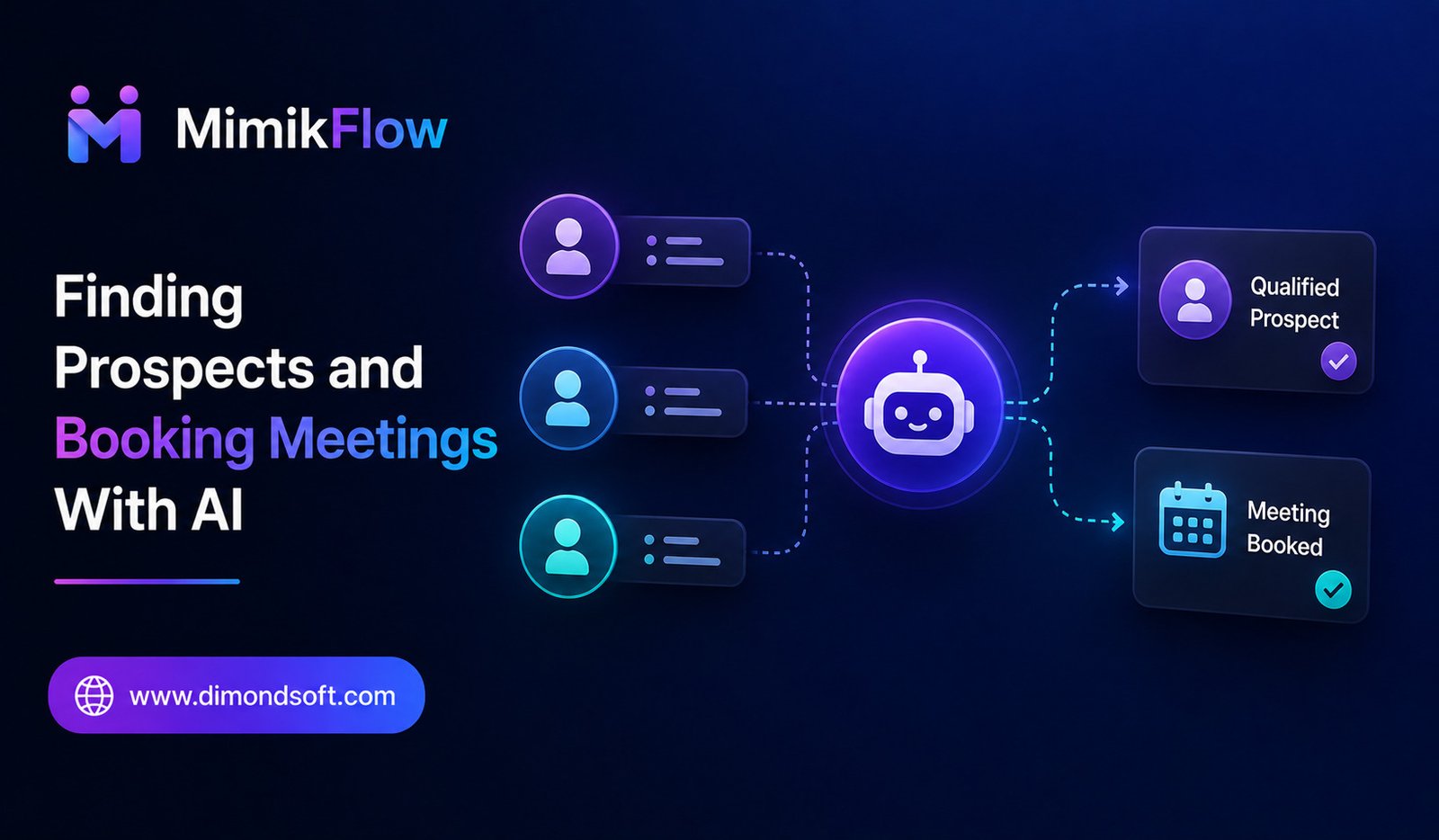
MimikFlow represents this emerging approach to using AI for finding prospects and booking meetings. The concept combines prospect discovery, automated outreach, lead qualification, and scheduling into a more connected workflow.
What Is MimikFlow?
MimikFlow can be understood as an AI-powered sales workflow designed to help businesses identify potential prospects and move qualified leads toward meetings.
Traditional sales prospecting often involves several disconnected activities.
A salesperson might search for potential customers, research each company, find contact information, write a personalized message, send the message, follow up, and then coordinate calendars.
AI can potentially bring these steps together.
A typical workflow could look like:
Find prospects → Research leads → Personalize outreach → Follow up → Qualify interest → Book meeting
The goal is to reduce repetitive work while allowing sales professionals to focus on conversations and relationships.
Why Prospecting Takes So Much Time
Sales prospecting involves more than simply finding a list of names.
A useful prospect needs to match specific criteria.
For example, a software company may want to target businesses of a particular size, operating in certain industries, located in specific markets, and using relevant technologies.
Salespeople need to identify these characteristics before deciding whether a lead is worth contacting.
AI can help organize and filter large amounts of prospect information.
This can make the initial research stage faster.
Finding the Right Prospects
The quality of a sales pipeline depends heavily on targeting.
Contacting thousands of irrelevant people isn’t necessarily better than contacting a smaller group of highly relevant prospects.
An AI-powered prospecting workflow can potentially use predefined criteria to identify suitable companies or individuals.
For example, a business could specify:
Industry
Company size
Geographic market
Job role
Business requirements
The system can then help narrow down potential leads.
This allows sales teams to spend more time on prospects who are more likely to be relevant.
AI-Powered Lead Research
Once a potential prospect is identified, salespeople often research the company before reaching out.
They may look at the company’s website, products, recent announcements, industry, technology stack, and business challenges.
This research helps create more relevant outreach.
AI can potentially summarize publicly available information and identify details that may be useful for personalization.
Instead of spending several minutes researching each prospect manually, a salesperson can start with an AI-generated summary and verify the important details.
Personalizing Sales Outreach
Generic sales messages often have low engagement.
A message that simply says “We provide great solutions for businesses like yours” may not give the prospect a strong reason to respond.
AI can help personalize outreach based on available information.
For example, an email might reference a company’s recent expansion, a relevant product, or a business challenge.
Personalization should be based on accurate and appropriate information.
AI-generated claims should always be reviewed because incorrect details can damage trust.
Automating Follow-Ups
Many sales opportunities are lost because follow-ups don’t happen consistently.
A salesperson may send an initial message and become busy with other tasks.
AI workflows can potentially automate follow-up schedules.
For example:
Day 1: Initial outreach
Day 4: Follow-up message
Day 9: Additional relevant information
Day 15: Final follow-up
The exact timing depends on the industry, audience, communication channel, and business strategy.
The objective is to create consistency without requiring salespeople to manually remember every follow-up.
Booking Meetings Automatically
Generating interest is only one part of the sales process.
The next challenge is scheduling a meeting.
Traditional scheduling can involve multiple messages:
“Are you available Tuesday?”
“No, how about Thursday?”
“Thursday afternoon works.”
“Which time?”
AI-powered scheduling can potentially simplify this process.
Once a prospect indicates interest, the system can offer available meeting times and coordinate the booking.
This reduces unnecessary back-and-forth.
Connecting With Calendars
Meeting automation becomes more useful when connected to calendar systems.
An AI workflow can potentially check available slots and offer appropriate options.
Once the prospect selects a time, the appointment can be added to the calendar.
Confirmation messages can then be sent automatically.
This creates a smoother transition from prospect interest to scheduled conversation.
Lead Qualification
Not every prospect should receive the same sales treatment.
Some leads may be highly qualified.
Others may have little interest or may not fit the company’s target market.
AI can potentially ask qualifying questions before scheduling a meeting.
For example, a business selling enterprise software might want to know:
What type of solution are you currently using?
How large is your team?
What problem are you trying to solve?
When are you planning to make a decision?
The answers can help determine whether the lead should move forward.
Reducing Manual Sales Administration
Salespeople often spend considerable time on administrative tasks.
They may update CRM records, enter lead information, schedule meetings, write follow-up messages, and organize notes.
AI automation can potentially reduce some of this work.
For example, after a prospect responds, the system could summarize the conversation and update relevant information in the CRM.
This allows sales representatives to spend more time actually selling.
AI and CRM Systems
Customer relationship management platforms are central to many sales teams.
AI prospecting tools can become more useful when connected to CRM systems.
A workflow might automatically record:
- Prospect details
- Outreach history
- Responses
- Qualification information
- Meeting status
- Follow-up activity
This gives sales teams a more complete view of the customer journey.
However, businesses need to ensure that automated updates are accurate.
Incorrect CRM data can create problems later in the sales process.
Supporting Small Businesses
Small businesses often don’t have large sales teams.
An owner or a small group of employees may handle everything from finding leads to closing deals.
AI prospecting can potentially provide additional capacity.
Instead of manually researching hundreds of potential customers, a small team could use AI to identify promising leads and automate parts of the outreach process.
This can help businesses build a more consistent sales pipeline without adding the same amount of administrative work.
Scaling Sales Outreach
Larger companies face a different challenge.
They may have thousands of potential prospects across different markets.
Manual personalization becomes difficult at scale.
AI can potentially help sales teams manage larger prospect lists while maintaining some degree of personalization.
However, scaling outreach responsibly is important.
Businesses should avoid turning automation into indiscriminate spam.
Relevant targeting and useful communication are more sustainable than simply increasing message volume.
AI for Different Sales Channels
AI-powered prospecting doesn’t necessarily have to be limited to email.
Depending on the system and integrations, workflows can potentially support multiple channels.
These may include:
Website conversations
Messaging platforms
Phone calls
Social selling workflows
Each channel has different rules and expectations.
Businesses need to use automation responsibly and comply with applicable communication, privacy, and marketing requirements.
Website Lead Generation
AI can also help convert website visitors into prospects.
A visitor might interact with an AI assistant and ask about pricing or product features.
The AI can answer basic questions and potentially identify whether the visitor is interested in speaking with a sales representative.
If the visitor wants a meeting, the system can help schedule one.
This creates a direct connection between website activity and sales operations.
AI Sales Assistants vs Human Salespeople
AI is particularly useful for repetitive processes.
Human salespeople remain important for relationship building, negotiation, complex questions, and understanding customer needs.
A useful division of responsibilities could be:
AI: Researches prospects, handles routine follow-ups, qualifies basic information, and coordinates scheduling.
Human: Conducts important conversations, builds relationships, negotiates, and makes strategic decisions.
This model allows AI to support sales teams rather than attempting to replace every human interaction.
Measuring Sales Automation
Businesses should measure whether an AI prospecting workflow actually produces better results.
Important metrics can include:
- Qualified leads generated
- Response rate
- Meeting-booking rate
- Show-up rate
- Conversion rate
- Cost per qualified lead
- Sales cycle length
A high number of automated messages doesn’t necessarily mean a successful sales strategy.
The ultimate goal is generating relevant opportunities and improving revenue outcomes.
Avoiding Low-Quality Outreach
One potential danger of AI sales automation is message overload.
If businesses use AI to send huge volumes of generic messages, prospects may receive more unwanted communication.
This can hurt a company’s reputation.
Effective automation should focus on relevance.
AI should help businesses communicate with the right prospects rather than simply communicate with more people.
Quality targeting, personalization, frequency controls, and clear opt-out mechanisms are important parts of responsible outreach.
Privacy and Compliance
Prospecting involves personal and business information.
Companies need to understand how prospect data is collected, stored, processed, and used.
Depending on the location and communication channel, privacy and marketing laws may impose specific requirements.
Businesses should also ensure that AI systems don’t make inappropriate assumptions about individuals based on limited information.
Human oversight is especially important when automated systems are making decisions about who should receive outreach.
Challenges of AI Prospecting
AI-powered sales automation has limitations.
Data can be outdated.
AI may misunderstand a prospect’s role.
Personalization can become inaccurate.
Automated messages can sound repetitive.
Scheduling systems can encounter conflicts.
For these reasons, AI workflows should be monitored regularly.
Sales teams should review message quality, lead accuracy, and conversion performance rather than assuming the system will work perfectly without supervision.
The Future of AI-Powered Sales
Sales automation is moving toward increasingly integrated workflows.
Instead of separate tools for lead generation, research, outreach, follow-up, qualification, and scheduling, AI systems may increasingly connect these stages.
A business could define its ideal customer profile and sales objectives.
The AI could then help identify prospects, research them, start appropriate conversations, qualify responses, and schedule meetings with interested leads.
This represents a shift from individual AI tools toward AI-powered sales agents.
Final Thoughts
MimikFlow represents the growing trend of using AI to find prospects and book meetings.
By combining prospect research, personalization, follow-ups, qualification, and scheduling, AI can potentially remove many repetitive tasks from the sales process.
The greatest benefit isn’t simply sending more outreach.
It is helping sales teams spend more time on the prospects who are genuinely relevant and interested.
Human judgment remains essential for relationship building, complex sales conversations, and important decisions. AI works best as a supporting layer that handles repetitive processes and keeps opportunities moving.
As AI agents become more capable, sales workflows could become increasingly automated—from discovering a potential customer to placing a qualified meeting directly on a salesperson’s calendar.
The companies that benefit most will likely be those that combine this automation with accurate data, thoughtful personalization, strong privacy practices, and a clear focus on delivering value to prospects.