Artificial intelligence is increasingly being used to work with documents. Businesses, developers, researchers, students, and content teams regularly provide AI systems with PDFs, Word files, presentations, spreadsheets, web pages, and other forms of information.
However, simply giving an AI model a document does not always guarantee good results.
Documents are usually designed for humans. They may contain complicated layouts, tables, headings, images, footnotes, columns, and formatting that can be difficult for AI systems to interpret accurately.
This has created demand for tools that transform traditional documents into cleaner, structured formats.
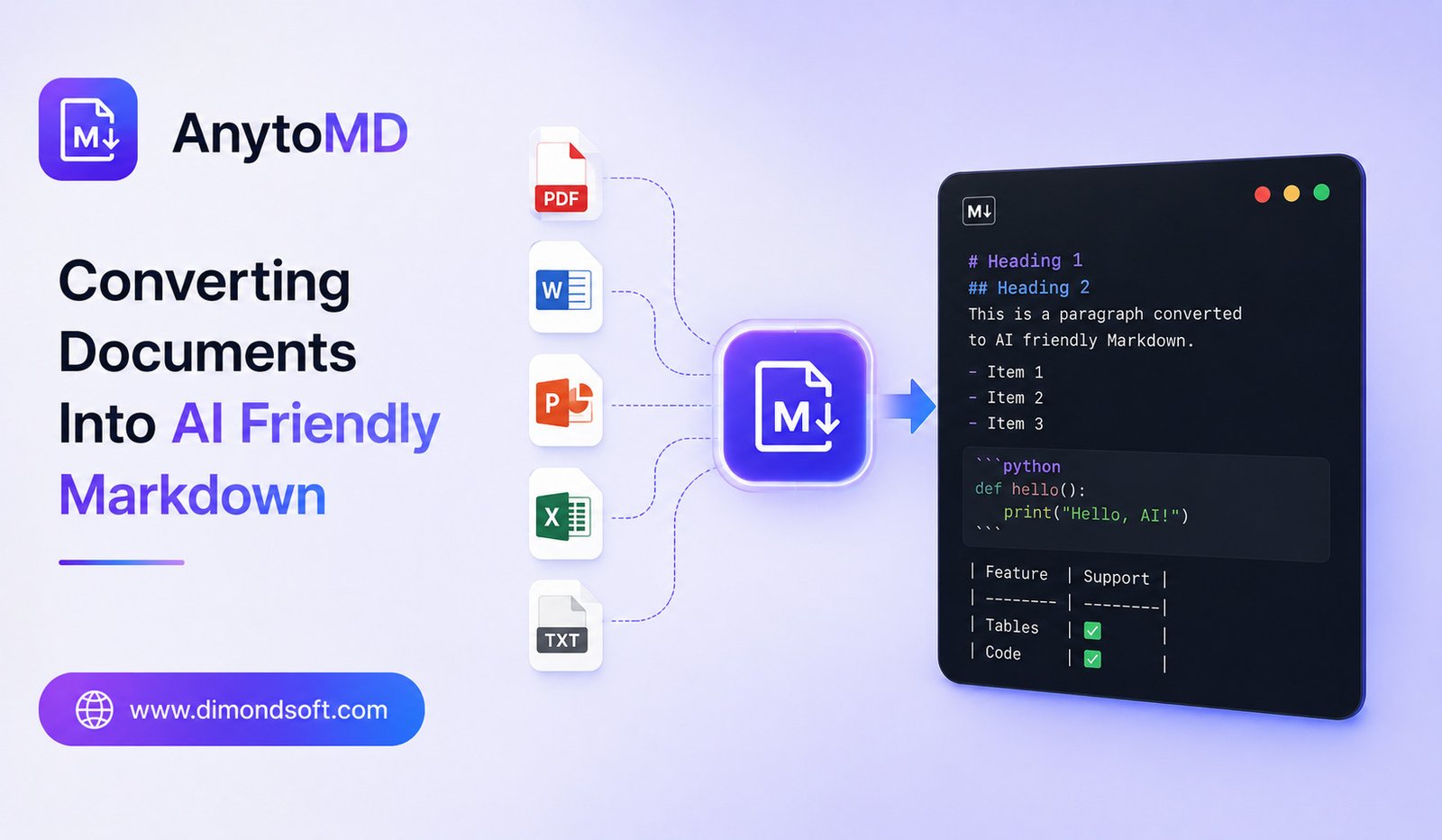
AnytoMD represents the idea of converting documents into AI-friendly Markdown. By turning information into a structured, text-based format, the content can become easier for AI systems and developers to process, search, index, and reuse.
What Is AnytoMD?
AnytoMD can be understood as a document-conversion approach focused on transforming different types of files into Markdown.
Markdown is a lightweight text format that uses simple characters to represent headings, lists, links, tables, emphasis, and other structures.
For example, a traditional document might contain a large title, several paragraphs, and multiple sections.
When converted into Markdown, the structure can become much clearer:
# Main Heading
## Section Heading
Paragraph text
– List item
This simplicity makes Markdown popular among developers and increasingly useful in AI workflows.
Why AI Needs Structured Documents
Large language models work with text and other forms of machine-readable information.
The quality of the information provided to an AI system can influence the quality of its output.
A poorly extracted document may lose important relationships between headings, paragraphs, tables, and lists.
For example, a PDF might visually display a table correctly to a human reader.
But when its contents are extracted as plain text, the rows and columns may become mixed together.
An AI model receiving that broken structure may misunderstand the information.
Converting documents into cleaner Markdown can help preserve important relationships.
From Human-Readable to AI-Friendly
Most business documents are created for people.
They use visual formatting to communicate structure.
A large font might indicate a title.
Bold text might indicate an important point.
A page break might separate sections.
A table might organize numerical information.
AI systems often need that structure represented explicitly.
Markdown provides a simple way to communicate many of these relationships.
A heading becomes a heading.
A list becomes a list.
A table becomes a structured table.
This makes the document easier for software to process.
Why Markdown Is Useful for AI
Markdown has several characteristics that make it attractive for AI workflows.
It is lightweight.
It is easy for humans to read.
It is easy for software to parse.
It preserves basic document hierarchy.
It works well with version-control systems.
It can be stored alongside source code and other digital assets.
Most importantly, Markdown avoids much of the unnecessary formatting information found in traditional document files.
This can make the underlying content easier to work with.
Converting PDFs Into Markdown
PDFs are one of the most common document formats used by businesses.
They are excellent for preserving visual layouts, but extracting their contents programmatically can be challenging.
A PDF may contain multiple columns, embedded fonts, images, tables, headers, footers, and page numbers.
A document-conversion tool can extract the meaningful content and reconstruct it as Markdown.
For example, a report containing:
Title → Introduction → Subsections → Tables → Conclusion
can be represented as a structured Markdown document.
This makes the information easier to pass into AI pipelines.
Word Documents and Markdown
Word files are widely used for business documentation.
They may contain headings, paragraphs, lists, hyperlinks, tables, and other formatting.
Converting these documents into Markdown can create a simpler representation.
This is useful when organizations want to move information from traditional office documents into AI-powered systems.
For example, a company could convert internal documentation into Markdown before adding it to a knowledge base.
The original document remains useful for human distribution, while the Markdown version becomes useful for machine processing.
Converting Presentations
Presentations can also contain valuable information.
A PowerPoint deck might include slide titles, bullet points, tables, speaker notes, and other text.
When converted into structured Markdown, each slide can potentially become a clearly separated section.
This makes the content easier to index and search.
For example:
Slide 1 — Company Overview
Slide 2 — Product Strategy
Slide 3 — Market Analysis
Slide 4 — Financial Outlook
An AI system can then process the presentation as structured information rather than relying entirely on its original visual layout.
Tables Are Especially Important
Tables can be difficult for document-processing systems.
A human can quickly understand that a number belongs to a particular row and column.
Poor extraction can destroy this relationship.
Markdown supports simple table structures that can preserve those relationships more clearly.
For example:
| Product | Price | Availability |
| Product A | ₹500 | Available |
| Product B | ₹750 | Limited |
This structure is easier for both humans and software to interpret.
Preparing Documents for RAG Systems
One major application for document conversion is retrieval-augmented generation, commonly known as RAG.
RAG systems allow AI applications to retrieve relevant information from external knowledge sources before generating an answer.
Companies can use RAG for internal knowledge bases, customer support, documentation, research, and other applications.
The quality of the retrieved information depends heavily on how the source documents are processed.
Clean Markdown can provide a useful intermediate format before documents are chunked, indexed, and stored in a retrieval system.
Better Document Chunking
AI applications often divide large documents into smaller pieces called chunks.
These chunks are then indexed so that relevant sections can be retrieved later.
Document structure matters during this process.
A chunk containing a heading and the paragraphs belonging to that heading is generally more meaningful than a random block of extracted text.
Markdown headings can provide useful boundaries.
For example:
# Product Information
followed by several paragraphs gives an AI system a clear indication of what those paragraphs are about.
This can improve the organization of knowledge during processing.
Building AI Knowledge Bases
Businesses are increasingly creating internal AI knowledge systems.
These systems may contain:
- Employee guides
- Product documentation
- Training materials
- Company policies
- Technical manuals
- Research reports
- Customer-support information
Before this information reaches an AI application, it often needs to be cleaned and structured.
Converting documents into Markdown can be one part of that preparation process.
The cleaner the source material, the easier it can be to search and retrieve relevant information.
Supporting AI Agents
AI agents often need access to external information.
A coding agent may need technical documentation.
A customer-support agent may need company policies.
A research agent may need reports and studies.
If those resources are stored in structured Markdown, agents can potentially retrieve and process them more efficiently.
This makes document conversion an important component of broader agentic AI workflows.
Markdown and Developer Workflows
Markdown is already common in software development.
Developers use it for README files, technical documentation, project notes, API documentation, and knowledge bases.
This creates an additional advantage.
AI-ready Markdown can fit naturally into existing development environments.
A company can store its documentation alongside code, track changes using version control, and allow AI tools to access the same structured information.
This creates a bridge between traditional documentation and AI-powered development.
Version Control and Document History
Traditional office documents can be difficult to compare across versions.
Markdown files are text-based, making changes easier to track.
For teams managing frequently updated documentation, this can be valuable.
Developers can see which lines changed and understand how a document evolved.
AI systems can also work with these version-controlled documents as part of automated workflows.
Reducing Unnecessary Formatting
Traditional documents often contain formatting information that isn’t important to an AI model.
Font sizes, margins, page positioning, decorative elements, and complex layout instructions may have little value when the goal is understanding the content.
Markdown removes much of this visual complexity.
The result is a cleaner representation focused on information and structure.
This can make document-processing pipelines simpler.
AI-Friendly Doesn’t Mean AI-Only
An important point is that Markdown isn’t exclusively for artificial intelligence.
People can read Markdown too.
A well-structured Markdown document is often easier for humans to understand than a large document containing complicated formatting.
This makes it useful as an intermediate format.
A company could maintain a Markdown knowledge base that supports both human developers and AI applications.
Improving Search and Retrieval
Structured content can also help with search.
When documents contain clear headings and organized sections, search systems can identify relevant portions more easily.
For example, a query about pricing can be associated with a section specifically titled “Pricing.”
This can make knowledge retrieval more precise.
Combined with semantic search, structured Markdown can become a useful foundation for AI-powered information systems.
Handling Images and Visual Content
Not all document information is text.
Documents may contain charts, diagrams, screenshots, logos, and photographs.
A conversion workflow needs to determine how such content should be handled.
Some images can be represented using links or references.
Charts may require additional processing if their data is important.
This is one reason document conversion isn’t simply a matter of changing a file extension.
The goal is to preserve the information that matters.
Document Conversion Challenges
No conversion system is perfect.
Complex layouts can produce extraction errors.
Tables may require correction.
Images can lose context.
Headers and footers may be accidentally treated as content.
Scanned documents may require optical character recognition before their text can be converted.
Therefore, converted documents should be checked when accuracy is important.
AI-friendly formatting is useful only when the underlying information remains reliable.
Benefits for Businesses
Businesses can benefit from document conversion in several ways.
They can create cleaner knowledge bases, improve AI search, simplify documentation, and prepare information for RAG systems.
It can also make company information easier to reuse across different AI tools.
Instead of keeping valuable information locked inside individual document formats, organizations can create structured versions that work across modern AI workflows.
Benefits for Developers
Developers building AI applications often need a reliable way to ingest documents.
Markdown can serve as a practical intermediate format.
It is simple to store, inspect, edit, process, and integrate with software.
This can reduce the complexity of building document-processing pipelines.
Developers can also manually inspect converted files when debugging AI retrieval problems.
The Future of AI-Ready Documents
As AI becomes more deeply integrated into business software, document structure will become increasingly important.
Organizations won’t only ask:
“Where is our information stored?”
They will also ask:
“Can our AI systems understand and use it?”
This creates a growing need for machine-friendly documentation.
Tools such as AnytoMD represent this shift from documents designed primarily for visual presentation toward information designed to be both human-readable and machine-accessible.
Final Thoughts
AnytoMD represents the growing need for converting documents into AI-friendly Markdown.
Traditional formats such as PDFs, Word documents, and presentations remain essential for human communication, but their complex structures can create challenges for AI applications.
Markdown provides a lightweight alternative that preserves important elements such as headings, lists, links, tables, and document hierarchy.
This can make information easier to process for RAG systems, AI agents, knowledge bases, search tools, and developer workflows.
The future of AI isn’t only about better models. It is also about better information.
When documents are clean, structured, searchable, and easy for machines to understand, AI systems have a stronger foundation for producing useful results.
For businesses building AI-powered workflows, converting existing documents into structured formats such as Markdown could therefore become an increasingly valuable step in preparing their knowledge for the AI era.