
Understanding how customers will respond to a product, advertisement, website, or business idea is one of the biggest challenges for companies. Businesses spend significant amounts of time conducting surveys, analyzing customer feedback, running focus groups, and testing marketing campaigns before making important decisions.
Artificial intelligence is introducing another way to explore customer behavior: AI personas.
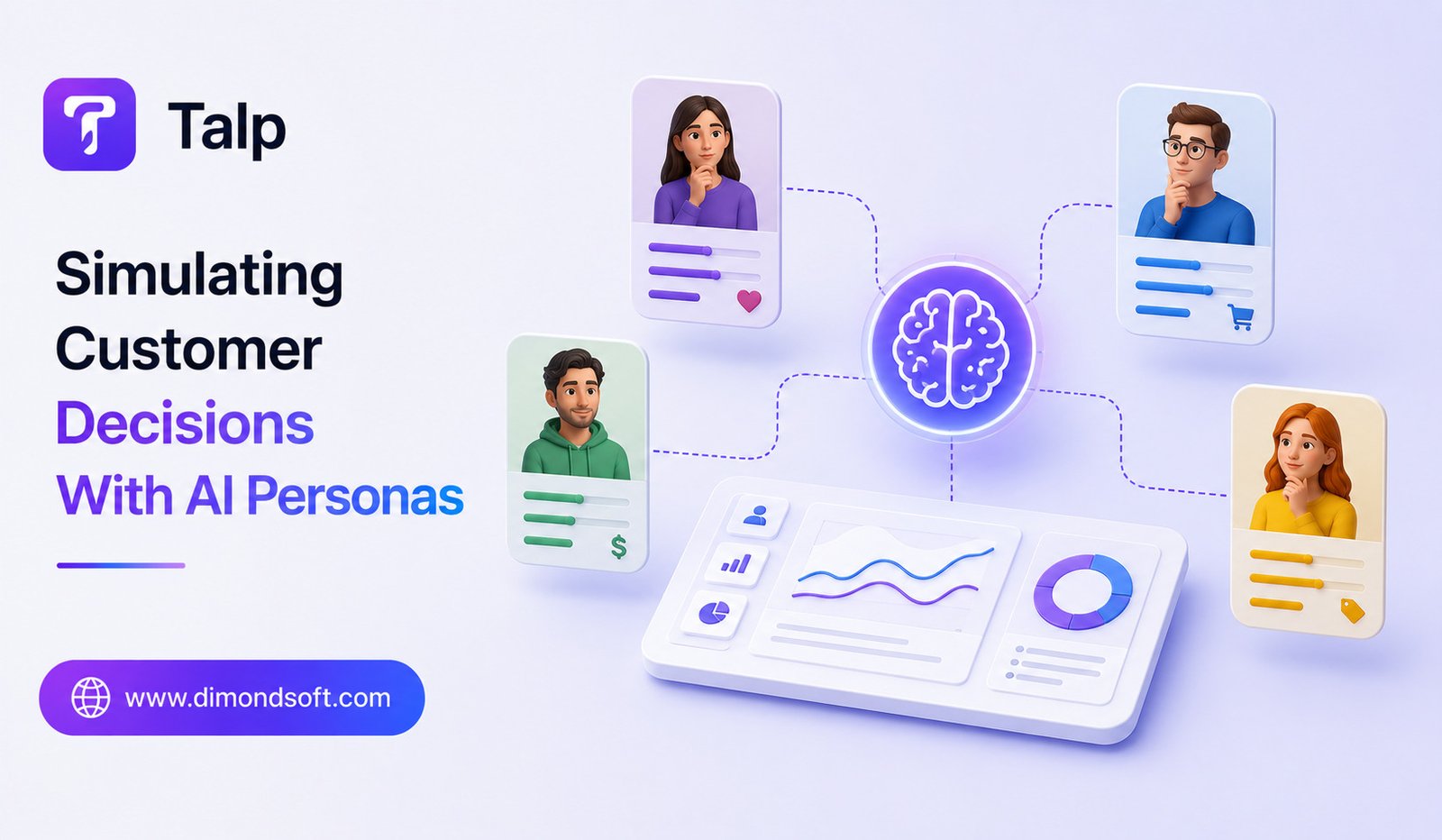
Instead of relying only on historical data or asking real customers every question, companies can use AI-powered personas to simulate different customer perspectives. These digital personas can be given characteristics such as demographics, preferences, goals, concerns, and purchasing motivations.
Talp represents this emerging approach to simulating customer decisions with AI personas. The idea is to create virtual representations of potential customers and use them to explore how different audiences might react to products, messaging, pricing, and business decisions.
While AI personas cannot replace real customers, they can potentially provide an additional layer of experimentation before a company invests heavily in a new idea.
What Is Talp?
Talp can be understood in the context of AI-powered customer simulation.
A traditional market research process might involve identifying a target audience, recruiting participants, conducting interviews, collecting responses, and analyzing the results.
An AI persona-based approach creates simulated customer profiles that can be used for preliminary testing.
For example, a company launching a productivity application might create several personas:
A price-conscious student
A busy small-business owner
A technology-focused professional
A manager looking for team collaboration tools
Each persona can be asked to react to the same product or marketing message.
The differences between their responses can help businesses explore potential customer concerns and motivations.
Why Simulate Customer Decisions?
Businesses make decisions under uncertainty.
Before launching a product, a company may wonder:
Will customers understand the value?
Is the pricing attractive?
Which features matter most?
What objections might buyers have?
Which message is likely to generate interest?
AI personas can provide a fast way to explore these questions.
Instead of testing only one idea, a team can simulate several alternatives and compare the responses.
This makes AI personas particularly useful during early-stage experimentation.
How AI Personas Work
An AI persona is more than a simple fictional character.
A useful persona can be given a structured profile containing information about its potential needs, preferences, goals, limitations, and decision-making context.
For example:
Persona: Small-business owner
Goal: Reduce administrative work
Concern: Limited budget
Priority: Ease of use
Buying behavior: Prefers simple tools with clear pricing
The AI can then evaluate a product from this perspective.
Another persona might prioritize advanced features over price.
Comparing these simulated perspectives can reveal how different customer segments may respond.
Simulating a Buying Journey
Customer decisions usually happen in stages.
A potential buyer may first become aware of a product, research it, compare alternatives, consider the price, and eventually decide whether to purchase.
AI personas can potentially simulate this journey.
A workflow could look like:
Awareness → Interest → Research → Comparison → Objection → Purchase Decision
At each stage, the persona can identify questions or concerns.
This can help businesses understand where potential customers might lose interest.
Testing Product Ideas
One of the most useful applications is testing a product concept before development is complete.
Imagine a startup has an idea for a new mobile application.
The team could present the concept to several AI personas and ask questions such as:
“Would you use this product?”
“What problem does this solve for you?”
“What would stop you from trying it?”
“What feature would make it more valuable?”
“Would you pay for it?”
The answers don’t represent real market demand, but they can help identify assumptions that deserve further investigation.
Testing Marketing Messages
Marketing teams constantly experiment with headlines, advertisements, landing pages, and promotional messages.
AI personas can provide a quick way to compare alternatives.
Suppose a company has three possible advertising messages.
The team can ask different personas to evaluate each message.
One persona may find the first version clear.
Another may consider it too technical.
A third may think the message doesn’t explain the product’s value.
This can help marketers identify potential weaknesses before launching a campaign.
Website and Landing Page Testing
Websites are another area where AI personas can be useful.
A company may want to know whether visitors will understand what the business offers.
An AI persona can review a landing-page concept and respond from a particular customer perspective.
It might identify questions such as:
What does this product do?
Who is it for?
Why should I trust this company?
How much does it cost?
What happens after I sign up?
These insights can help teams improve clarity.
However, actual usability testing with real people remains important.
Simulating Pricing Reactions
Pricing is often one of the hardest decisions for a new business.
Companies want to know how customers may react to different price points.
AI personas can simulate conversations around pricing.
For example, a business could test:
₹499 per month
₹799 per month
₹999 per month
Different personas can explain whether each price seems affordable, expensive, reasonable, or difficult to justify based on the assumptions built into their profiles.
This can help companies explore positioning.
It cannot establish the actual willingness to pay of a real market.
Understanding Customer Objections
Customers often have objections that businesses don’t anticipate.
They may worry about price, complexity, security, reliability, switching costs, or whether a product will actually solve their problem.
AI personas can be asked to actively challenge a product.
For example:
“Give me three reasons why you would not buy this.”
This can produce a useful list of potential objections.
Sales and marketing teams can then prepare better responses.
Comparing Competitors
AI personas can also be used to compare products.
A simulated customer can be given information about several alternatives and asked to evaluate them.
For example, a persona might compare:
Price
Features
Ease of use
Customer support
Brand reputation
Integration options
This can help companies think about competitive positioning.
Again, the quality of the result depends on the accuracy of the information given to the AI.
Creating Multiple Customer Segments
Businesses rarely have one type of customer.
A product may appeal to several different groups.
AI personas can represent these segments individually.
For example, an online education platform might create personas for:
College students
Working professionals
Career changers
Business owners
Each group may have different motivations.
Students might prioritize affordability.
Professionals might prioritize flexibility.
Career changers might focus on job outcomes.
Understanding these differences can help companies develop more targeted messaging.
AI Personas for Product Development
Product teams can use simulated customers during feature planning.
Suppose developers are considering ten potential features.
Instead of automatically building all of them, the team can ask different personas which features appear most valuable.
The simulated responses can help prioritize questions for further research.
This can potentially reduce wasted development effort.
The key is to treat the output as a hypothesis rather than proof.
AI Personas and User Experience
User experience design depends on understanding how people interact with products.
AI personas can simulate possible user journeys.
For example, a persona could be asked to walk through the process of signing up for a service.
It might identify confusing steps or unnecessary questions.
Designers can use this feedback to create hypotheses for real usability testing.
This can make early design exploration faster.
Benefits for Startups
Startups often have limited budgets for market research.
They may not have enough resources to conduct large-scale surveys or focus groups for every product decision.
AI personas can provide a low-cost way to explore assumptions.
A founder can test multiple product concepts and identify potential questions before spending heavily on development.
This can be particularly useful during brainstorming and early validation.
However, startups should not mistake AI simulations for actual customer validation.
Speaking to real potential customers remains essential.
Benefits for Larger Businesses
Large companies can use AI personas as an additional research layer.
They may already have customer data, surveys, interviews, and behavioral analytics.
AI personas can help teams explore scenarios based on that information.
For example, a company could use different simulated profiles to brainstorm potential reactions to a new product launch.
This can complement existing research methods.
The Importance of Good Persona Design
AI personas are only as useful as their underlying assumptions.
If the persona is vague, its responses may be generic.
If the persona contains unrealistic characteristics, the simulation may be misleading.
Businesses should define personas carefully.
Useful information can include:
- Customer goals
- Common frustrations
- Buying motivations
- Budget considerations
- Product familiarity
- Preferences
- Possible objections
- Decision-making factors
The persona should represent a plausible customer segment rather than a fictional stereotype.
AI Personas Are Not Real Customers
This is one of the most important limitations.
AI personas generate simulated responses.
They do not possess real purchasing intentions, personal experiences, or genuine financial consequences.
A simulated customer saying “I would buy this” doesn’t mean real customers will purchase the product.
AI personas can be influenced by the information provided to them and by patterns learned during model training.
Therefore, they should be used for exploration and hypothesis generation, not as a replacement for market validation.
Avoiding Confirmation Bias
Another challenge is confirmation bias.
If a business creates an AI persona using assumptions that already favor its product, the resulting responses may reinforce those assumptions.
For example, describing a persona as highly interested in a particular technology makes positive reactions more likely.
A better approach is to deliberately include skeptical personas.
Ask them to challenge the product.
Ask what would prevent them from buying.
Ask what competitors might do better.
This can produce more useful insights.
Combining AI With Real Customer Research
The strongest approach is often a combination of methods.
AI personas can help businesses explore ideas quickly.
Surveys can measure opinions across larger groups.
Interviews can provide deeper qualitative insights.
Usability testing can reveal real interaction problems.
Sales data can show actual purchasing behavior.
AI simulation can sit alongside these methods rather than replace them.
Measuring the Quality of Simulations
Businesses should also evaluate whether AI personas are producing useful insights.
One approach is to compare simulated predictions with actual customer research.
If AI personas consistently identify concerns that later appear in real customer interviews, they may be useful for that particular workflow.
If their predictions are consistently inaccurate, the persona design or methodology needs improvement.
This creates a feedback loop.
Real-world evidence can gradually improve how simulated customers are designed.
The Future of AI Customer Simulation
AI personas could become increasingly sophisticated.
Future systems may incorporate structured customer research, behavioral data, product information, and historical interactions.
Instead of asking a generic AI model what customers might think, companies could build richer simulations based on clearly defined evidence.
This could allow businesses to explore thousands of potential scenarios before conducting real-world tests.
The technology could become especially valuable for early-stage product design and marketing experimentation.
Final Thoughts
Talp represents the growing trend of simulating customer decisions with AI personas.
AI-powered customer simulations can help businesses explore product concepts, test marketing messages, analyze objections, compare pricing ideas, evaluate user experiences, and think through different buying journeys.
The biggest advantage is speed.
Companies can test multiple hypotheses quickly before investing significant time and money in real-world experiments.
But AI personas should not be treated as actual customers. Their responses are simulations, not proof of market demand.
The most effective approach is to use AI personas as an early research and brainstorming layer, followed by real customer interviews, surveys, usability tests, and behavioral data.
As AI becomes better at modeling different perspectives, simulated customers could become a valuable tool for helping businesses ask better questions before making important product and marketing decisions.