
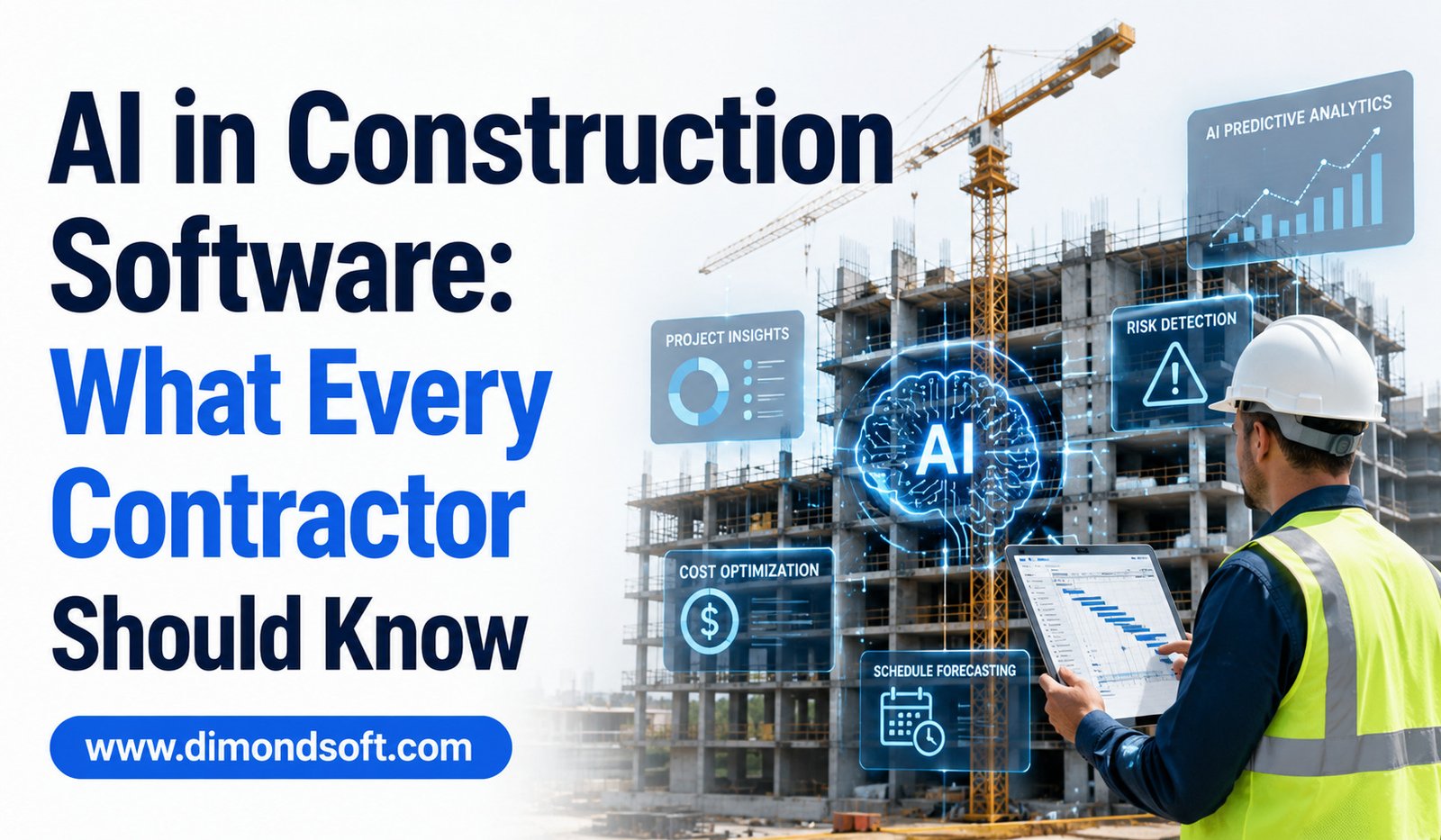
Artificial intelligence is changing how construction companies plan, manage, and complete projects. What once depended heavily on spreadsheets, phone calls, manual calculations, and individual experience is increasingly supported by intelligent construction software. For contractors, this shift is not simply about adopting a new technology. It is about finding practical ways to improve estimating, scheduling, budgeting, communication, safety, and project performance.
AI in construction software uses technologies such as machine learning, predictive analytics, automation, computer vision, and natural language processing to analyze project information and assist teams with everyday decisions. These capabilities can help contractors identify risks earlier, reduce repetitive work, and gain better visibility into project performance.
However, AI is not a replacement for experienced contractors and project managers. Instead, it works best as a decision-support tool that combines data-driven insights with professional judgment. Understanding what AI can realistically do is therefore essential before investing in new construction technology.
What Is AI in Construction Software?
AI in construction software refers to intelligent features that analyze project data and automate or improve specific construction processes. The software can examine information from estimates, schedules, budgets, documents, equipment, jobsite reports, and other sources to identify patterns and provide useful recommendations.
For example, an AI-powered estimating system may compare historical project information with current plans to help identify potential cost issues. Scheduling software can analyze dependencies and suggest adjustments when delays occur. Document management tools can quickly locate information across large collections of project files.
The important point is that AI is becoming part of existing construction workflows rather than functioning as a completely separate system. Contractors can use these capabilities alongside traditional estimating, project management, accounting, and field operations.
How AI Can Help Contractors
One of the biggest advantages of AI is its ability to process large amounts of information much faster than manual methods. Construction projects generate substantial data, and contractors often have limited time to review it.
AI can help in several important areas:
- Estimating and bidding: AI can analyze historical costs, quantities, labor information, and project details to support more consistent estimates.
- Scheduling: Intelligent systems can identify scheduling conflicts, analyze dependencies, and highlight activities that could affect completion dates.
- Cost control: AI can monitor budgets and project spending to identify unusual patterns or potential overruns.
- Risk management: Software can analyze project information to flag conditions associated with delays, cost increases, or other risks.
- Document management: AI can search contracts, specifications, drawings, reports, and other documents to find relevant information quickly.
- Field operations: Computer vision and mobile applications can help teams monitor progress, identify site conditions, and improve communication between office and field personnel.
These applications do not eliminate the need for human oversight. Instead, they reduce the amount of time contractors spend searching for information and performing repetitive analysis.
AI-Powered Construction Estimating
Estimating is one area where AI can provide significant value. Preparing an accurate estimate requires contractors to review drawings, specifications, quantities, labor requirements, material costs, subcontractor information, and historical project data.
AI-enabled estimating software can assist with quantity takeoffs, cost comparisons, historical analysis, and identifying missing information. By learning from previous projects, some systems can help contractors recognize patterns that may otherwise be overlooked.
This can make the estimating process faster, but contractors should not assume that an AI-generated estimate is automatically accurate. Construction projects are highly dependent on local labor rates, material availability, site conditions, design changes, and contract requirements.
The best approach is to use AI to accelerate the estimating process while allowing experienced estimators to review assumptions and make final decisions.
Smarter Construction Scheduling
Project delays can quickly increase labor costs, equipment expenses, and overhead. Scheduling software enhanced with AI can help contractors understand how different activities influence one another.
AI can evaluate schedules and project data to identify potential bottlenecks. When a task is delayed, intelligent software may help determine which downstream activities could be affected. This gives project managers an opportunity to respond before a small issue becomes a major disruption.
AI can also support schedule forecasting by comparing current project performance with historical patterns. Contractors can use these insights to make more informed decisions about labor allocation, sequencing, and deadlines.
Still, schedules must reflect real-world conditions. Weather, subcontractor performance, inspections, material deliveries, and unexpected site conditions can change quickly. Human experience remains essential when interpreting AI-generated recommendations.
Improving Project Cost Management
Profitability depends heavily on controlling project costs. Even small errors in labor, materials, change orders, or purchasing can affect the final margin.
AI-based construction software can analyze financial information and compare actual performance with budgets and forecasts. When spending patterns change unexpectedly, the system can help bring attention to areas requiring investigation.
For example, if labor costs on a project are increasing faster than expected, an AI system may highlight the trend earlier than a traditional monthly review. A project manager can then investigate whether the increase is caused by productivity problems, schedule changes, overtime, or another factor.
This proactive approach can help contractors address financial problems before they become difficult to correct.
AI and Construction Safety
Safety is another area where technology can provide valuable support. Construction sites contain constantly changing conditions, making it difficult for supervisors to monitor everything manually.
Computer vision systems can analyze images or video to identify certain safety conditions, such as missing protective equipment or restricted-area issues. Other software can analyze incident records and historical data to identify patterns associated with safety risks.
However, AI should support rather than replace safety professionals. Construction safety involves human behavior, site-specific circumstances, regulations, training, and judgment. Technology can identify potential concerns, but qualified personnel must evaluate those concerns and determine appropriate action.
Better Document and Communication Management
Construction projects involve contracts, drawings, specifications, change orders, RFIs, inspection reports, invoices, schedules, and countless messages. Finding the right information can consume significant amounts of time.
AI-powered document tools can make this process easier by allowing users to search and analyze large volumes of project information. Natural language processing can help software understand questions and locate relevant content without requiring users to remember exact file names or keywords.
This can improve communication between contractors, architects, engineers, subcontractors, and owners. Faster access to reliable information can also reduce misunderstandings and help teams make decisions with greater confidence.
What Contractors Should Consider Before Adopting AI
AI software can be useful, but contractors should avoid choosing a platform simply because it advertises artificial intelligence. The technology should solve a genuine business problem.
Before investing, contractors should consider whether the software integrates with existing systems, how easily employees can use it, what data it requires, and whether the provider offers reliable support.
Data quality is particularly important. AI systems depend on the information they receive. If historical project data is incomplete, inconsistent, or inaccurate, the resulting recommendations may also be unreliable.
Contractors should also examine security and data ownership. Construction projects often contain confidential financial information, contracts, designs, and client details. Understanding how software providers store, process, and protect this information is essential.
The Human Role Still Matters
One of the biggest misconceptions about AI is that it will completely automate construction management. In reality, construction remains a people-centered industry.
Experienced contractors understand site conditions, customer expectations, subcontractor relationships, practical building methods, and unexpected challenges that may not appear in a database. AI can identify patterns and provide recommendations, but it does not possess the full context of every project.
The strongest results come from combining AI capabilities with human expertise. Contractors can let software handle repetitive analysis while professionals focus on negotiation, problem-solving, leadership, and critical decisions.
The Future of AI in Construction
AI adoption is likely to expand as construction software becomes more connected. Future systems may provide more accurate forecasting, automated reporting, real-time risk detection, intelligent resource planning, and deeper integration between office and field operations.
The construction companies that benefit most will not necessarily be those that adopt the most AI tools. They will be the companies that identify meaningful problems and apply technology where it can create measurable improvements.
Contractors should therefore approach AI as a long-term business tool rather than a temporary trend. Starting with a specific challenge, measuring the results, and gradually expanding successful applications can make adoption more practical and manageable.
Final Thoughts
AI in construction software is changing the way contractors manage information, estimate projects, control costs, schedule work, and identify risks. Its greatest value comes from helping teams work faster and make better-informed decisions.
For contractors, the goal should not be to replace experience with artificial intelligence. Instead, AI should strengthen the capabilities of experienced professionals by reducing repetitive tasks and providing timely insights.
As construction projects become more data-driven, understanding AI will become increasingly important. Contractors who learn how to evaluate and use these tools responsibly can improve efficiency, strengthen project control, and position their businesses for a more technology-driven future.