
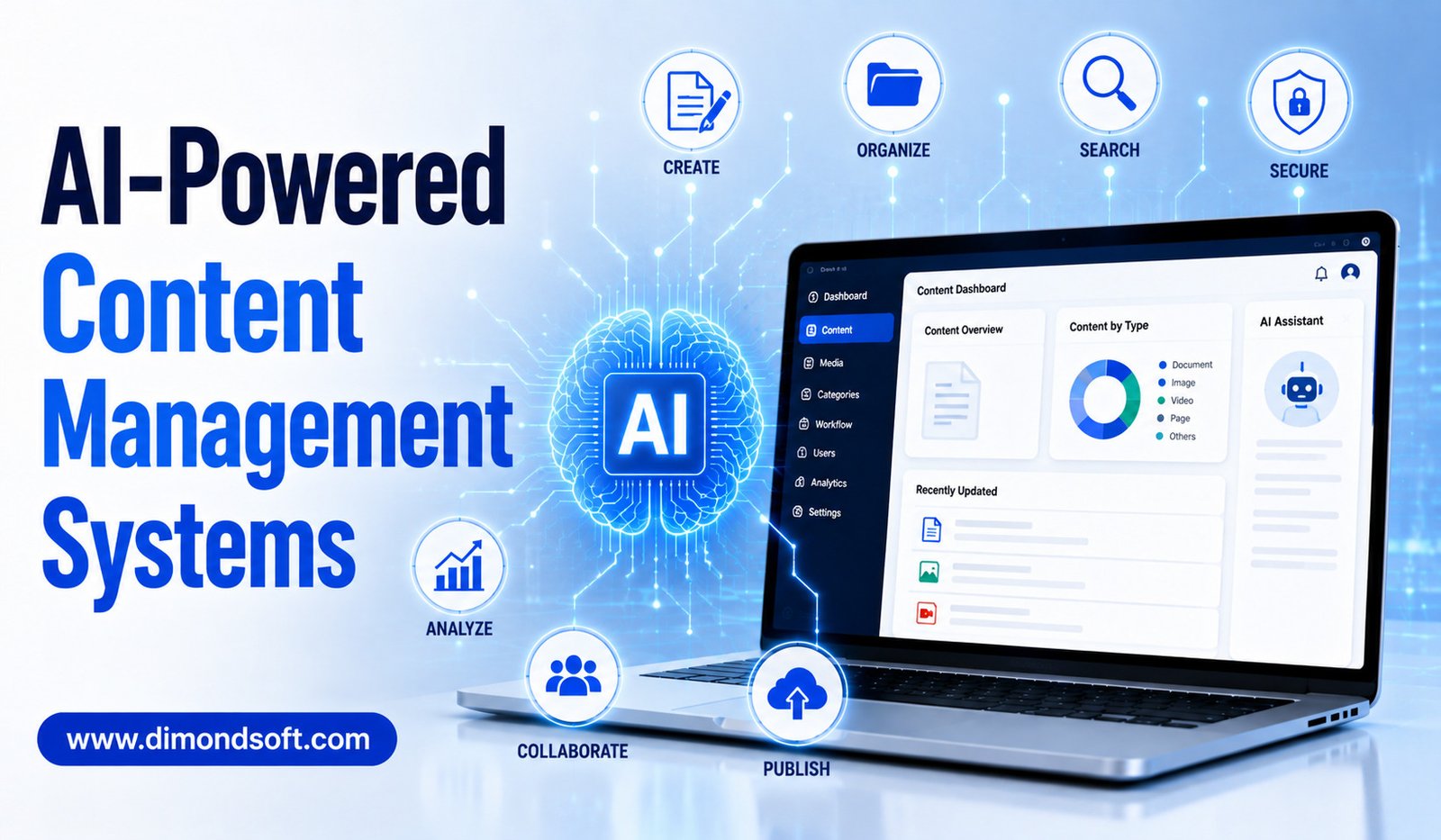
Content management systems have evolved far beyond their original purpose of storing and publishing website pages. In 2026, artificial intelligence is becoming an important part of how businesses create, organize, optimize, personalize, and distribute digital content. Modern AI-powered content management systems can assist with everything from drafting and editing to search, metadata, personalization, workflow automation, and content governance.
This shift is changing the role of the CMS from a publishing tool into a more intelligent content operations platform. Industry discussions in 2026 increasingly focus on generative AI, agentic AI, predictive analytics, structured content, and governance as major developments in content management.
For businesses managing large volumes of content, the opportunity is significant. AI can reduce repetitive work, help teams find information faster, and make it easier to deliver relevant experiences across multiple channels. However, adopting an AI-powered CMS also introduces questions around accuracy, security, human oversight, data privacy, and governance.
Understanding how these platforms work and what they offer can help businesses make better technology decisions in 2026.
What Is an AI-Powered Content Management System?
An AI-powered content management system is a CMS that incorporates artificial intelligence into content creation, organization, optimization, search, personalization, or publishing workflows.
A traditional CMS primarily allows users to create pages, upload media, organize content, and publish information. An AI-powered CMS adds intelligent capabilities that can analyze content and assist users with different tasks.
For example, AI may generate a first draft, summarize a long document, recommend metadata, identify related content, suggest SEO improvements, or personalize content for different audiences.
The important difference is that AI is increasingly becoming part of the CMS workflow rather than existing as a separate application. This allows content teams to use intelligent tools without constantly moving information between different platforms.
Why AI Is Becoming Important in CMS Platforms
Businesses are producing more digital content than ever. Websites, blogs, product pages, knowledge bases, social media content, email campaigns, mobile applications, and other digital channels all require regular updates.
Managing this volume manually can place significant pressure on content teams.
AI can help automate repetitive activities and provide recommendations based on available data. Research and industry analysis around 2026 CMS trends shows that organizations are moving beyond early generative-AI experiments toward broader implementations, while agentic AI and predictive analytics are also gaining attention.
The objective is not simply to publish more content. Businesses increasingly want content that is accurate, relevant, personalized, consistent, and easy to manage.
AI-Assisted Content Creation
One of the most visible AI capabilities in modern CMS platforms is content generation.
AI writing assistants can help create first drafts for blog posts, product descriptions, landing pages, email copy, FAQs, and other formats. They can also rewrite existing material, adjust tone, shorten text, expand explanations, or create alternative versions.
This can reduce the time required for repetitive writing tasks.
However, businesses should treat AI-generated content as a starting point rather than an automatic replacement for professional writers and editors. Human teams still need to check facts, brand voice, originality, context, and accuracy.
A strong workflow uses AI to accelerate production while keeping people responsible for final decisions.
Intelligent Content Optimization
Creating content is only one part of content management. Businesses also need to ensure that content is easy to understand, discoverable, and aligned with business objectives.
AI-powered CMS platforms can analyze content and provide suggestions related to readability, structure, keywords, metadata, search optimization, and other factors.
Instead of manually checking every page against a long list of requirements, content teams can receive recommendations while working inside the CMS.
This can make optimization part of the publishing workflow rather than a separate activity performed after content has already been created.
Automated Metadata and Tagging
Large content libraries can become difficult to manage when files and pages lack consistent metadata.
Manually adding tags, descriptions, categories, and other information can be time-consuming, particularly for companies with thousands of digital assets.
AI can analyze content and recommend or automatically generate metadata. This can improve organization and make internal search more effective.
Better tagging also makes content easier to reuse. Teams can locate related articles, images, documents, or product information without relying entirely on manual searches.
Automated metadata enrichment is increasingly being discussed as an important AI capability for enterprise content management.
Smarter Content Search
Searching a large content repository can be frustrating when users have to remember exact keywords or file names.
AI-powered search can make content discovery more conversational. Users may be able to ask questions in natural language and receive relevant information from the organization’s content repository.
AI can also summarize documents or surface related content, reducing the time required to review large collections.
For enterprises with extensive knowledge bases, this can be particularly valuable. Employees may be able to find answers without opening dozens of individual documents.
This development reflects a broader shift toward AI-assisted enterprise search and question-and-answer experiences within content repositories.
Personalization at Scale
Customers increasingly expect digital experiences to reflect their interests and needs. However, manually creating different versions of content for every audience can be difficult.
AI-powered CMS platforms can analyze customer behavior and available data to support personalized content recommendations.
For example, a website might present different articles, products, or messages depending on a visitor’s interests or previous interactions.
Personalization can help businesses make digital experiences more relevant while reducing the manual effort required to manage multiple content variations.
Companies still need to use customer data responsibly and provide appropriate privacy controls when implementing these capabilities.
AI and Content Repurposing
Creating a single piece of content can require significant time. AI-powered CMS tools can help transform existing material into different formats.
A long article could be converted into a short summary, FAQ, email draft, social media copy, or product explanation. A technical document could be rewritten for a general audience.
This can help businesses extend the value of existing content without recreating everything manually.
Content repurposing is especially useful for organizations that publish across multiple channels and need to maintain consistent messaging.
Workflow Automation
Content management involves many repetitive steps. Content may need to be drafted, reviewed, edited, approved, tagged, optimized, translated, and published.
AI and automation can help streamline parts of this workflow.
A CMS may identify content that needs review, suggest the next action, route material to the appropriate team member, or flag missing information before publication.
This can reduce administrative work and help content move through the organization more efficiently.
The broader direction in 2026 is moving from simple AI assistance toward more coordinated content operations, where multiple systems and workflows work together.
Agentic AI and the Future of CMS
A major development in 2026 is the growing discussion around agentic AI.
Unlike a simple AI assistant that responds to individual prompts, an AI agent can potentially perform a sequence of tasks based on a defined objective.
Within content management, this could mean an AI system identifying outdated content, recommending updates, preparing revised versions, organizing metadata, or initiating an approval workflow.
This creates significant opportunities but also introduces additional governance requirements. When AI systems can take actions rather than simply generate suggestions, businesses need clear permissions, approval processes, audit trails, and controls.
The emerging concept of AI-enabled content governance recognizes that traditional publishing permissions may not be enough when AI systems can access and modify structured content.
Headless CMS and AI
Headless CMS architecture is also becoming increasingly relevant to AI-powered content management.
A headless CMS separates content management from the presentation layer, allowing structured content to be delivered through APIs to websites, applications, mobile platforms, and other digital experiences.
This architecture can make content more reusable across channels.
When AI capabilities are added, structured content becomes even more important. AI systems need well-organized and accessible information to retrieve, analyze, and use content effectively.
Industry discussions in 2026 increasingly emphasize structured, metadata-rich content as an important foundation for AI search, retrieval, and agentic workflows.
AI-Powered Content Governance
More content and more automation create a greater need for governance.
Businesses need to ensure that AI-assisted content follows brand guidelines, legal requirements, accessibility standards, security policies, and editorial rules.
AI can help with some of these checks. A system may identify missing metadata, inconsistent language, potentially problematic wording, or content that requires human review.
However, governance should not be completely automated. Human oversight remains important for sensitive, regulated, or high-impact content.
A strong AI CMS should therefore provide controls that allow organizations to define who can create, edit, approve, and publish content.
Security and Data Privacy
AI-powered content management also raises security considerations.
CMS platforms can contain customer information, proprietary documents, product data, internal knowledge, and other sensitive material. Businesses need to understand how this information is stored and processed.
Before choosing an AI CMS, organizations should examine access controls, authentication, data protection, audit capabilities, vendor policies, and how information is used by AI models.
Companies should also be careful about sending confidential information to external AI services without understanding the applicable data policies.
Security should be considered from the beginning rather than added after implementation.
Challenges of AI-Powered CMS Adoption
AI-powered content management has clear advantages, but implementation is not without challenges.
AI-generated content can contain factual errors, outdated information, or inappropriate recommendations. Automation can also create problems when workflows are poorly designed.
Another challenge is maintaining a consistent brand identity. If multiple teams use AI tools without clear guidelines, content may become inconsistent in tone and quality.
Organizations may also face integration challenges when connecting AI capabilities with existing CMS platforms, customer data systems, analytics tools, and other business applications.
Training is equally important. Employees need to understand both the capabilities and limitations of AI.
How to Choose an AI-Powered CMS
Businesses should evaluate AI CMS platforms based on practical requirements rather than simply choosing the platform with the largest list of AI features.
Important considerations include:
- AI writing and editing capabilities
- Intelligent search and summarization
- Metadata and tagging automation
- Personalization features
- Workflow automation
- Security and permissions
- Integration capabilities
- Headless and omnichannel support
- Human approval controls
- Analytics and performance monitoring
The right platform should also fit the company’s existing content processes.
An AI feature is valuable only when it solves a genuine problem and can be integrated into everyday workflows.
The Future of Content Management in 2026 and Beyond
The CMS is increasingly becoming an intelligent layer between content teams, data, digital channels, and AI systems.
Future platforms are likely to place greater emphasis on content orchestration rather than simply content creation. AI may help organizations decide what content needs updating, where it should appear, which audiences should receive it, and how it should be adapted for different channels.
At the same time, governance will become more important as AI systems gain greater access to content repositories and workflows.
The businesses that benefit most will likely be those that balance automation with human expertise.
Conclusion
AI-powered content management systems are changing how organizations create, organize, optimize, and distribute digital information in 2026. Features such as AI-assisted writing, intelligent search, automated metadata, personalization, content repurposing, workflow automation, and predictive capabilities can help teams work more efficiently.
However, the value of an AI CMS is not measured by how much content it can generate. The real advantage comes from improving the entire content lifecycle while maintaining accuracy, consistency, security, and human oversight.
As AI continues to become embedded in content operations, CMS platforms are evolving from passive publishing systems into intelligent content management environments. Businesses that adopt these technologies strategically can reduce repetitive work, improve digital experiences, and build more scalable content operations for the future.