
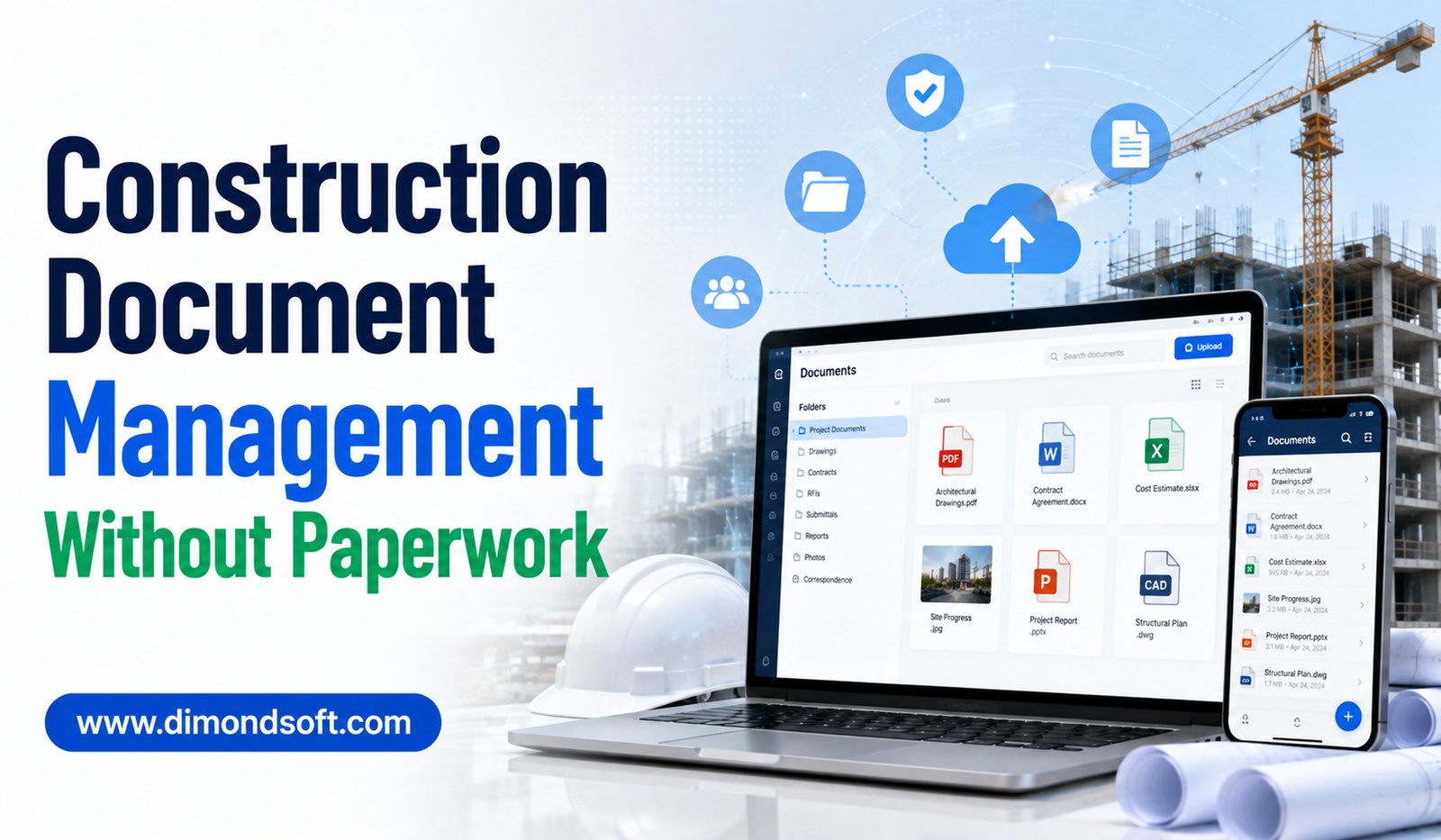
Construction projects generate a huge amount of documentation. Contracts, blueprints, permits, inspection reports, invoices, change orders, safety records, material details, daily logs, and project correspondence all need to be created, reviewed, stored, and accessed throughout a project’s lifecycle.
Traditionally, much of this information has been handled through printed documents, physical folders, filing cabinets, and manual signatures. While paper-based processes have been common in construction for decades, they can create delays, increase administrative work, and make it difficult to find important information quickly.
Digital construction document management provides a more efficient alternative. Instead of relying on physical paperwork, contractors and project teams can store, organize, share, review, and update documents through cloud-based software.
The goal is not simply to eliminate paper. A well-designed digital document management process can improve collaboration, reduce errors, strengthen document security, and give project teams better visibility into important information.
What Is Digital Construction Document Management?
Digital construction document management is the process of creating, storing, organizing, sharing, and controlling construction documents electronically.
Construction management software can provide a centralized location where project teams access the latest versions of documents. Authorized users can upload files, review changes, add comments, approve documents, and maintain records without relying on physical copies.
Instead of searching through filing cabinets or email attachments, a project manager can search the digital system for a specific drawing, contract, inspection report, or change order.
This creates a more organized approach to managing project information.
Why Construction Companies Are Moving Away From Paper
Paper documents can create several operational problems.
A document may be stored in one office while the project team needs it at a jobsite. A revised drawing may be printed and distributed, while another team continues working with an older version. Important paperwork may also be damaged, lost, or misplaced.
Paper-based communication can also slow down approvals.
Digital systems address many of these issues by allowing documents to be shared electronically. Updates can be distributed to authorized users without printing and physically delivering multiple copies.
For construction companies managing several projects at once, the time savings can be significant.
Centralizing Project Documents
One of the biggest advantages of digital document management is centralized storage.
A construction company may have hundreds or thousands of documents associated with a single project. Keeping them organized across individual computers, email inboxes, and physical folders makes information difficult to control.
A digital platform can create a dedicated project environment where documents are categorized and stored systematically.
Team members can access information according to their permissions, while managers have greater visibility over the project’s documentation.
Centralization also reduces the possibility of important information being trapped in one employee’s computer or email account.
Managing Construction Drawings
Drawings are among the most important documents on a construction project. They may go through numerous revisions as designs change.
Managing these revisions manually can be challenging.
Digital document management software can maintain drawing versions and provide clear information about revisions. Project teams can access the latest approved drawing while retaining earlier versions for reference.
This helps reduce the risk of workers or subcontractors using outdated information.
Drawing management can also make collaboration easier because authorized team members can review files from offices, mobile devices, or jobsites.
Version Control Prevents Confusion
Version control is essential for construction documentation.
A project can quickly become complicated when multiple files have names such as “Plan Final,” “Plan Final 2,” and “Plan Final Updated.”
A digital document management system can automatically maintain version histories and identify changes.
This gives project teams a clearer understanding of which document is current.
If a dispute or question arises later, previous versions can also provide useful documentation about how the project information changed over time.
Faster Document Sharing
Construction projects involve many stakeholders. General contractors, subcontractors, architects, engineers, suppliers, owners, inspectors, and consultants may all need access to different documents.
Paper-based distribution can take considerable time.
Digital platforms allow authorized users to access documents from a shared environment. Instead of printing and delivering documents, project managers can share files electronically.
This can speed up communication and reduce administrative work.
It also helps teams working across different locations collaborate without waiting for physical documents to arrive.
Mobile Access at the Jobsite
Construction information is often needed where the work is happening, not just inside an office.
Mobile access allows supervisors and workers to view relevant documents from tablets or smartphones while on-site.
For example, a site manager can access a drawing while inspecting an installation or review an inspection report without returning to the office.
Mobile document access can reduce interruptions and help field teams make decisions using current information.
Companies should ensure that mobile access is appropriately secured, particularly when sensitive project information is involved.
Digital Approvals and Signatures
Approvals are another area where paper can create unnecessary delays.
Contracts, purchase orders, change requests, submittals, and other documents may require multiple approvals.
Digital workflows can route documents to the appropriate people automatically.
Electronic signatures can also reduce the need to print, sign, scan, and email documents.
This can shorten approval cycles and provide an electronic record of completed actions.
Businesses should ensure that their electronic signature processes meet applicable legal and contractual requirements.
Managing Change Orders Digitally
Change orders are common in construction and can have significant financial and scheduling consequences.
A change may involve revised drawings, additional materials, labor adjustments, cost changes, and schedule modifications.
Managing these documents through paper can make it difficult to maintain a complete record.
Digital software can connect change orders with supporting documents and project records.
This creates a clearer history of what changed, who approved it, and how it affected the project.
Better documentation can also help reduce misunderstandings between project participants.
Improving Communication
Poor communication is a major source of construction delays.
When project information is scattered across different systems, employees may not know where to find the latest update.
Digital document management creates a shared source of information.
Comments, notifications, document updates, and approvals can be managed within the same environment, depending on the software.
This can reduce reliance on long email chains and make project communication easier to track.
Better Search and Document Retrieval
Finding a specific paper document can take several minutes or even hours if files are poorly organized.
Digital document management software provides search capabilities that allow users to locate documents using names, keywords, categories, dates, project numbers, or metadata.
Some modern platforms also use artificial intelligence to improve search and document classification.
Faster retrieval may appear like a small improvement, but repeated across hundreds of employees and projects, it can save substantial amounts of time.
Protecting Sensitive Construction Information
Construction documents can contain confidential information, including contracts, pricing, financial records, designs, employee information, and customer details.
Physical documents can be difficult to protect when they are copied, misplaced, or left in unsecured locations.
Digital systems can provide permissions that restrict access to authorized users.
Administrators may be able to determine who can view, edit, download, or share particular documents.
Additional security measures can include authentication, encryption, activity tracking, and backup systems.
Security settings should be carefully configured based on the sensitivity of the information.
Creating a Reliable Audit Trail
A digital document management system can provide a record of document activity.
Depending on the platform, companies may be able to see when a document was uploaded, modified, reviewed, approved, or shared.
This creates an audit trail that can be useful for project management and dispute resolution.
If a question arises about when a drawing was changed or who approved a particular document, the digital record can provide supporting information.
This level of visibility is much more difficult to achieve with traditional paper systems.
Reducing Administrative Costs
Paper does not only cost money when it is printed.
Businesses also spend money on printers, toner, storage space, filing systems, physical transportation, scanning, and administrative labor.
Digital document management can reduce many of these expenses.
There may still be costs associated with software subscriptions, implementation, training, and data storage, but companies can potentially reduce the recurring administrative burden associated with paper.
The greatest savings often come from reducing the amount of time employees spend managing documents.
Supporting Sustainability
Reducing unnecessary printing can also support environmental goals.
Large construction projects can generate substantial quantities of paperwork. Drawings may be printed multiple times, and revised versions may require additional copies.
Digital documents can reduce the amount of paper and physical storage required.
However, sustainability should be considered as part of a broader construction strategy. Digital document management is one way companies can reduce unnecessary material consumption while improving operational efficiency.
Integrating Documents With Construction Software
Document management becomes even more useful when connected with other construction software.
A company may integrate documents with project scheduling, estimating, accounting, safety, procurement, or field-management systems.
For example, a change order could be connected to relevant cost information and supporting drawings.
An inspection record could be associated with a particular project location or task.
These connections reduce duplicate data entry and create a more complete digital project record.
Challenges of Going Paperless
Moving away from paperwork is not completely effortless.
Employees who are accustomed to physical documents may need training. Older project records may also need to be scanned or digitized.
Poor file organization can create problems even in a digital environment. Simply uploading thousands of documents without a logical structure can replace paper clutter with digital clutter.
Companies should establish naming conventions, folder structures, permissions, retention policies, and document workflows before fully transitioning.
How to Start a Paperless Construction Workflow
Construction companies do not need to digitize everything overnight.
A practical approach is to begin with one project or department.
First, identify which documents create the most administrative work. These might include drawings, daily reports, inspection records, submittals, or change orders.
Choose software that supports those requirements and train the relevant employees.
The company can then refine its processes before expanding digital document management across other projects.
Regular backups and clear security procedures should be included from the beginning.
The Role of AI in Construction Document Management
Artificial intelligence is making digital document management more capable.
AI can help classify files, extract information, summarize lengthy documents, identify duplicate content, and improve search.
For example, a project manager may be able to search a large document repository using a natural-language question rather than remembering an exact file name.
AI can also help identify information that requires attention, although important construction decisions should continue to involve qualified professionals.
The value of AI depends on the quality of the underlying documents and the controls surrounding the technology.
Future of Paperless Construction Documentation
Construction document management will likely become increasingly connected and automated.
Cloud platforms, mobile applications, AI, electronic signatures, digital workflows, and connected project systems can create a more integrated information environment.
Instead of treating documents as separate files, future construction platforms may connect drawings, contracts, schedules, costs, inspections, and field information into a unified project record.
This can help construction companies make decisions faster and maintain better control over project information.
Conclusion
Construction document management without paperwork is about more than replacing printed documents with digital files. It represents a shift toward a more organized, accessible, and collaborative way of managing project information.
Digital document management can help contractors control drawing revisions, speed up approvals, improve communication, protect sensitive information, simplify searches, and create reliable project records.
The transition requires planning, employee training, security controls, and consistent document-management procedures. Simply purchasing software will not eliminate paperwork if teams continue following inefficient processes.
When implemented properly, however, digital document management can reduce administrative work while giving construction teams faster access to the information they need.
For contractors looking to improve productivity and modernize project operations, moving toward a paperless document environment can be an important step toward a more efficient and connected construction workflow.