
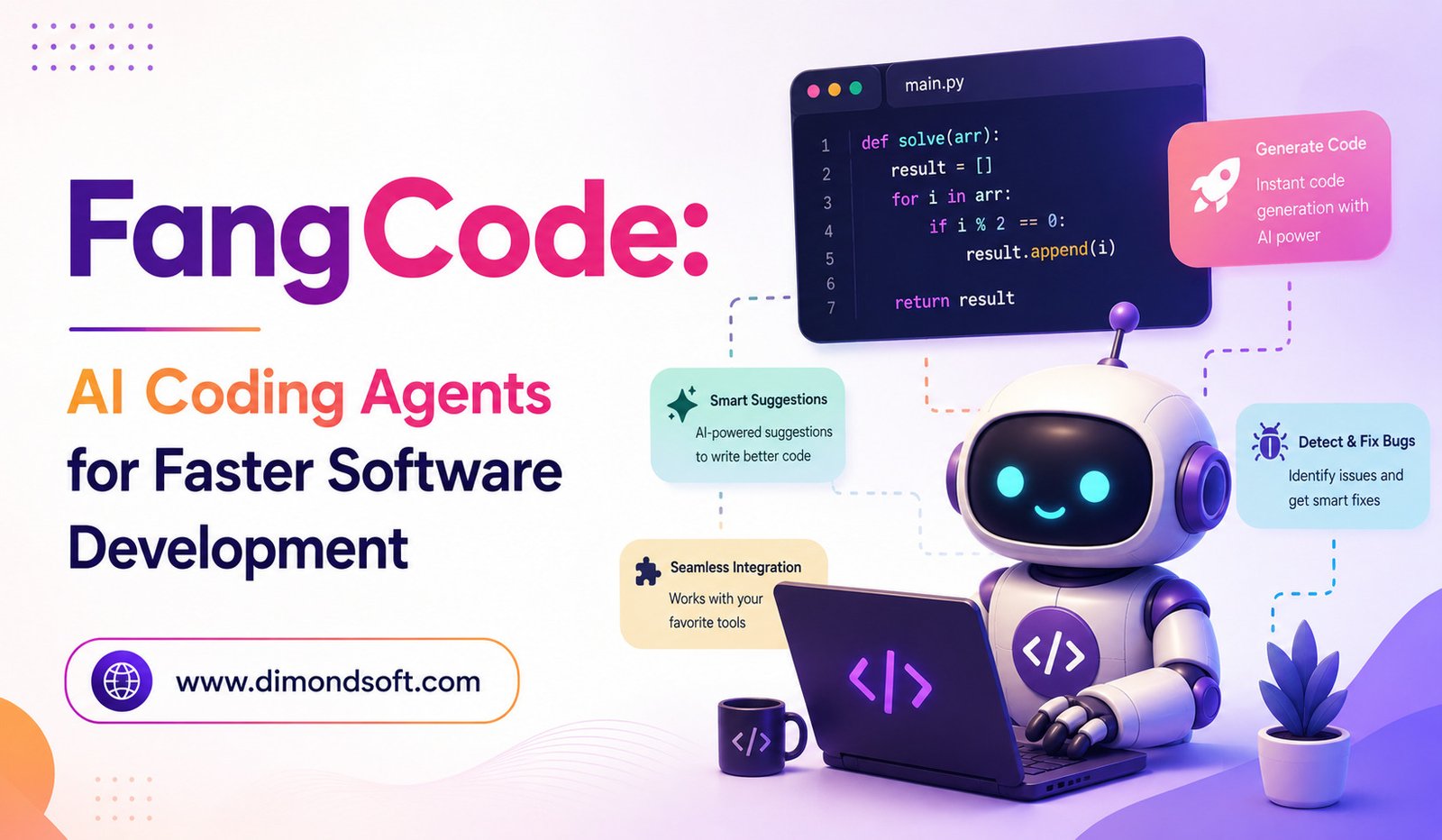
Software development has changed dramatically with the rise of artificial intelligence. Developers once had to write almost every line of code manually, search documentation for solutions, and spend hours debugging technical problems. Today, AI coding tools can assist with many of these activities, helping development teams move from an idea to working software more quickly.
FangCode fits into the growing category of AI coding agents designed to support software development. Instead of functioning only as a chatbot that answers programming questions, an AI coding agent can be designed to understand development tasks, work with code, and help developers complete multi-step programming workflows.
For startups, freelancers, professional engineering teams, and individual developers, this technology could make software development faster while changing how programmers interact with their tools.
What Is FangCode?
FangCode can be understood as an AI-powered coding agent concept focused on helping developers create and modify software more efficiently.
Traditional coding assistants generally provide suggestions when a developer asks a question or begins writing code. AI coding agents take a more task-oriented approach.
A developer can describe an objective, such as creating a feature, fixing a bug, refactoring part of an application, or adding tests. The AI agent can then help break the task into smaller steps and work through the development process.
This approach moves AI from being simply an answer generator toward becoming a more active development assistant.
The developer still remains in control, but the AI can potentially handle more of the repetitive work involved in completing a programming task.
How AI Coding Agents Work
An AI coding agent typically relies on a combination of large language models, code understanding, project context, and development tools.
Instead of looking at one isolated code snippet, an agent may need to understand the relationships between multiple files and components.
For example, if a developer asks an AI agent to add a new user profile feature, the task may involve:
- Finding the relevant application components
- Understanding existing data structures
- Creating or modifying code
- Updating related interfaces
- Adding tests
- Identifying potential errors
- Reviewing the resulting changes
The ability to work across multiple steps is what makes an AI coding agent different from a simple autocomplete tool.
Faster Coding With AI
One of the clearest benefits of AI coding agents is speed.
Developers frequently write repetitive code, create similar functions, generate configuration files, and implement standard application patterns.
AI can accelerate these tasks by generating an initial implementation based on a developer’s instructions.
Instead of starting from an empty file, a programmer can review AI-generated code and modify it according to the project’s requirements.
This doesn’t mean that developers can blindly accept everything generated by AI. Human review remains necessary because generated code can contain logical errors or fail to account for specific project requirements.
However, having a useful starting point can significantly reduce development time.
AI Agents for Debugging
Debugging is another area where coding agents can be valuable.
When software fails, developers often need to trace errors through multiple files and understand how different components interact.
An AI coding agent can help investigate an issue by examining relevant code and identifying possible causes.
For example, if an application crashes after a database update, an agent could help trace the affected code paths, explain the error, and suggest possible fixes.
The developer can then test the proposed solution and determine whether it actually resolves the underlying problem.
This can turn debugging from a completely manual process into a collaborative one.
Building Features From Natural Language
Perhaps the most interesting aspect of AI coding agents is the ability to describe development requirements using natural language.
A developer could potentially say:
“Add a password reset feature that sends a verification email and allows users to create a new password.”
The AI can interpret the request and identify the technical components required.
This can make software development more accessible because the user doesn’t always need to describe every implementation detail.
However, clear instructions are still important. Developers should specify requirements, constraints, security expectations, preferred technologies, and other relevant project information whenever necessary.
The better the context, the more useful the AI’s output is likely to be.
Working With Existing Codebases
Creating a new application from scratch is only one part of software development.
Many developers spend most of their time maintaining existing applications.
Older codebases can be difficult to understand, especially when documentation is incomplete or the original developers are no longer working on the project.
AI coding agents can potentially help developers navigate these environments.
A programmer could ask the agent to explain how a particular feature works, locate relevant functions, identify dependencies, or summarize a section of the application.
This can reduce the time required to understand unfamiliar systems.
For businesses with large legacy applications, this capability could become particularly useful.
AI-Assisted Refactoring
As software evolves, code can become complicated.
Developers may eventually need to reorganize code, remove duplication, improve performance, or modernize outdated components.
Refactoring can be time-consuming because changes in one part of an application may affect other areas.
An AI coding agent can help identify opportunities for improvement and suggest alternative implementations.
For example, it might identify repeated code patterns or recommend breaking a large function into smaller components.
Developers can then review the suggestions and decide which changes make sense for the project.
Automated Testing and Quality Checks
Writing tests is essential for maintaining reliable software, but developers don’t always have enough time to create comprehensive test coverage.
AI coding agents can help generate test cases based on existing functionality.
For example, if a new function accepts user input, the AI might suggest tests covering normal inputs, missing values, invalid data, and unusual edge cases.
AI can also help developers understand failing tests and suggest potential corrections.
Testing should still be performed using reliable development and continuous-integration systems. AI-generated tests are useful assistance, but they don’t guarantee that an application is bug-free.
Benefits for Small Development Teams
Large technology companies often have specialized teams for engineering, testing, security, infrastructure, and operations.
Smaller businesses may not have the same resources.
AI coding agents could help small teams handle a wider range of development activities.
A small startup, for example, might use AI assistance for generating initial code, creating tests, preparing documentation, investigating bugs, and performing routine refactoring.
This doesn’t eliminate the need for skilled developers. Instead, it can allow a small team to spend more time on important product decisions and less time on repetitive implementation work.
Important Limitations
Despite their potential, AI coding agents are not perfect.
They can misunderstand requirements, generate incorrect code, introduce security vulnerabilities, or make changes that appear reasonable but don’t fit the application’s architecture.
Another challenge is context.
An AI agent may not fully understand undocumented business rules or assumptions embedded within an existing system.
Developers therefore need to review AI-generated changes carefully.
For critical applications, code should go through normal testing, security reviews, code reviews, and deployment procedures.
The goal should be faster development without sacrificing software quality.
Security Matters in AI-Assisted Coding
Security becomes especially important when AI systems interact with source code and development environments.
Developers should be careful about providing sensitive information such as passwords, private keys, authentication tokens, confidential customer data, or proprietary business information.
Organizations should also establish clear policies around which repositories AI tools can access and what actions agents are permitted to perform.
Giving an AI system the ability to modify files or execute commands can be powerful, but those capabilities should be controlled appropriately.
Will AI Coding Agents Replace Programmers?
AI coding agents are likely to change programming, but replacing all developers is a much more complicated question.
Writing code is only one part of software engineering.
Developers also need to understand users, define requirements, design architecture, evaluate trade-offs, manage security, test systems, and make decisions when requirements are unclear.
AI can generate an implementation, but humans still need to determine whether that implementation is appropriate.
The most realistic future is therefore likely to involve developers working alongside increasingly capable AI agents.
Programmers may spend less time typing repetitive code and more time directing AI systems, reviewing their work, and solving higher-level problems.
The Future of AI Coding Agents
The development of tools such as FangCode reflects a larger transformation in software engineering.
AI is moving from simple code completion toward more autonomous, task-oriented development assistance.
Future coding agents may become better at understanding entire repositories, planning implementation strategies, running tests, investigating failures, and making coordinated changes across multiple components.
This could make development workflows significantly more efficient.
At the same time, developers will need new skills. Understanding how to provide context, verify AI-generated code, identify mistakes, and manage AI-assisted workflows could become increasingly important.
Final Thoughts
FangCode represents the growing potential of AI coding agents for faster software development. By helping with coding, debugging, testing, code exploration, and repetitive development tasks, AI agents can potentially reduce the time required to build and maintain software.
However, speed should not come at the expense of quality or security.
The strongest approach is to treat AI as a capable development partner rather than an unquestionable programmer. Developers can use AI to accelerate implementation while retaining responsibility for architecture, testing, security, and final decisions.
As AI coding agents continue to evolve, the definition of programming itself may change. The future developer may spend less time writing every line manually and more time describing problems, guiding intelligent tools, reviewing solutions, and turning ideas into reliable software.