Software development is becoming increasingly collaborative between humans and artificial intelligence. Developers are no longer using AI only to generate small pieces of code or answer programming questions. Modern AI tools can assist with debugging, documentation, testing, research, code reviews, and other parts of the development lifecycle.
Unify represents the broader idea of using AI teammates to support software development. Instead of treating AI as a simple chatbot, the AI teammate approach focuses on giving developers intelligent assistance throughout their workflow.
For development teams dealing with tight deadlines, complex codebases, and constantly changing requirements, AI teammates could become an important part of the modern software development process.
What Is Unify?
Unify can be viewed in the context of the emerging generation of AI-powered development tools that aim to work alongside software engineers.
Traditional programming assistants generally respond to individual requests. A developer asks for a function, provides an error message, or requests an explanation, and the AI provides an answer.
The AI teammate concept goes further.
An AI teammate can potentially understand project context, help with multiple development tasks, and support developers throughout different stages of a project.
The objective isn’t necessarily to replace software engineers. Instead, AI can take responsibility for repetitive or time-consuming activities while developers focus on architecture, product decisions, problem-solving, and creative engineering work.
How AI Teammates Are Changing Software Development
Software development involves much more than writing code.
Developers spend significant amounts of time reading existing code, investigating bugs, reviewing pull requests, writing tests, documenting features, searching for information, and understanding unfamiliar systems.
AI can potentially assist across these activities.
For example, a developer working on an unfamiliar project could ask an AI teammate to explain how a particular feature works. The AI could analyze relevant code and provide a simplified explanation.
Similarly, when an error occurs, developers can use AI to investigate possible causes and suggest potential fixes.
This makes AI useful not only during coding but throughout the development lifecycle.
AI Assistance for Writing Code
Code generation is one of the most visible applications of AI in programming.
Developers can describe what they want to build using natural language and ask an AI system to produce an initial implementation.
For example, a developer might request a function that validates user input, processes data, or connects to an API.
The generated code can provide a starting point that the developer reviews and modifies.
This can reduce the amount of repetitive coding required for common programming tasks.
However, generated code should always be reviewed. AI systems can produce incorrect logic, outdated approaches, security vulnerabilities, or code that doesn’t match the project’s architecture.
The developer remains responsible for the final implementation.
Debugging With AI Teammates
Debugging can consume a large portion of a development team’s time.
A small issue may require examining logs, tracing functions, reviewing recent changes, and testing multiple possible solutions.
AI teammates can help developers investigate these problems more efficiently.
A developer can provide an error message or describe unexpected behavior and ask the AI to identify possible causes.
The AI may then suggest debugging steps, explain relevant code, or propose a potential fix.
The biggest advantage is often not that AI immediately solves every bug. Instead, it can reduce the time developers spend searching for where a problem might be located.
AI for Software Testing
Testing is another area where AI can support development teams.
Developers need to ensure that new features work correctly while existing functionality remains intact.
AI can assist with generating test cases based on application requirements or existing code. It can also help identify scenarios that developers may have overlooked.
For example, if a function handles customer registration, AI could suggest tests for valid information, missing fields, unusual input, duplicate accounts, and other edge cases.
Automated testing remains essential, but AI can make the process of creating and maintaining tests more efficient.
Understanding Large Codebases
Large software projects can contain thousands or millions of lines of code.
When developers join an existing project, understanding its architecture can take considerable time.
An AI teammate with access to appropriate project context can potentially help explain relationships between files, functions, modules, and services.
A developer might ask:
“Where is the authentication process handled?”
or
“Which components depend on this database service?”
Instead of manually searching through the entire codebase, developers could use AI to narrow down relevant areas.
This can be particularly useful when maintaining older systems where documentation may be incomplete.
AI and Code Reviews
Code reviews are an important part of professional software development.
They help teams identify bugs, maintain coding standards, improve readability, and detect potential security problems before code reaches production.
AI can provide an additional layer of review by analyzing proposed changes and highlighting possible issues.
For example, an AI system might identify duplicated logic, suspicious error handling, inefficient code, or potential security concerns.
AI review should complement human code review rather than replace it.
Experienced developers can understand product requirements, architectural trade-offs, and business context in ways an automated system may not.
Improving Developer Productivity
The strongest argument for AI teammates is productivity.
Developers frequently lose time on small tasks that are necessary but not particularly creative.
Writing boilerplate code, creating documentation, converting data formats, explaining errors, generating test templates, and searching for syntax examples can interrupt deeper work.
If an AI teammate handles some of these activities, developers can spend more time solving meaningful technical problems.
The productivity gain can be especially noticeable when AI is integrated directly into the development workflow instead of requiring developers to constantly switch between different applications.
AI Teammates and Collaboration
Software development is fundamentally a team activity.
Developers, designers, product managers, testers, and operations teams all contribute to a project.
AI teammates could potentially help improve collaboration by summarizing technical information and translating complex engineering concepts into simpler explanations.
For example, a product manager may need to understand why a particular feature requires additional development time.
An AI system could help explain the technical dependencies in more accessible language.
Similarly, developers could use AI to summarize project documentation or convert technical discussions into actionable tasks.
Security and Privacy Considerations
AI-assisted development also introduces important security concerns.
Developers may work with proprietary source code, customer information, API credentials, internal documentation, and other sensitive material.
Organizations therefore need to understand how an AI development tool handles data.
Teams should carefully review permissions, data retention policies, access controls, and organizational security requirements before connecting AI systems to private codebases.
Developers should also avoid exposing passwords, private keys, authentication tokens, or other secrets to AI systems.
Security must remain a priority even when AI is being used for productivity.
Will AI Teammates Replace Developers?
The idea of AI replacing software engineers receives significant attention, but the more immediate transformation is likely to involve human-AI collaboration.
AI can generate code quickly, but software engineering involves much more than producing syntax.
Developers must understand what should be built, why it should be built, how components should interact, what trade-offs are acceptable, and how a system should behave under real-world conditions.
Human developers remain important for architecture, judgment, security, product understanding, and accountability.
AI teammates are therefore better viewed as productivity partners than complete replacements for engineering teams.
The Future of AI-Powered Development
The role of AI in software development is likely to become increasingly sophisticated.
Today’s tools can generate code and answer programming questions. Future AI teammates may become more capable of understanding entire projects, planning development tasks, running tests, investigating failures, preparing changes, and coordinating different parts of the development workflow.
This could change the role of developers.
Instead of spending most of their time manually writing code, developers may increasingly focus on defining requirements, reviewing AI-generated work, designing systems, and managing increasingly complex software environments.
The skill of communicating clearly with AI could become another important part of software engineering.
Final Thoughts
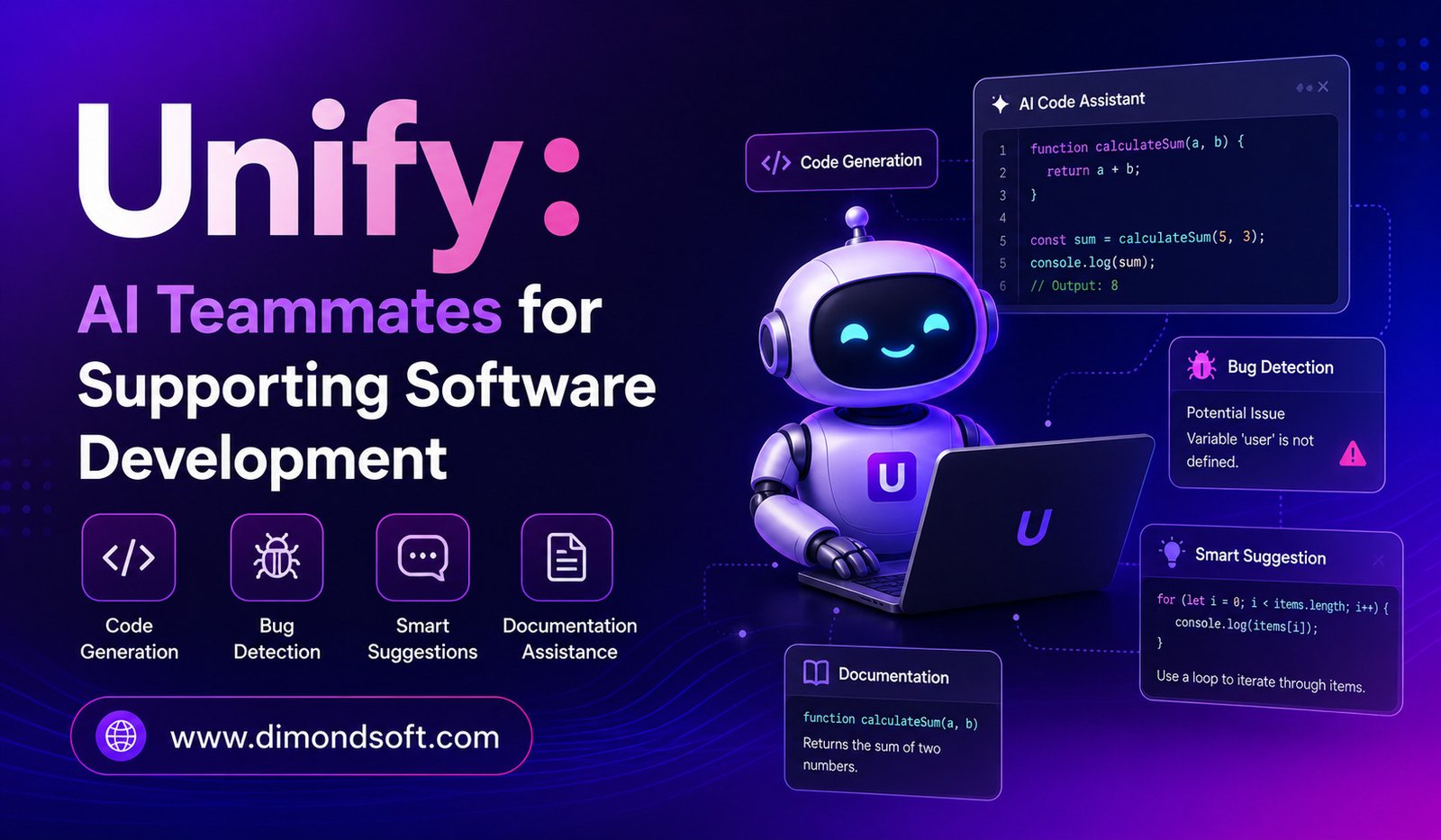
Unify reflects a broader movement toward AI teammates for software development. The concept goes beyond basic code generation by imagining AI as a collaborative partner that can assist with coding, debugging, testing, documentation, code understanding, and other engineering tasks.
The greatest value may come from combining AI’s speed with human expertise.
AI can handle repetitive work and quickly explore possible solutions, while developers provide judgment, creativity, architectural thinking, and accountability.
As these systems continue to improve, software development could become less about manually completing every technical step and more about directing, reviewing, and collaborating with intelligent digital teammates.