
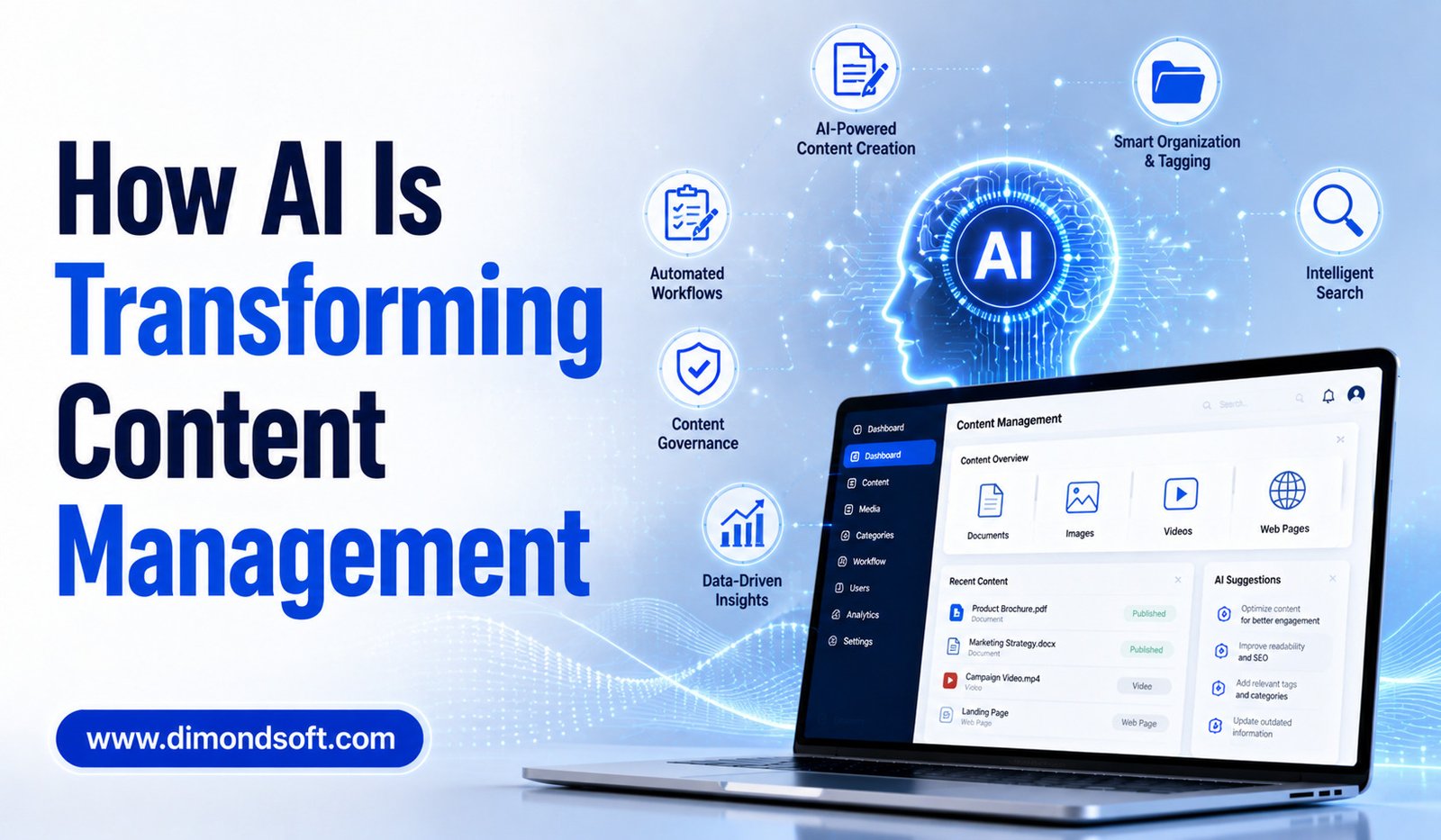
Artificial intelligence is changing the way businesses create, organize, manage, and distribute digital content. Content management has traditionally involved writing, editing, categorizing, publishing, updating, and storing information across websites and other digital channels. Many of these activities require significant amounts of manual work, particularly for organizations managing thousands of pages, documents, images, and product records.
AI is introducing a new approach. Instead of simply providing a place to store and publish content, modern content management systems can use artificial intelligence to assist with writing, search, classification, personalization, workflow automation, optimization, and content governance.
The change is important because businesses are producing more content across more channels than ever. Websites, mobile applications, social media platforms, ecommerce stores, knowledge bases, newsletters, and customer portals all require regular updates. AI can help content teams handle this growing workload while allowing employees to focus on strategy, creativity, and quality control.
However, AI is not a replacement for human expertise. Its greatest value comes from combining automated capabilities with human judgment. When implemented carefully, AI can make content management faster, more organized, and more scalable.
What Does AI Mean for Content Management?
AI in content management refers to the use of technologies such as machine learning, natural language processing, generative AI, computer vision, and predictive analytics to improve content-related processes.
Traditional CMS platforms primarily help users create pages, organize files, and publish information. AI-powered systems can go further by understanding the content itself.
For example, an AI system can analyze an article and suggest tags, summarize its main points, recommend related content, identify optimization opportunities, or generate a draft based on a specific requirement.
This makes the CMS more than a storage and publishing system. It becomes an intelligent assistant that can support different stages of the content lifecycle.
AI Is Changing Content Creation
Content creation is one of the most obvious areas where artificial intelligence is having an impact.
Generative AI can produce initial drafts for blog posts, product descriptions, landing pages, emails, FAQs, social media posts, and other formats. Content teams can provide instructions about a topic, audience, tone, or format and use the output as a starting point.
This can reduce the time required to move from an idea to a draft.
AI can also help with rewriting. Existing content can be shortened, expanded, simplified, or adapted for different audiences.
However, automated content still requires editorial review. AI-generated material can contain inaccurate information, unsupported claims, repetitive language, or content that does not reflect a company’s brand.
The most effective approach is to use AI for productivity while keeping people responsible for accuracy and final approval.
Faster Content Editing
Editing can be a time-consuming part of content production, especially when teams manage large volumes of material.
AI-powered editing tools can identify grammar problems, awkward sentences, repetition, unclear language, and inconsistencies. Some systems can also suggest changes to tone and readability.
This allows editors to spend less time identifying basic writing issues and more time improving the substance and structure of content.
For businesses with multiple contributors, AI can also help establish consistency. Content can be checked against predefined style guidelines before publication.
Smarter Content Search
Finding information becomes increasingly difficult as a company’s content library grows.
Employees may need to search through thousands of documents, articles, product records, images, and internal resources. Traditional keyword search can struggle when users do not know the exact words contained in a document.
AI can make search more contextual.
Users may be able to ask questions in natural language and receive relevant results based on meaning rather than exact keyword matches. AI can also summarize information from multiple documents, helping users understand the answer without opening every file individually.
For large organizations, intelligent search can turn a massive content repository into a more useful knowledge resource.
Automated Tagging and Classification
Organizing content manually is another area where AI can reduce repetitive work.
A large website may contain thousands of articles covering different topics, industries, products, and audiences. Assigning categories and tags to every item manually takes time and can lead to inconsistencies.
AI can analyze content and recommend classifications automatically.
For example, an article about cloud accounting software could be identified as relevant to accounting, finance technology, business software, and small businesses.
Automated classification can make content easier to find and improve the consistency of large content libraries.
AI-Powered Metadata Generation
Metadata provides information that helps systems understand and organize digital content. It may include titles, descriptions, categories, keywords, authors, dates, and other attributes.
Adding metadata manually is often tedious.
AI can examine content and suggest appropriate metadata automatically. It can generate descriptions, identify topics, recommend tags, and extract important entities.
This can improve internal search and content discovery while reducing administrative work.
For companies managing large digital asset libraries, automated metadata can be especially valuable.
Personalization at Scale
Customers do not all have the same interests or needs. A new visitor may require introductory information, while an existing customer may be more interested in advanced features or support resources.
AI can help businesses personalize content based on available behavioral and contextual data.
A website could recommend articles based on previous interactions. An ecommerce platform could highlight relevant products. A customer portal could surface support information related to a user’s activity.
Personalization becomes more practical when AI can analyze large amounts of information and identify patterns automatically.
Businesses must still use customer data responsibly and comply with applicable privacy requirements.
AI and Content Recommendations
Content recommendation systems are becoming increasingly intelligent.
Instead of simply showing the newest articles, AI can consider relationships between topics, user behavior, content performance, and other signals.
This can help businesses identify which content a visitor may find useful next.
For example, someone reading an introductory article about business accounting could be shown a related guide about financial reporting or bookkeeping software.
Better recommendations can increase engagement and help visitors discover more useful information.
Automating Content Workflows
Content management involves many steps beyond writing.
A typical process may include drafting, editing, SEO review, legal approval, translation, publishing, promotion, and periodic updating.
AI can help automate parts of these workflows.
It may identify content that needs review, flag missing information, recommend an editor, suggest publication timing, or route material to an appropriate workflow.
This reduces administrative work and helps teams manage large content operations more efficiently.
The goal is not to remove human involvement. Instead, automation can ensure that people spend their time on decisions that genuinely require human expertise.
AI Helps Identify Outdated Content
Websites often contain content that becomes outdated over time.
Old statistics, product information, service details, screenshots, links, and recommendations can reduce the usefulness of a website.
AI can analyze large content libraries and identify pages that may require review.
For example, it may detect references to old dates, discontinued products, outdated terminology, or information that has not been updated for a long period.
Content managers can then review the flagged material and decide whether it should be updated, consolidated, or removed.
This creates a more proactive approach to content maintenance.
Improving SEO Workflows
Artificial intelligence is also influencing search engine optimization.
AI-powered CMS tools can help identify keyword opportunities, analyze content structure, suggest headings, generate metadata, and improve readability.
They can also help content teams identify related topics that may be useful for building comprehensive content resources.
However, AI should not be treated as an automatic SEO strategy.
Search performance depends on many factors, including content quality, relevance, technical performance, authority, user experience, and the ability to satisfy search intent.
AI is most useful when it supports informed SEO decisions rather than encouraging businesses to publish large quantities of low-value content.
AI-Powered Image and Media Management
Content management is not limited to written text.
Businesses often maintain large libraries of photographs, videos, illustrations, product images, and other digital assets.
AI can analyze visual files and automatically identify objects, subjects, categories, and other characteristics.
This makes it easier to search large media libraries.
AI can also help generate descriptions and accessibility-related information for images, although human review remains important, particularly when accurate descriptions are essential.
Translation and Localization
Businesses operating internationally often need to publish content in multiple languages.
AI-assisted translation can accelerate the process of adapting content for different markets.
Rather than translating every piece entirely from scratch, organizations can use AI to create an initial version and have human translators review important content.
This hybrid approach can reduce turnaround time while maintaining quality.
AI can also help adapt content to different regional audiences, but cultural context and local language preferences still require human expertise.
Predictive Content Analytics
Traditional analytics show what happened. AI can help businesses identify patterns and potentially predict what may happen next.
A content management system can analyze performance data to identify which topics, formats, or pages are attracting attention.
These insights can help teams decide what content to update or produce next.
For example, if AI detects that certain topics consistently generate high engagement, the content team may decide to create related resources.
Predictive analytics can therefore connect content management with broader business strategy.
AI and Content Governance
As AI becomes more involved in content creation, governance becomes increasingly important.
Businesses need to establish rules for accuracy, brand voice, copyright, privacy, security, and human approval.
AI-generated content should not automatically be published simply because it was produced quickly.
Companies may establish different levels of review depending on the content. Routine marketing material might require basic editorial checks, while financial, medical, legal, or technical information may require significantly stronger human oversight.
AI can assist with governance by flagging potential problems, but organizations remain responsible for their publishing decisions.
Security and Privacy Concerns
AI-powered content management can involve sensitive business and customer information.
Companies should understand how their CMS provider handles data, what information is processed by AI systems, who can access it, and how long it is retained.
Access controls should be carefully configured, particularly for internal documents and confidential information.
Businesses should also establish clear rules about what employees are allowed to submit to AI tools.
Security should be treated as part of the AI adoption strategy rather than an afterthought.
Challenges of Using AI in Content Management
AI can provide major efficiency improvements, but it also introduces new risks.
One challenge is accuracy. AI systems can generate convincing information that is incorrect.
Another issue is content quality. If businesses rely too heavily on automated generation, websites may become repetitive and lack genuine expertise.
There are also concerns surrounding copyright, privacy, bias, transparency, and excessive automation.
Employee training is therefore essential. Teams need to understand where AI can help, where human review is necessary, and how to use AI responsibly.
How Businesses Can Adopt AI Successfully
Organizations do not need to transform their entire content operation immediately.
A practical approach is to start with repetitive, lower-risk tasks such as metadata generation, content tagging, summarization, basic editing, or internal search.
Once employees become comfortable with these tools, companies can explore more advanced applications such as personalization, predictive analytics, and automated workflows.
Businesses should also establish clear AI guidelines covering review requirements, data security, brand standards, and acceptable use.
Measuring results is equally important. Companies should track whether AI is actually saving time, improving content quality, increasing engagement, or reducing operational costs.
The Future of AI in Content Management
AI is likely to become increasingly integrated into the entire content lifecycle.
Future systems may not simply respond to individual prompts. They may continuously monitor content libraries, identify outdated information, recommend improvements, organize digital assets, and coordinate workflows.
Agentic AI could eventually perform sequences of content-related tasks based on defined goals, with human approval at important stages.
This could make content management more proactive. Instead of waiting for employees to identify every problem, intelligent systems may continuously monitor content and recommend what needs attention.
The challenge will be balancing automation with control.
Conclusion
AI is transforming content management by making content creation, organization, search, personalization, optimization, and maintenance more efficient.
From generating first drafts and metadata to identifying outdated pages and improving internal search, AI can reduce repetitive work and help content teams manage increasingly complex digital environments.
However, successful AI adoption requires more than installing an intelligent CMS. Businesses need clear processes, strong governance, reliable data, security controls, and human oversight.
The future of content management will not be entirely automated. Instead, it will likely involve closer collaboration between people and intelligent systems. AI can handle repetitive analysis and operational tasks, while human professionals provide creativity, expertise, judgment, and accountability.
For businesses prepared to adopt this balanced approach, AI can turn content management from a largely manual publishing process into a smarter, faster, and more scalable part of digital strategy.