
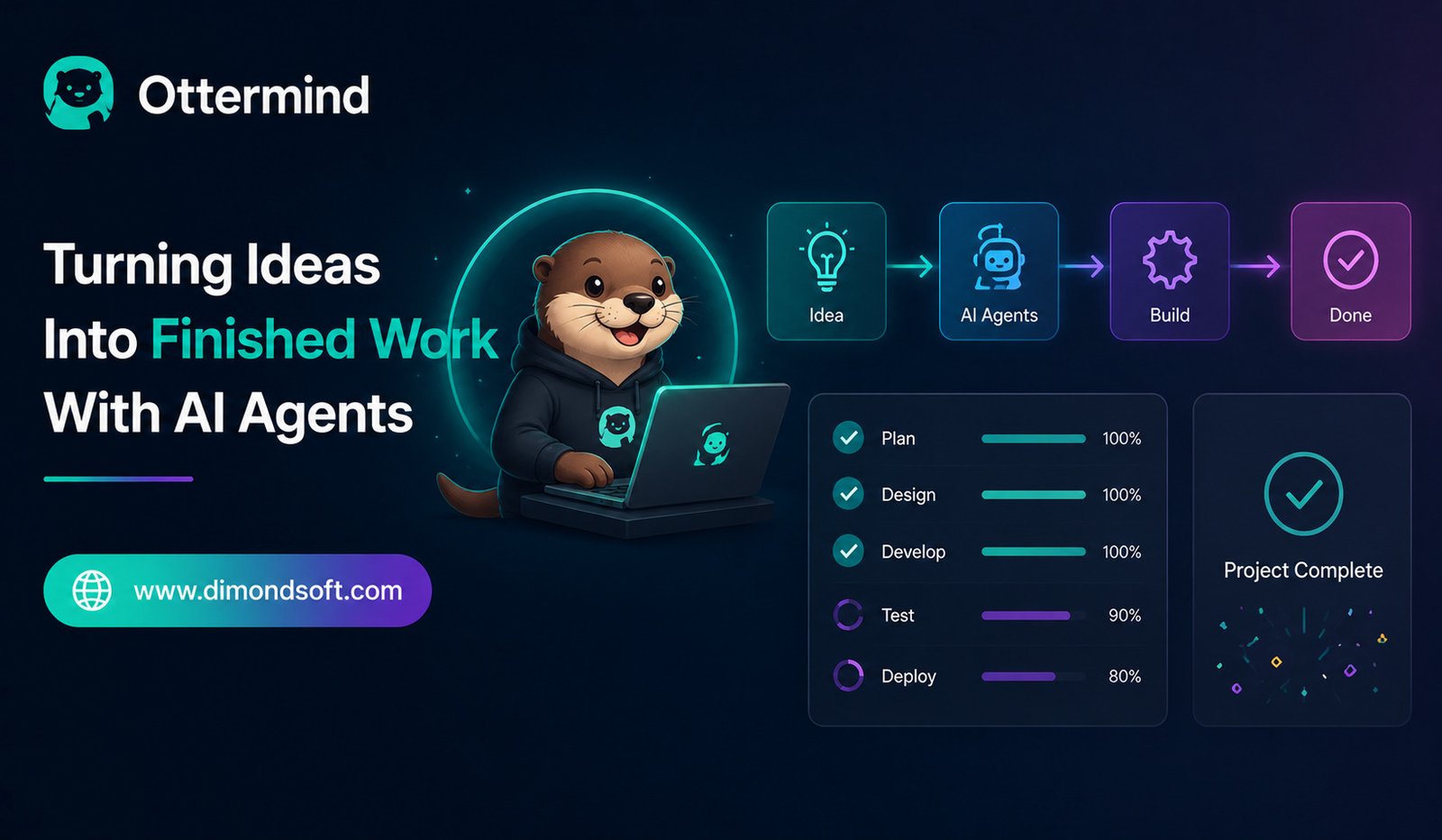
Coming up with an idea is often the easiest part of a project. Turning that idea into something finished requires planning, research, execution, communication, revisions, and follow-up. For individuals and businesses managing multiple projects at once, the gap between having an idea and completing the work can become a major challenge.
Artificial intelligence is beginning to address this gap through AI agents. Unlike traditional AI assistants that primarily answer questions or generate content, AI agents can be designed to break objectives into tasks, use tools, manage workflows, and continue working toward a defined outcome.
Ottermind represents this emerging approach to using AI agents to turn ideas into finished work. The concept focuses on moving beyond simple suggestions and helping transform an initial idea into a structured, actionable result.
What Is Ottermind?
Ottermind can be understood as an AI-agent approach to project execution.
Traditional AI tools are often reactive. A user asks a question, receives an answer, and decides what to do next.
AI agents can take a more active role.
Given a clear objective, an agent can potentially break the goal into smaller tasks, gather information, organize resources, perform actions, and track progress.
For example, instead of asking an AI to suggest a marketing campaign, a user could provide the goal of launching a campaign and allow an agent-based workflow to help organize the research, content, scheduling, and follow-up activities.
The key idea is execution rather than just ideation.
Why Turning Ideas Into Work Is Difficult
Businesses and individuals rarely suffer from a lack of ideas.
The bigger problem is execution.
A new product idea may require market research, competitor analysis, product planning, design, development, testing, and marketing.
A content idea may require research, writing, editing, images, publishing, and promotion.
Without a structured workflow, promising ideas can remain unfinished.
AI agents can help address this problem by breaking large objectives into manageable steps.
From a Goal to an Action Plan
One of the first things an AI agent can do is turn a broad objective into a plan.
Suppose a business owner says:
“I want to launch a new online service.”
That statement doesn’t provide enough information to execute the project directly.
An agent could help identify the major areas involved:
Research → Define audience → Plan service → Build assets → Launch → Measure results
Each stage can then be divided into smaller tasks.
This makes a large project easier to manage.
The human still defines the desired outcome, while AI helps structure the path toward it.
AI Agents and Task Decomposition
Complex projects contain dependencies.
One task often needs to be completed before another can begin.
For example, a product launch may require market research before finalizing the target audience.
The target audience may need to be defined before creating advertising campaigns.
AI agents can potentially analyze these relationships and organize tasks accordingly.
This process is known as task decomposition.
Instead of trying to solve an entire project in one step, the agent approaches it as a sequence of smaller objectives.
This can make complex work more manageable.
Research as Part of Execution
Research is often one of the most time-consuming parts of a project.
Businesses may need to examine competitors, industry trends, customer feedback, pricing, market information, and existing documentation.
AI agents can assist by gathering and organizing information from approved sources.
For example, an agent working on a product research project might collect competitor information and summarize important differences.
The resulting research can then become an input for the next stage of the workflow.
Human review remains important because AI-generated research can contain inaccuracies or misunderstand sources.
AI Agents That Use Tools
The real power of an AI agent comes from its ability to use tools.
An agent can potentially interact with applications, databases, search systems, documents, APIs, project-management platforms, and other software.
This means the agent isn’t limited to generating text.
For example, an agent could research information, create a project task, organize a document, prepare an email draft, and update a workflow.
The exact capabilities depend on the systems connected to it and the permissions provided.
Turning Content Ideas Into Published Material
Content creation provides a simple example of an idea-to-execution workflow.
A user might provide an idea for an article.
An AI agent could help with:
Topic research → Outline → Draft → Editing → SEO review → Image requirements → Publishing preparation
The agent can handle repetitive parts of the workflow while the human reviews the final material.
This can make content production more systematic.
For businesses publishing frequently, the biggest benefit may come from creating a repeatable process rather than generating one article faster.
Product Development Workflows
AI agents can also support software projects.
A founder may have an idea for a new application but not know where to begin.
An agent could help break the concept into product requirements and development tasks.
For example:
Product idea → User requirements → Feature list → Development tasks → Testing → Deployment
Coding agents can potentially handle some implementation work, while other agents or tools focus on research, planning, testing, or documentation.
This creates the possibility of an AI-assisted development team.
Human developers remain important for architecture, security, complex engineering decisions, and quality assurance.
Business Operations
AI agents can also be used for routine business operations.
Consider an employee who receives a request that requires information from several systems.
A traditional workflow might require manually opening different applications, searching for information, copying results, and preparing a response.
An AI agent could potentially coordinate these steps.
For example:
Receive request → Retrieve information → Analyze data → Prepare result → Request approval → Complete task
This can reduce repetitive administrative work.
Managing Multi-Step Projects
Projects often change as they progress.
A task may fail.
New information may appear.
A deadline may move.
An AI agent designed for longer workflows needs to respond to these changes rather than blindly following an original plan.
This is where agent-based systems differ from simple automation.
Traditional automation generally follows predefined rules.
AI agents can potentially interpret new information and determine the next appropriate step.
However, this flexibility also introduces risk.
Agents need boundaries, permissions, and clear instructions.
Human Approval and Control
AI agents should not automatically receive unlimited authority.
Some actions have significant consequences.
Sending an internal message may be relatively low risk.
Purchasing an expensive product, deleting data, changing financial records, or modifying production infrastructure is very different.
A well-designed agent workflow should include approval checkpoints for important actions.
For example, an agent might prepare a purchase order but require a manager to approve it before submission.
This creates a balance between automation and human control.
Measuring Progress
Turning ideas into finished work requires more than completing individual tasks.
Teams need to know whether the overall objective is being achieved.
AI agents can potentially summarize progress and identify remaining work.
For example, an agent managing a launch project could report that research and content preparation are complete while advertising setup and final testing remain.
This gives users a clearer view of project status.
The system becomes not only an execution tool but also a project-management assistant.
Reducing the Gap Between Planning and Execution
Traditional productivity tools often separate planning from execution.
One application may contain the project plan.
Another may contain documents.
Another may handle communication.
Another may contain data.
The user has to move between these systems.
AI agents could potentially connect these activities.
Instead of simply displaying a checklist, an agent can help perform the tasks represented on that checklist.
This creates a more action-oriented approach to productivity.
Benefits for Small Teams
Small businesses often have limited staff.
One person may handle marketing, operations, customer service, and administration.
AI agents can potentially provide additional operational capacity.
A small team could use agents for research, reporting, content preparation, scheduling, customer communication, and other repetitive work.
This doesn’t necessarily mean replacing employees.
Instead, AI can help small teams accomplish more without adding manual workload for every new project.
Challenges of AI Agent Execution
AI agents are not perfect.
They can misunderstand objectives, choose inappropriate actions, make incorrect assumptions, or produce inaccurate information.
Long workflows also create more opportunities for errors.
The more actions an agent can take, the more important monitoring becomes.
Businesses should therefore start with well-defined, lower-risk workflows and gradually expand agent permissions as reliability improves.
Testing, logging, approval systems, and clear instructions can all help reduce risk.
Security and Permissions
An AI agent may need access to business systems to complete tasks.
This creates security considerations.
Agents should receive only the permissions necessary for their responsibilities.
A marketing agent doesn’t necessarily need access to financial records.
A customer-support agent shouldn’t automatically have permission to modify sensitive account information.
Role-based access and activity monitoring can help businesses control what agents are allowed to do.
The Future of AI-Powered Work
The broader idea behind Ottermind points toward a major change in productivity software.
AI may gradually move from being a tool that helps people think about work to a system that helps them complete work.
Instead of asking:
“How should I do this?”
Users may increasingly be able to say:
“Here is the outcome I want. Help me get it done.”
The AI can then organize the required steps, use available tools, and return to the human when a decision or approval is needed.
This could change how project management, business operations, and personal productivity work.
Final Thoughts
Ottermind represents the growing idea of turning ideas into finished work with AI agents.
The biggest opportunity isn’t simply generating more ideas. It is reducing the amount of effort required to move from an idea to a completed result.
AI agents can potentially help with planning, research, task management, tool usage, content creation, software development, and business operations.
At the same time, successful agent-based workflows require clear goals, appropriate permissions, reliable information, monitoring, and human oversight.
As AI agents become more capable, the distinction between an AI assistant and an AI worker may become increasingly important.
The future of productivity could involve people defining what they want accomplished, while AI agents handle more of the steps required to turn those ideas into reality.