
Artificial intelligence assistants have become useful for writing, research, coding, planning, and everyday productivity. However, most AI tools are designed around short interactions. You ask a question, receive a response, and start another conversation when you need help again.
A new generation of AI systems is exploring a different model: persistent AI teammates that can remain available, remember ongoing work, and assist with tasks over longer periods.
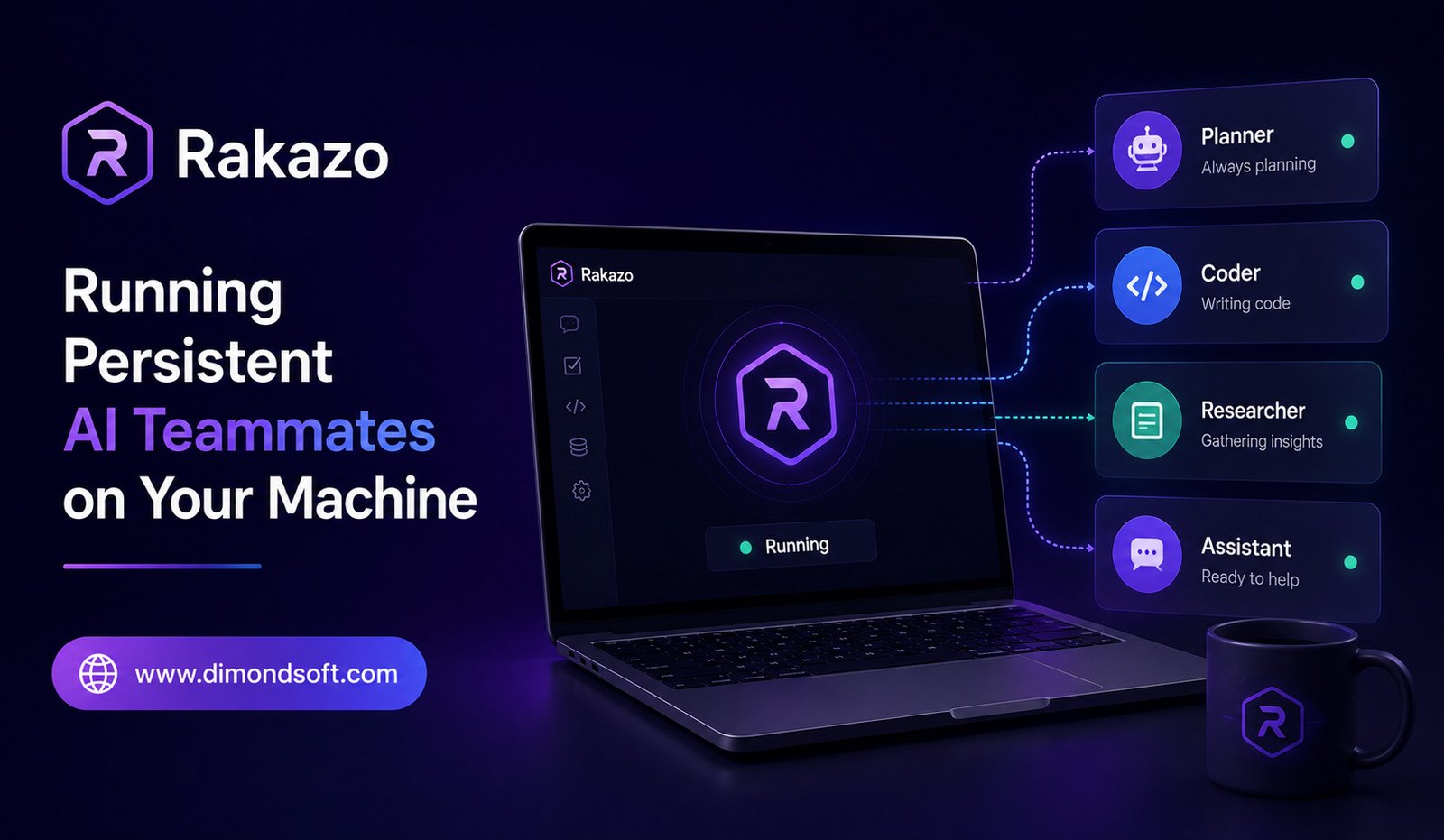
Rakazo represents this emerging idea of running persistent AI teammates directly on your own machine. Instead of treating AI as a temporary chatbot, the concept is closer to having digital collaborators that stay connected to your projects and work environment.
This approach could be particularly interesting for developers, entrepreneurs, researchers, and professionals who want AI assistance that fits into their existing workflow.
What Is Rakazo?
Rakazo can be understood as a platform or approach for running persistent AI teammates on a personal computer.
Traditional AI assistants usually require users to open an application, provide context, and start a conversation.
Persistent AI teammates work differently.
They can be designed to remain available for ongoing tasks and maintain context around a project.
For example, a developer might have an AI teammate focused on coding, another on research, and another on documentation.
Instead of recreating the context every time, these AI workers can operate as continuing participants in a workflow.
What Does “Persistent AI” Mean?
Persistence is an important distinction.
A temporary AI session may only know what is included in the current conversation.
A persistent AI teammate can potentially retain relevant information about an ongoing project, depending on how memory is implemented.
Imagine working on a software project for several weeks.
A persistent AI teammate could potentially understand the project’s goals, previous tasks, technical decisions, and outstanding work.
This creates a more continuous relationship between the user and the AI system.
The objective is to reduce the need to repeatedly explain the same background information.
Why Run AI Teammates on Your Own Machine?
One of the most interesting aspects of Rakazo’s concept is local execution.
Cloud-based AI services are convenient because most of the infrastructure is managed by the provider.
However, sending data to external servers isn’t always ideal for every workflow.
Running AI-related processes locally can offer greater control over the environment and the information being accessed.
For developers and businesses working with private code, internal documents, or proprietary projects, local infrastructure can be attractive.
The exact privacy and security benefits depend on how the local system, models, integrations, and data storage are configured.
AI Teammates Instead of AI Chatbots
The difference between an AI chatbot and an AI teammate is primarily about workflow.
A chatbot generally waits for a prompt.
An AI teammate can be designed around an ongoing responsibility.
For example:
Chatbot: “Write a summary of this report.”
AI teammate: “Monitor the project documents, summarize important changes, and prepare updates when needed.”
The second approach is more persistent and task-oriented.
It treats AI as part of a workflow rather than a question-and-answer interface.
Multiple AI Teammates for Different Roles
A single AI assistant doesn’t have to handle every task.
A team of specialized AI agents can divide responsibilities.
For example, a software project might have:
Coding teammate: Helps with implementation.
Research teammate: Finds and organizes information.
Testing teammate: Reviews functionality and identifies possible issues.
Documentation teammate: Maintains technical documentation.
Each teammate can have different instructions and responsibilities.
This resembles the way human teams divide work according to expertise.
Persistent AI for Software Development
Developers are one of the groups that could benefit from persistent AI teammates.
Software projects generate continuous work.
New features need to be implemented, bugs need to be investigated, tests need to be written, and documentation needs to be updated.
A persistent AI teammate can potentially remain connected to the project and help with recurring responsibilities.
For example, an AI coding teammate might understand the project’s structure and help developers investigate a bug without requiring the entire codebase and context to be explained from scratch each time.
Human developers remain responsible for reviewing and approving important changes.
AI Teammates for Research
Research is another area where persistence can be useful.
A research project may continue for weeks or months.
Information is gathered gradually, sources are evaluated, notes are organized, and conclusions evolve over time.
A persistent AI research teammate could potentially maintain a structured knowledge base around the project.
Instead of starting every research session from zero, the user can continue from previous work.
This could make long-term research workflows more efficient.
Personal Knowledge Management
People often collect large amounts of information.
Documents, notes, bookmarks, emails, project files, and research materials can become difficult to organize.
A persistent AI teammate could potentially act as an intelligent layer over this information.
For example, users could ask questions about their own project materials without manually searching through every document.
This is particularly useful when information is spread across many files.
However, local AI systems still need carefully designed indexing and retrieval mechanisms to provide accurate results.
Working Alongside Existing Applications
AI teammates become more useful when they can interact with the tools people already use.
Depending on the system, an AI worker could potentially interact with:
- Files
- Code repositories
- Databases
- Development tools
- Project-management systems
- Local applications
- APIs
The more tools an agent can use, the more tasks it can potentially complete.
But greater access also means greater responsibility.
Permissions need to be carefully controlled so that an AI teammate cannot accidentally modify or expose important information.
Local AI and Data Privacy
Privacy is one of the strongest reasons businesses may consider local AI.
Organizations often work with confidential information.
This could include source code, internal documents, product plans, customer information, or business strategies.
Keeping AI processing closer to the user’s own environment can provide additional control.
However, “running locally” does not automatically guarantee complete privacy.
Users should understand where models run, whether external APIs are involved, what information is logged, and which integrations have access to data.
Privacy depends on the entire architecture.
Reducing Repeated Context
One frustrating part of working with AI is repeatedly providing context.
You might explain your project structure on Monday and have to explain it again later.
Persistent AI teammates are designed to reduce this problem.
The system can maintain relevant project information and use it in future interactions.
This makes AI feel less like a blank assistant and more like a colleague who has been working on the same project.
The quality of this experience depends heavily on how memory is stored and retrieved.
Too little memory makes the AI forgetful.
Too much irrelevant information can make responses confusing or inefficient.
Running AI Continuously
Persistence also raises an important technical question: how does the AI continue operating?
A persistent teammate may need a process that remains active, scheduled tasks, event triggers, or other mechanisms that allow it to respond when something happens.
For example, an AI teammate could potentially react when a new file appears, a project task changes, or a development event occurs.
This turns AI from a tool that is manually activated into something that can participate in ongoing workflows.
Autonomous Actions and Human Control
Persistent AI systems introduce a greater need for safeguards.
If an AI assistant is simply answering questions, the consequences of an incorrect response may be limited.
If an AI teammate can modify files, execute commands, communicate with people, or interact with external services, mistakes can become more serious.
A good system should therefore distinguish between actions that are safe to automate and actions that require approval.
For example, an AI teammate might draft a message automatically but require a person to approve it before sending.
Benefits for Developers
Local persistent AI teammates can offer several potential benefits to developers.
They can reduce repeated context-setting, support long-running projects, assist with routine tasks, and potentially operate closer to development environments.
Developers can also customize AI behavior according to the project.
Instead of using one generic assistant, they can create specialized teammates with different instructions.
This can make AI assistance more relevant.
Benefits for Small Businesses
Small businesses may also find persistent AI workers useful.
A company could potentially create AI teammates for content planning, customer support, internal research, documentation, or operations.
Running some workloads locally may also provide greater control over business information.
The main advantage is not necessarily replacing employees.
Instead, AI teammates can take responsibility for repetitive tasks, allowing people to concentrate on customers, strategy, creativity, and decision-making.
Challenges of Running AI Locally
Local AI also comes with trade-offs.
Running capable models can require substantial computing resources.
Performance depends on hardware, model size, optimization, and workload.
Users may also need to manage updates, storage, networking, security, and integrations.
Cloud services can sometimes be simpler because the provider handles much of the infrastructure.
Therefore, local AI isn’t automatically better for every user.
It is most attractive when control, customization, privacy, or continuous availability are particularly important.
Security Considerations
Persistent agents should be treated as software with meaningful access to a computer.
If an AI teammate can read files or execute commands, its permissions should be limited.
Users should avoid giving broad access unless it is genuinely required.
Separate environments, permission controls, logging, backups, and approval workflows can reduce potential risks.
This becomes even more important when multiple AI teammates operate simultaneously.
The Future of Personal AI Teammates
The concept of persistent AI teammates points toward a more continuous relationship between humans and AI.
Instead of opening an AI application only when assistance is needed, users may eventually have digital workers running alongside them throughout the day.
A developer could have a coding teammate monitoring a project.
A researcher could have a research teammate organizing new information.
A business owner could have an operations teammate tracking recurring tasks.
These AI systems could become part of the user’s working environment.
Final Thoughts
Rakazo represents the growing idea of running persistent AI teammates on your own machine.
The concept moves beyond conventional chatbots by giving AI a more continuous role in personal and professional workflows.
Persistent teammates can potentially maintain project context, specialize in different responsibilities, interact with local files and applications, and assist with long-running tasks.
Running AI locally can also provide greater control over data and infrastructure, although users still need to understand how models and external integrations handle information.
The biggest opportunity is the combination of persistence, specialization, local execution, and tool access.
As AI agents become more capable, personal computers could evolve from devices where people simply run software into environments where people work alongside digital teammates that understand their projects and help move work forward.