
AI coding tools have changed software development by helping programmers write functions, fix bugs, generate tests, explain code, and work through complex technical problems. But a new stage of AI-assisted development is emerging: coding agents that can continue working without constant human input.
Instead of waiting for a developer to provide instructions for every step, an AI coding agent can receive a task, inspect a codebase, make changes, run tests, and continue working toward a goal.
This creates a major productivity opportunity, but it also introduces a serious question: How can unattended AI coding agents be run safely?
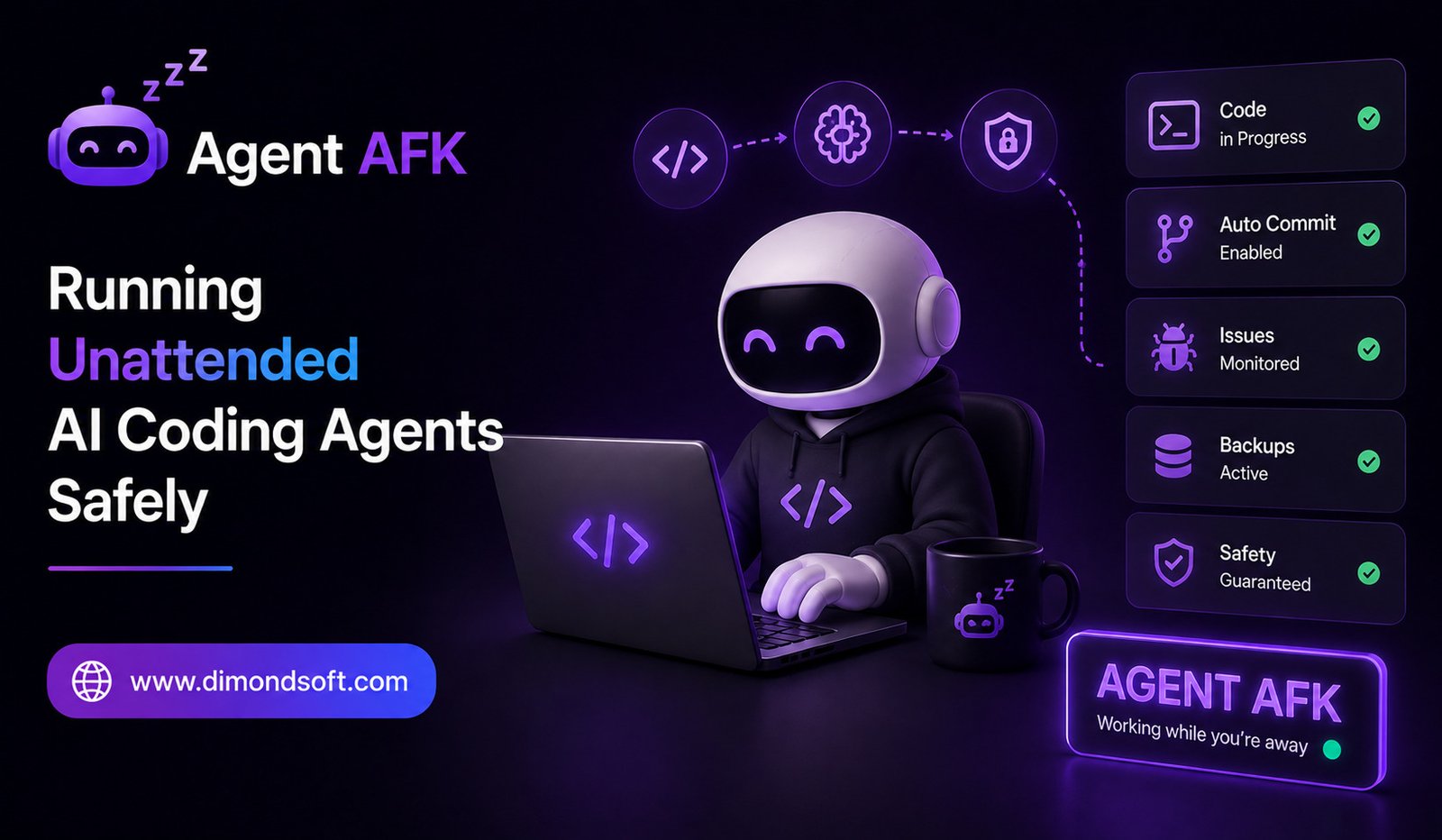
Agent AFK represents this emerging approach to managing coding agents while they work independently. The concept focuses on allowing AI agents to continue software development tasks while providing safeguards around execution, permissions, monitoring, and human control.
What Is Agent AFK?
Agent AFK can be understood as an approach to running AI coding agents without continuous supervision.
The term “AFK” traditionally means “away from keyboard.” In the context of AI development, it suggests that an agent can continue performing coding tasks even when the developer isn’t actively watching every action.
A developer could assign a task such as fixing a bug, implementing a feature, improving tests, or refactoring part of a project.
The agent can then work through the task while the developer focuses on something else.
The important part is that unattended operation needs boundaries.
An AI agent with unrestricted access to a development environment could potentially make unwanted changes, execute unsafe commands, expose secrets, or create expensive infrastructure activity.
Safety therefore becomes a fundamental part of autonomous coding.
Why Unattended Coding Agents Matter
Traditional coding assistants generally operate interactively.
A developer asks for code, reviews the response, makes adjustments, and continues the conversation.
That model still requires frequent human involvement.
Autonomous coding agents can work differently.
A developer might provide a high-level objective:
“Fix the failing tests in this module and update the implementation without changing the public API.”
The agent can investigate the repository, identify relevant files, make changes, run tests, and report its results.
If the agent can work for an extended period without interruption, developers can potentially delegate longer tasks.
This can increase productivity, particularly for repetitive development work.
The Risk of Giving AI Too Much Access
Autonomy creates a trade-off.
The more an AI agent can do, the more useful it can become.
But the more permissions it has, the greater the potential impact of a mistake.
A coding agent may need access to the project files.
It may need permission to run tests.
It may need access to package managers or development tools.
Some workflows may require network access.
Giving all these capabilities to an unrestricted agent can create unnecessary risk.
The solution is not necessarily to prevent agents from working independently. Instead, developers can create controlled environments in which agents have only the access they need.
Sandboxing AI Coding Agents
Sandboxing is one of the most important concepts for safe autonomous coding.
A sandbox provides an isolated environment where an AI agent can work without having unrestricted access to the rest of the computer.
For example, an agent could operate inside a dedicated development container or virtualized environment.
If the agent makes an unexpected change, the impact can remain limited to that environment.
This creates a safety boundary between the AI’s workspace and important personal or production resources.
Limiting File Access
AI agents should generally have access only to the files they need.
A software project may contain source code, configuration files, documentation, build artifacts, and sensitive credentials.
Not every file should automatically be accessible to an autonomous agent.
Restricting file access reduces the potential consequences of an error.
For example, an agent working on a frontend component may not need access to unrelated private documents stored on the same machine.
This principle is similar to the broader security practice of least privilege.
Protecting API Keys and Secrets
Software projects frequently depend on credentials.
These may include API keys, database passwords, cloud credentials, deployment tokens, and service-account information.
An unattended AI agent should not automatically receive unrestricted access to these secrets.
If an agent can read credentials, a mistake or compromised workflow could expose them.
Secure secret management can help separate credentials from the agent’s general working environment.
Developers should also avoid storing sensitive keys directly inside source code whenever possible.
Controlling Network Access
Network access is another important consideration.
An AI coding agent may need the internet to download dependencies or access documentation.
However, unrestricted network access can create additional risks.
An agent might unintentionally send information to an external service or access an unsafe resource.
A controlled environment can restrict which network connections are permitted.
For example, development workflows may allow access to approved package repositories and documentation services while blocking unrelated destinations.
The right configuration depends on the project and its requirements.
Monitoring Agent Activity
Unattended doesn’t have to mean invisible.
Developers can monitor what an agent is doing through logs and activity records.
Useful information can include:
- Commands executed
- Files modified
- Tests run
- Dependencies installed
- Network activity
- Errors encountered
- Changes committed
This creates an audit trail.
If something goes wrong, developers can investigate what happened instead of trying to reconstruct the agent’s actions from memory.
Monitoring also makes it easier to evaluate how effective the agent is.
Automatic Testing
Testing becomes especially important when AI agents work independently.
A developer who manually reviews every change can catch problems early.
An unattended agent may make dozens of changes before anyone looks at the result.
Automated tests provide a first line of defense.
An agent can be configured to run unit tests, integration tests, linters, type checks, or other validation processes after making changes.
If tests fail, the agent can potentially investigate and attempt another solution.
Human review should still be used before important changes are merged or deployed.
Git as a Safety Layer
Version control provides another useful protection.
An AI coding agent should generally work inside a repository where changes can be tracked and reverted.
Git allows developers to see what changed.
If an agent makes a mistake, unwanted modifications can potentially be discarded or rolled back.
Branches can provide an additional layer of isolation.
Instead of allowing an AI agent to modify the main production branch directly, developers can have it work on a separate branch.
A human can then review the proposed changes before merging them.
Pull Requests and Human Approval
For higher-risk projects, human approval can remain a required step.
An AI agent can create a branch, implement a change, run tests, and prepare a pull request.
A developer reviews the code before it becomes part of the main application.
This creates a useful division of responsibilities.
AI: Performs repetitive implementation work.
Automated systems: Run tests and checks.
Human: Reviews important changes and makes the final decision.
This approach can provide many of the productivity benefits of autonomous agents without giving them complete control over production systems.
Setting Time and Resource Limits
Unattended agents can potentially run for long periods.
Without limits, an agent could consume excessive computing resources or become stuck in a loop.
Resource controls can help prevent this.
For example, teams can limit:
- Maximum execution time
- CPU usage
- Memory consumption
- Number of tool calls
- Number of retries
- Network requests
These controls help make autonomous operation more predictable.
They can also prevent unexpectedly high infrastructure costs.
Preventing Destructive Commands
Some commands can cause serious damage.
An AI agent should not be given unrestricted permission to execute destructive operations without appropriate controls.
For example, commands that delete large amounts of data, modify production infrastructure, or change critical system configuration deserve additional protection.
A safe agent environment can block or require approval for high-risk actions.
This is especially important when the agent is operating unattended.
AI Coding Agents and Production Systems
One of the most important boundaries is between development and production.
An autonomous coding agent can be useful for experimenting and preparing changes.
Allowing that same agent to directly modify production systems is a much higher-risk proposition.
Production environments often contain customer data, financial information, critical services, and infrastructure.
A safer architecture separates development activities from production access.
The AI can prepare changes in an isolated environment.
Automated tests can validate them.
Human-controlled deployment processes can then determine whether those changes should reach production.
Handling AI Mistakes
AI agents can make incorrect assumptions.
They may misunderstand a requirement, modify the wrong file, introduce a bug, or choose an inefficient solution.
This is normal for current AI systems.
The objective of safety isn’t to assume that the agent will always be correct.
Instead, systems should be designed around the assumption that mistakes will happen.
Isolation, backups, testing, version control, monitoring, and approval workflows can limit the consequences.
This is one of the most important principles for autonomous AI development.
Useful Tasks for Unattended Coding Agents
Not every task is equally suitable for autonomous execution.
Lower-risk examples may include:
- Updating documentation
- Writing basic tests
- Fixing straightforward lint errors
- Refactoring isolated code
- Investigating test failures
- Generating boilerplate
- Updating non-critical dependencies
More sensitive tasks may require stronger human involvement.
These could include security changes, authentication systems, payment processing, database migrations, production infrastructure, and changes involving confidential information.
The level of autonomy should match the risk.
Benefits for Development Teams
When implemented carefully, unattended coding agents can provide several benefits.
Developers can delegate repetitive work and return to completed tasks later.
AI agents can work outside normal working hours.
Teams can run multiple development tasks in parallel.
Long-running tasks can also be broken into smaller autonomous workflows.
For small teams, this could provide additional development capacity without requiring every task to receive continuous human attention.
Challenges of Autonomous Coding
The biggest challenge is balancing autonomy with control.
If agents require approval for every tiny action, much of the productivity benefit disappears.
If agents have unlimited freedom, the risks become difficult to manage.
Finding the right middle ground is therefore essential.
Organizations also need to consider code quality, security, resource consumption, data privacy, and accountability.
AI coding agents should be treated as powerful development tools rather than infallible software engineers.
The Future of Safe AI Development
AI coding agents are likely to become increasingly capable.
Future systems may be able to manage larger portions of software projects, investigate complex bugs, implement features, run extensive tests, and coordinate with other development tools.
As this happens, safety infrastructure will become just as important as agent intelligence.
Sandboxing, permission management, observability, automated testing, version control, and human approval could become standard components of autonomous development environments.
The winning systems may not be those that give AI unlimited freedom.
They may be the systems that provide useful autonomy inside carefully designed boundaries.
Final Thoughts
Agent AFK represents the growing need to run unattended AI coding agents safely.
Autonomous coding can potentially save developers significant time by allowing AI agents to work on tasks without constant supervision.
But independence must be combined with security.
Sandboxed environments, restricted permissions, protected secrets, network controls, automated tests, version control, monitoring, and human approval can help keep autonomous coding workflows manageable.
The key principle is simple: let AI work independently without allowing it to operate without boundaries.
As coding agents become more capable, developers may increasingly delegate longer and more complex tasks to them. The future of software development could involve AI working continuously in the background while humans focus on architecture, product decisions, review, and the problems that require deeper judgment.