
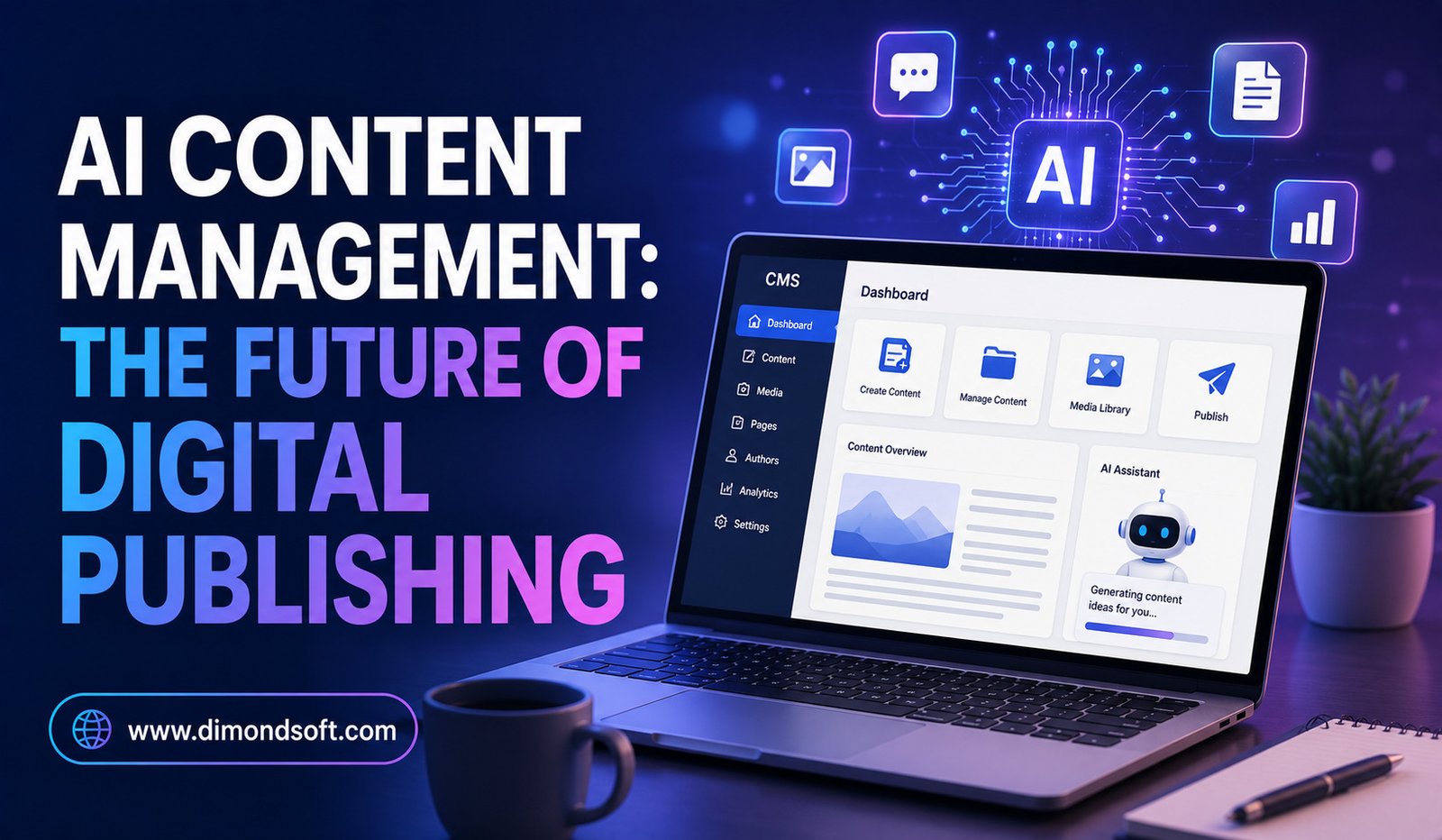
Digital publishing has changed dramatically over the past decade. Businesses, publishers, media organizations, and creators now produce content for websites, mobile applications, social media, newsletters, ecommerce platforms, and other digital channels. As the volume of content continues to grow, managing it efficiently has become a major challenge.
Artificial intelligence is emerging as one of the technologies capable of changing how digital content is created, organized, published, analyzed, and maintained. AI-powered content management systems can automate repetitive tasks, improve search and organization, support content creation, personalize experiences, and provide insights that would be difficult to generate manually.
AI content management does not mean removing people from the publishing process. Instead, it creates opportunities for humans and intelligent software to work together. Writers, editors, marketers, and publishers can use AI to reduce repetitive tasks while focusing more attention on creativity, strategy, accuracy, and audience needs.
As digital publishing becomes more complex, AI-powered content management could become an important part of how organizations operate their content ecosystems.
What Is AI Content Management?
AI content management refers to the use of artificial intelligence within systems that create, organize, manage, distribute, and analyze digital content.
Traditional content management systems primarily provide tools for storing and publishing information. AI-powered platforms can analyze content and make recommendations or perform certain tasks automatically.
For example, an AI-enabled system may identify the subject of an article, recommend tags, generate a summary, suggest related content, detect outdated information, or help a writer create an initial draft.
These capabilities can make content operations more efficient, especially for organizations managing large digital libraries.
Why Digital Publishers Need AI
The amount of content produced online is growing rapidly. Organizations are expected to publish frequently while maintaining accuracy, relevance, and consistency.
Manual processes become difficult to scale when hundreds or thousands of pieces of content need to be reviewed and maintained.
AI can help address this problem by automating repetitive activities.
Instead of asking an employee to manually categorize every article, an AI system can analyze content and suggest categories. Instead of searching thousands of documents individually, employees can use intelligent search to locate relevant information.
This allows publishing teams to spend more time on high-value activities.
AI-Assisted Content Creation
Generative AI has become one of the most visible applications of artificial intelligence in publishing.
AI tools can help create outlines, headlines, summaries, product descriptions, email drafts, social posts, and other content formats.
Writers can use these tools to overcome writer’s block or quickly develop an initial version of an idea.
However, AI-generated content should not automatically be treated as finished material.
Human editors remain important for fact-checking, originality, brand voice, context, and quality. AI can accelerate production, but publishing organizations are still responsible for the information they distribute.
The most effective model is often collaborative: AI handles routine drafting assistance while human professionals provide expertise and final approval.
Automated Content Classification
Large publishing organizations can have enormous content libraries.
Without effective organization, valuable information becomes difficult to find.
AI can analyze the meaning of content and automatically recommend categories, topics, tags, and metadata.
For example, a business article about cloud computing may be classified under cloud technology, software, digital transformation, and business technology.
Automated classification reduces manual data entry and creates a more consistent content structure.
It can also make future search and content recommendations more effective.
Intelligent Search
Traditional website searches often depend heavily on exact keywords.
AI-powered search can understand the meaning behind a query rather than simply matching individual words.
This can be especially useful for organizations with large content libraries.
An employee searching an internal knowledge base could ask a natural-language question and receive relevant documents or summaries.
Readers could also receive more useful search results when looking for specific information.
Intelligent search can therefore improve both internal productivity and customer experience.
AI-Powered Content Recommendations
Digital publishers want readers to discover useful content rather than leave after viewing a single page.
AI can analyze relationships between content and user behavior to recommend relevant articles, videos, products, or resources.
For example, someone reading an introductory article about digital marketing might receive recommendations for SEO, content strategy, analytics, and social media resources.
Relevant recommendations can improve engagement and help audiences discover more of a publisher’s content.
However, recommendation systems should be designed carefully to avoid creating repetitive experiences or reinforcing narrow content patterns.
Personalizing Digital Experiences
Different users may have different interests.
AI can help publishers deliver more relevant content based on available behavioral and contextual information.
A returning visitor may see recommendations based on previously viewed topics. An ecommerce customer may receive product information relevant to previous interactions.
Personalization can make digital experiences more useful, but privacy must remain a priority.
Businesses should be transparent about data collection and follow applicable privacy requirements.
AI and Content Optimization
Creating content is only one part of digital publishing. Existing content also needs continuous improvement.
AI can analyze content and suggest improvements to readability, structure, metadata, headings, summaries, and other elements.
It can also help identify pages with declining performance or content that may need updating.
For SEO teams, AI can support keyword analysis and identify related topics that could improve content coverage.
However, automated optimization should support a broader content strategy rather than encouraging publishers to produce large quantities of low-value material.
Content Repurposing
One piece of content can often be transformed into several formats.
A long article can become a newsletter, social media post, video script, presentation, or short summary.
AI can speed up this repurposing process.
For publishers, this creates opportunities to extend the value of existing material without recreating everything manually.
Human review remains important because each platform has different audience expectations and communication styles.
A social media post should not simply be a shortened copy of an article. It may require a different structure and tone.
AI for Content Translation
Global publishers often need to deliver content in multiple languages.
AI-powered translation can help create initial versions much faster than traditional manual processes.
This can reduce turnaround times and make multilingual publishing more scalable.
However, automated translation may struggle with cultural context, specialized terminology, humor, and regional language preferences.
Human review is particularly important for high-value or sensitive content.
AI can therefore act as a productivity tool while professional translators maintain quality and cultural accuracy.
Managing Digital Assets With AI
Publishing involves more than text.
Images, videos, audio files, graphics, presentations, and documents all need to be organized.
AI can analyze digital assets and automatically generate descriptions, identify objects, recognize subjects, and recommend categories.
This makes large media libraries easier to search.
A marketing employee might search for images related to a particular product or concept without remembering the exact filename.
AI-powered asset management can therefore reduce the time employees spend searching through large collections of files.
AI and Content Governance
As AI becomes part of publishing workflows, governance becomes increasingly important.
Organizations need clear rules covering how AI can be used and where human approval is required.
A governance framework may address:
- Accuracy and fact-checking
- Brand guidelines
- Privacy and data protection
- Copyright and intellectual property
- Human review
- AI disclosure policies
- Security
- Content ownership
Not every piece of content needs the same level of review.
Routine internal material may require basic checks, while financial, legal, medical, or technical content may require extensive expert validation.
Detecting Outdated Content
Digital content has a limited useful life.
Statistics become old, products change, links stop working, and business policies are updated.
AI can monitor content libraries and identify potential problems.
It may detect old dates, broken links, outdated terminology, or pages that have not been reviewed for a long time.
This allows content teams to prioritize maintenance.
Rather than manually checking every page, editors can focus on the material most likely to require attention.
AI-Powered Analytics
Analytics help publishers understand what content performs well.
AI can analyze large datasets to identify patterns that may not be obvious through standard reporting.
It can help identify topics that attract engagement, formats that generate conversions, or audience segments that respond differently to particular content.
These insights can influence future publishing decisions.
Instead of relying entirely on intuition, editorial teams can combine human judgment with data-driven recommendations.
Improving Publishing Workflows
Publishing can involve many steps, including writing, editing, SEO review, legal approval, translation, design, scheduling, and distribution.
AI can automate parts of these workflows.
A system might identify missing metadata, route content to the appropriate reviewer, suggest publication timing, or notify an editor when an article requires an update.
Automation reduces administrative work and helps teams manage higher content volumes.
However, organizations should avoid automating important decisions without appropriate oversight.
Challenges of AI Content Management
AI offers significant opportunities, but it also introduces risks.
One major concern is accuracy. AI systems can generate information that sounds convincing but is incorrect.
There are also concerns about originality, copyright, privacy, bias, and excessive reliance on automation.
Another challenge is maintaining a consistent brand voice.
If different employees use AI tools without common guidelines, the organization’s content may become inconsistent.
Training and governance are therefore essential components of successful AI adoption.
Human Creativity Still Matters
AI may become better at generating and organizing information, but human creativity remains central to effective publishing.
Readers value original ideas, personal experience, expert knowledge, storytelling, and unique perspectives.
Human professionals also understand organizational goals and audience expectations in ways automated systems may not fully capture.
The future is therefore unlikely to be a simple competition between humans and AI.
Instead, publishers can use AI to handle repetitive activities while people focus on creativity, judgment, research, and strategic decisions.
How Businesses Can Prepare for AI Publishing
Organizations should begin by identifying repetitive content tasks that consume significant employee time.
These might include tagging, summarizing, content search, metadata creation, translation, or routine editing.
Starting with lower-risk applications allows teams to understand the technology before applying it to more complex processes.
Businesses should also establish AI policies and train employees.
Clear rules can help employees understand what information may be entered into AI systems and when human review is mandatory.
Performance should be measured through practical outcomes such as time savings, content quality, engagement, and operational efficiency.
The Future of AI Content Management
AI-powered content management is likely to become increasingly integrated into publishing platforms.
Future systems may continuously monitor content, recommend new topics, identify outdated information, personalize experiences, and coordinate publishing workflows.
AI agents may eventually complete multiple connected tasks based on predefined objectives, with human employees approving important decisions.
Content management could become more proactive rather than reactive.
Instead of waiting for someone to discover a broken link or outdated article, intelligent systems may identify the problem automatically and recommend an appropriate action.
Conclusion
AI content management is changing the future of digital publishing by making content creation, organization, search, personalization, optimization, and maintenance more efficient.
The technology can reduce repetitive work and help publishers manage increasingly large content libraries. AI-powered search, automated classification, content recommendations, translation, asset management, and workflow automation can improve the entire publishing process.
However, successful adoption requires more than adding AI features to a CMS. Businesses need strong governance, reliable information, privacy safeguards, security controls, and human oversight.
The future of digital publishing will likely combine artificial intelligence with human creativity and expertise. AI can handle repetitive analysis and operational tasks, while writers, editors, marketers, and subject experts continue to provide originality, judgment, and accountability.
For organizations willing to adopt this balanced approach, AI-powered content management can create a faster, smarter, and more scalable publishing environment while helping businesses deliver more relevant and useful digital experiences.