Businesses rely on processes to keep everyday operations running smoothly. From onboarding new employees and handling customer requests to processing invoices and managing sales leads, almost every organization has workflows that determine how work gets completed.
The problem is that many business processes are difficult to understand, document, and improve. Teams may rely on spreadsheets, flowcharts, outdated documents, or information stored in employees’ minds.
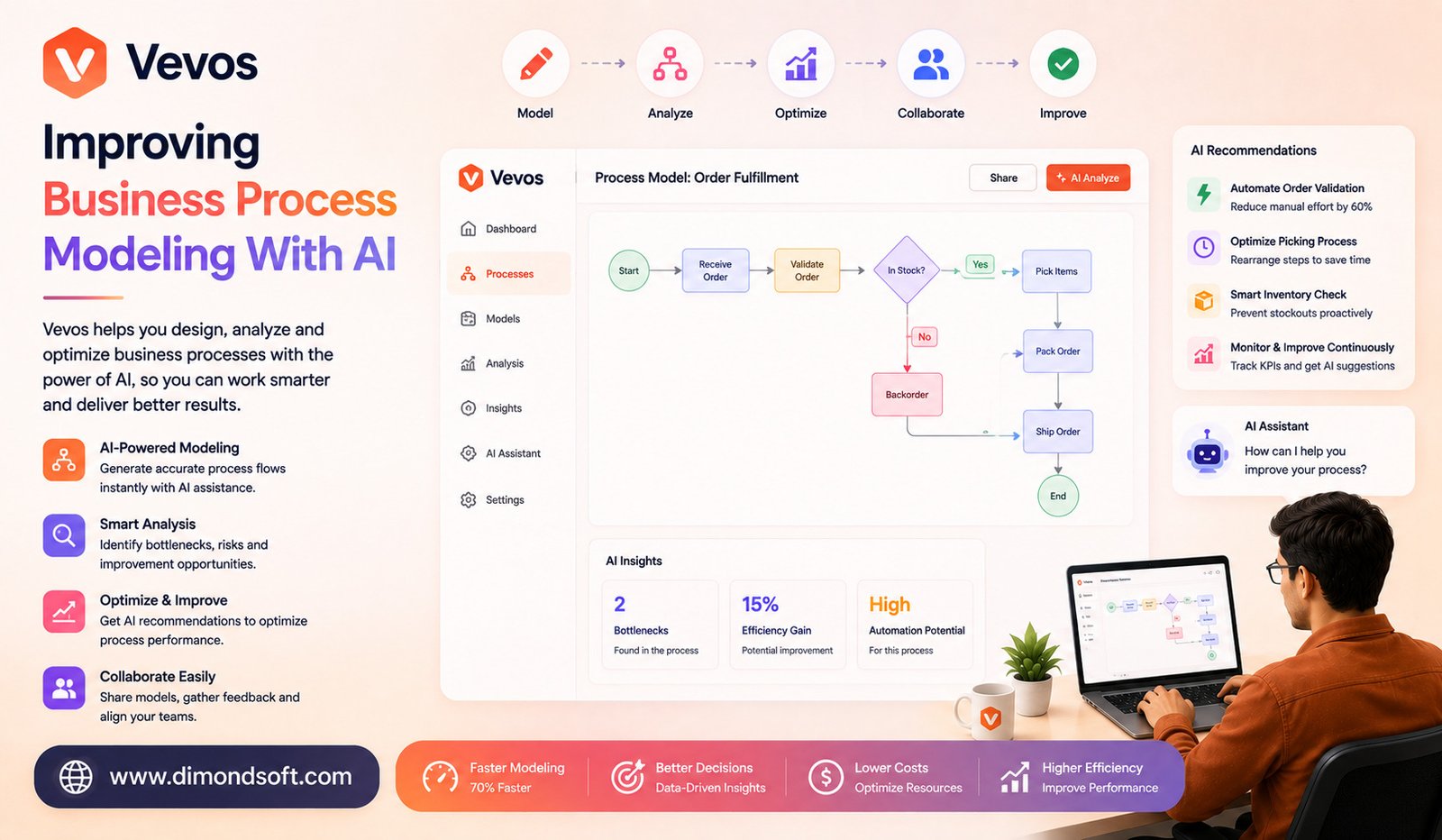
Artificial intelligence is creating new possibilities for business process modeling. Vevos represents this emerging approach, where AI can help organizations understand, visualize, document, and improve the way work moves through a business.
Instead of manually creating every process diagram or spending hours analyzing complicated workflows, businesses can increasingly use AI to assist with process discovery and optimization.
What Is Vevos?
Vevos can be understood in the context of AI-powered tools designed to improve business process modeling.
Business process modeling involves representing how different activities are performed within an organization. A process model can show tasks, decisions, people, systems, inputs, and outputs.
For example, a customer support process might begin when a customer submits a request and continue through ticket classification, employee assignment, investigation, resolution, and follow-up.
A process model turns that sequence into something easier to understand.
AI can help make the process of creating and analyzing these models faster and more accessible.
Why Business Process Modeling Matters
A company cannot improve a process it doesn’t understand.
Many organizations have workflows that have developed gradually over several years. Different employees may perform the same task in different ways. Departments may use separate systems. Manual approvals can create delays.
Without a clear model, identifying these problems can be difficult.
Process modeling provides a visual and structured representation of how work actually happens.
Once a process has been documented, teams can look for unnecessary steps, repeated work, bottlenecks, and opportunities for automation.
Traditional Process Modeling Can Be Time-Consuming
Creating a business process model manually requires employees to gather information from different teams.
They may need to conduct interviews, review documentation, observe workflows, and create diagrams.
This process can take considerable time.
There is also a risk that the resulting diagram describes how a process should work rather than how it actually works.
Employees may skip certain steps, use workarounds, or rely on undocumented procedures.
AI-assisted process modeling can help organizations analyze available information and identify patterns that might otherwise be missed.
AI for Process Discovery
One of the most valuable applications of AI is process discovery.
Organizations often have large amounts of operational data stored in business systems.
This data can reveal how work actually moves through an organization.
For example, a company might analyze customer support tickets and discover that certain requests are repeatedly transferred between departments before being resolved.
That pattern could indicate an unnecessary bottleneck.
AI can help identify these patterns and present them in a form that business teams can understand.
This creates a bridge between raw operational data and practical process improvement.
Turning Complex Workflows Into Visual Models
Complex business processes can be difficult to describe using text alone.
A visual process model can make relationships between activities easier to understand.
For example, an order fulfillment process might include:
Order received → Payment verified → Inventory checked → Product prepared → Shipment created → Order delivered
There may also be decision points.
If inventory is unavailable, the process follows one path. If the product is available, it follows another.
AI can assist in organizing these relationships into understandable workflows.
This can make process discussions easier for employees and managers.
Identifying Bottlenecks With AI
Bottlenecks occur when one part of a process slows down the entire workflow.
A company may have a sales process that normally moves quickly but becomes delayed during contract approval.
Another business may have customer support requests waiting several days for specialist review.
AI-powered process analysis can help identify where delays occur.
Once the bottleneck is identified, management can investigate why it exists.
Possible solutions might include automation, additional resources, process redesign, or changes to approval requirements.
AI doesn’t necessarily solve the problem automatically. Its value is in helping teams find and understand the problem faster.
Reducing Repetitive Work
Process modeling can also reveal repetitive tasks.
Employees may spend hours copying information between systems, entering the same data multiple times, sending routine emails, or manually checking information.
These activities are potential candidates for automation.
For example, if a process model shows that employees repeatedly transfer customer information from one application to another, the organization could explore system integration.
AI can help identify these opportunities and suggest areas where automation might provide value.
AI and Process Optimization
Once a process has been modeled, businesses can begin exploring improvements.
AI can potentially compare different workflow structures and highlight areas where processes could be simplified.
For example, a company may discover that five approval stages are being used for a low-risk request.
The organization could investigate whether some approvals can be combined or automated.
Another process might contain duplicate data-entry steps that could be eliminated.
The goal isn’t to automate everything.
The goal is to create a process that is efficient, understandable, reliable, and appropriate for the business.
Improving Employee Onboarding
Business process modeling can also support employee training.
New employees often struggle to understand how work moves between departments.
A visual workflow can explain the responsibilities of different teams.
For example, an employee in a procurement department might need to understand how purchase requests move from employees to managers, finance teams, suppliers, and accounts payable.
An AI-assisted process model can potentially turn complex procedures into easier-to-understand documentation.
This can reduce the learning curve for new employees.
AI for Compliance and Governance
Organizations in regulated industries often need to demonstrate that processes follow specific rules.
Process models can help document responsibilities, approvals, and control points.
AI can potentially assist teams in reviewing workflows and identifying areas that may require additional controls.
For example, a process may involve sensitive customer information. A process analysis could highlight where that information is accessed or transferred.
However, AI should not be treated as a substitute for professional compliance or legal advice.
Human experts should remain responsible for interpreting regulations and determining whether processes meet applicable requirements.
Connecting Process Modeling With Automation
One of the most promising possibilities is connecting process modeling directly to automation.
A business can first map how a process works.
Next, it can identify repetitive steps.
Then, suitable automation technologies can be introduced.
For example, a customer onboarding workflow might involve collecting information, verifying documents, creating an account, and sending confirmation messages.
Some of these activities could potentially be automated using software and AI.
A clear process model helps determine where automation belongs.
This reduces the risk of automating a poorly designed process.
The Importance of Accurate Data
AI process modeling depends heavily on the quality of available information.
If business systems contain incomplete or inconsistent data, the resulting analysis may not accurately represent the real workflow.
Organizations should therefore validate process models with employees who understand the actual operation.
AI may identify a pattern in system data, but employees can explain why that pattern exists.
Combining data analysis with human knowledge produces a stronger process model.
Challenges of AI-Based Process Modeling
AI-assisted process modeling has limitations.
Business workflows can involve informal decisions, exceptions, personal judgment, and organizational knowledge that isn’t recorded in digital systems.
An AI model may not see these factors.
There is also a risk of over-optimizing processes based purely on efficiency.
A process that appears slower may exist for a legitimate reason, such as quality control, security, or customer service.
Businesses should therefore evaluate AI recommendations in their broader operational context.
Vevos and the Future of Business Operations
The concept represented by Vevos points toward a more intelligent approach to process management.
Instead of treating business processes as static diagrams that are created once and rarely updated, organizations could use AI to continuously analyze how work is actually happening.
Process models could become dynamic resources that help businesses understand operational performance.
AI could identify changes, highlight bottlenecks, and suggest potential improvements.
This could make process management more responsive to changing business conditions.
Who Can Benefit From AI Process Modeling?
AI-powered process modeling can be useful for companies of many sizes.
Large enterprises can use it to understand complex workflows across departments.
Medium-sized businesses can use it to identify operational inefficiencies.
Startups can use process modeling to establish scalable workflows before operations become complicated.
It can also help consultants and business analysts document processes more efficiently.
The technology becomes particularly valuable when organizations have many interconnected workflows that are difficult to understand manually.
Final Thoughts
Vevos represents the growing role of AI in business process modeling.
By helping organizations discover workflows, visualize processes, identify bottlenecks, recognize repetitive tasks, and explore automation opportunities, AI can make process improvement more accessible.
The biggest benefit isn’t simply creating attractive flowcharts. It is helping businesses understand how work actually happens and where meaningful improvements can be made.
However, AI-generated process models still require human validation. Employees understand exceptions, business priorities, customer expectations, and regulatory requirements that may not be visible in operational data.
The strongest approach combines AI-driven analysis with human expertise.
As organizations continue adopting automation and AI, understanding their existing processes will become increasingly important. Tools and approaches such as Vevos could help businesses move from documenting processes to continuously understanding and improving them.