
Cloud computing has transformed the way businesses build and operate software. Companies can launch applications without purchasing physical servers, scale infrastructure when demand increases, and access powerful computing resources through flexible pricing models.
The growth of artificial intelligence has added another layer to this equation. AI applications can consume significant amounts of compute, model inference, storage, and API resources. As companies deploy more AI-powered features, understanding and controlling these expenses becomes increasingly important.
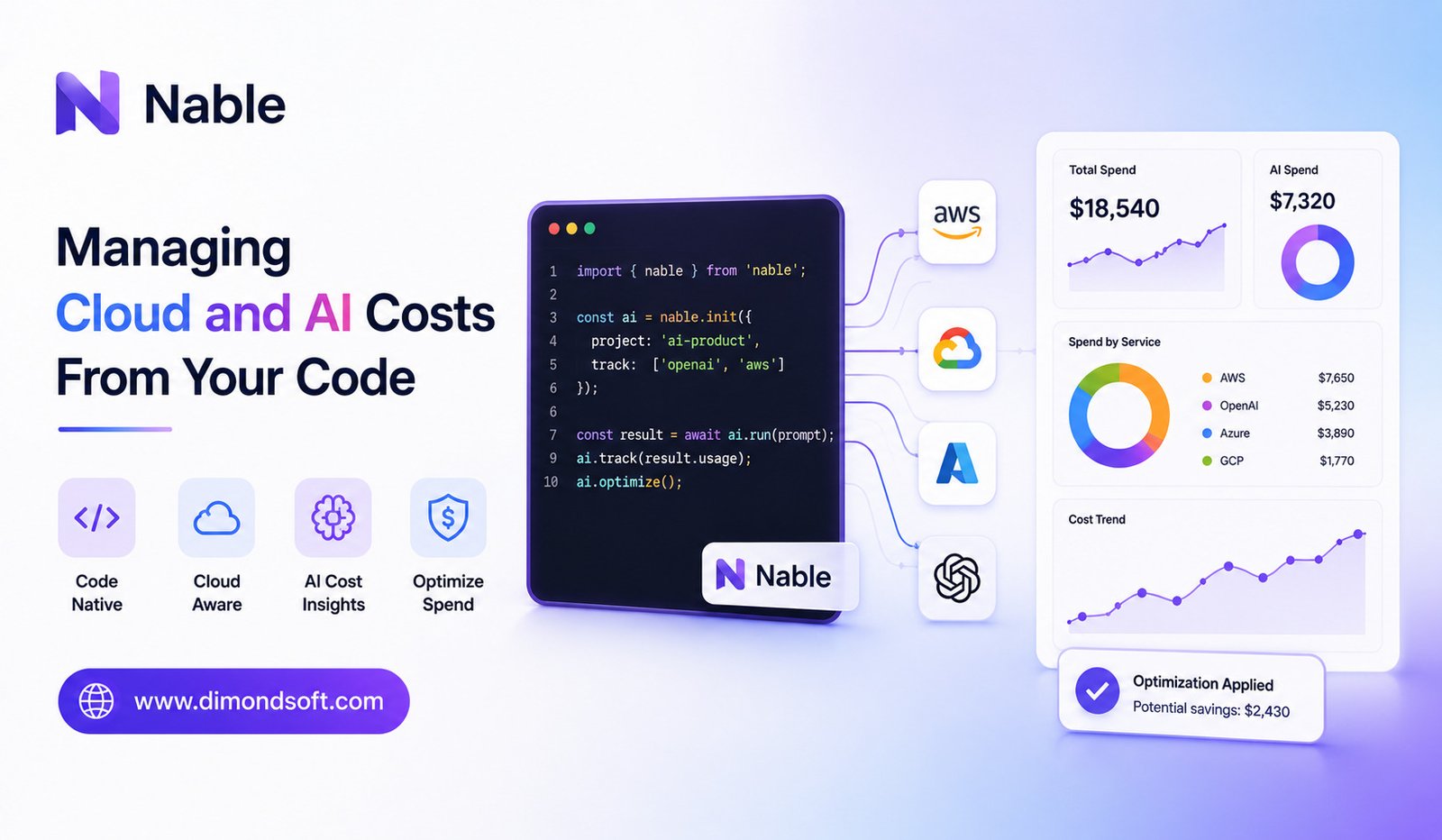
This is where Nable represents an interesting approach: managing cloud and AI costs directly from code. Instead of treating infrastructure spending as something developers only discover through a billing dashboard at the end of the month, the idea is to bring cost awareness closer to the development process.
For engineering teams, this can create a more transparent relationship between software decisions and their financial impact.
What Is Nable?
Nable can be understood as an approach to cloud and AI cost management that connects infrastructure spending with application code.
Traditional cloud billing tools generally show how much a company has spent on different services. These dashboards can be useful, but they don’t always explain why a particular piece of code is responsible for a cost.
Developers may know that an application uses a certain AI model or cloud service, but understanding the cost of a specific feature, request, workflow, or function can be more difficult.
Code-level cost visibility aims to bridge this gap.
Instead of looking at cloud costs only as financial data, developers can think about them as another attribute of the software they are building.
Why Cloud Costs Matter to Developers
Cloud spending is often closely connected to engineering decisions.
Choosing a database, increasing server capacity, adding background jobs, storing large files, or making more API calls can all affect operating expenses.
When applications are small, these differences may not seem significant.
As usage increases, however, inefficient architecture can become expensive.
For example, an application that makes unnecessary API requests may work perfectly during development. But when thousands or millions of users interact with it, those requests can create a substantial bill.
Developers need visibility into these costs before they become problems.
AI Makes Cost Management More Complicated
Generative AI introduces additional variables.
An AI application may use different models for different tasks.
Some requests may be short and inexpensive, while others require larger amounts of context or more powerful models.
Applications may also perform multiple AI calls during a single workflow.
For example, an AI customer-support system could:
Receive request → Classify question → Search information → Generate response → Check response
Each step could involve a separate model call or infrastructure service.
If developers only look at the final monthly bill, it can be difficult to determine which workflows are responsible for the largest expenses.
Code-level cost tracking can provide a more useful perspective.
Bringing Cost Awareness Into the Development Process
The central idea behind Nable is to make cost information part of software development.
Developers already think about factors such as execution time, memory usage, latency, and reliability.
Cost can become another metric.
When engineers understand how much a particular function or workflow costs, they can make better technical decisions.
For example, two approaches may produce similar results but have significantly different operating costs.
If that difference is visible during development, the team can choose the more efficient solution.
Tracking AI Model Usage
AI model selection can have a major effect on application costs.
A powerful model may provide better reasoning capabilities for complex tasks, while a smaller model may be sufficient for simple requests.
Using the most expensive model for every operation may therefore be unnecessary.
A cost-aware application can route different tasks to appropriate models.
For example:
Simple classification → Smaller model
Routine summarization → Efficient model
Complex reasoning → More capable model
This type of model routing can help organizations balance performance and cost.
Cost Per Feature
One useful way to think about AI and cloud spending is cost per feature.
Suppose a company has an AI-powered document analysis feature.
Instead of knowing only that the entire AI infrastructure costs a certain amount each month, the company could estimate how much it costs to process one document.
This creates a clearer connection between technical usage and business value.
If processing one document costs a small amount and generates significant value, the economics may be attractive.
If the cost becomes too high, developers can investigate optimization opportunities.
Cost Per User or Customer
Businesses can also think about infrastructure costs in relation to customers.
For a SaaS product, understanding the average infrastructure cost per active customer can be valuable.
An application may generate revenue from subscriptions while simultaneously consuming cloud and AI resources.
If usage costs increase faster than revenue, margins can shrink.
Code-level cost tracking can help businesses understand how different user behaviors affect infrastructure spending.
This can be particularly important for AI products where usage varies significantly between customers.
Optimizing AI Workflows
AI workflows often contain opportunities for optimization.
A developer might discover that the same information is being sent repeatedly to a model.
Another workflow might use a powerful model for tasks that don’t require advanced reasoning.
Some applications may perform multiple AI calls where one carefully designed request could be sufficient.
Cost visibility can help identify these patterns.
Once developers know where money is being spent, they can experiment with alternatives.
Optimization might involve reducing unnecessary calls, shortening prompts, caching results, changing models, or restructuring workflows.
Cloud Infrastructure Optimization
The same principle applies outside AI.
Cloud applications can generate costs through compute, storage, networking, databases, monitoring, and other services.
A developer may accidentally create inefficient infrastructure that consumes more resources than necessary.
For example, a background process might run more frequently than required.
A database query might consume excessive resources.
Large files may be stored indefinitely when they could be archived or deleted according to appropriate retention policies.
Code and infrastructure-level cost visibility can help teams identify these opportunities.
Developers and FinOps Working Together
Cloud financial management is often associated with FinOps, a discipline that brings engineering, finance, and business teams together to manage cloud spending.
Developers play a central role because many cloud costs originate from technical decisions.
However, developers don’t always have detailed knowledge of financial implications.
Tools that connect code and costs can help bridge the communication gap.
Finance teams can understand what is driving infrastructure spending, while developers can see the financial consequences of their engineering choices.
This can create a more collaborative approach to cloud economics.
Making Cost a Software Metric
Software teams commonly monitor metrics such as:
- Response time
- Error rate
- CPU usage
- Memory consumption
- Availability
- Throughput
Cost can be treated in a similar way.
For example, a team might monitor the cost of processing a customer request alongside latency and reliability.
This encourages developers to consider efficiency from multiple perspectives.
A technically successful feature isn’t necessarily an efficient feature if it costs far more to operate than expected.
Cost Optimization Without Sacrificing Quality
Reducing spending doesn’t always mean choosing the cheapest technology.
A low-cost system that produces poor results may create more problems than it solves.
For AI applications, an inexpensive model may generate lower-quality responses that require additional processing or human review.
Similarly, reducing cloud resources too aggressively can hurt application performance.
The objective should therefore be cost efficiency, not simply cost reduction.
Teams need to balance price, quality, speed, reliability, and user experience.
AI Cost Management for Startups
Startups can particularly benefit from early cost awareness.
Young companies often prioritize speed because they need to build and test products quickly.
But an architecture that works for a few hundred users may become expensive at larger scale.
If developers understand cost drivers early, they can make more informed architectural decisions.
This doesn’t mean startups should prematurely optimize everything.
Instead, they can identify the areas most likely to affect future operating costs.
AI-powered products may benefit especially from this approach because model usage can grow rapidly as customer adoption increases.
Managing Costs at Scale
Large companies face a different challenge.
They may have hundreds of applications, multiple cloud providers, numerous development teams, and many AI workloads.
In these environments, cost information can become fragmented.
Different teams may use different services and models.
A centralized cost-management strategy can help organizations understand spending across applications and departments.
Connecting costs to code, projects, services, or business units can make large-scale spending easier to analyze.
Challenges of Code-Level Cost Tracking
There are still technical challenges.
Cloud pricing models can be complicated.
Costs may depend on usage volume, geographic region, storage duration, reserved capacity, data transfer, and other factors.
AI pricing can also change as model providers introduce new models and pricing structures.
Accurately attributing shared infrastructure to individual features may be difficult.
Therefore, cost estimates should be treated as useful operational information rather than perfect financial accounting.
Businesses should combine code-level estimates with official billing and accounting systems.
Security and Data Considerations
Cost-management tools may need access to infrastructure information, application metadata, or usage data.
Organizations should carefully control these permissions.
Developers should also understand what application information is being processed by any third-party system.
Security should remain important when introducing cost monitoring into development environments.
The goal is to improve financial visibility without creating unnecessary access to sensitive infrastructure or business information.
The Future of AI and Cloud Cost Management
As AI becomes part of more applications, cost management is likely to become increasingly important.
Developers may eventually treat cost as a first-class application metric.
AI systems could automatically identify expensive workflows, recommend cheaper alternatives, select appropriate models, or predict how infrastructure spending will change as usage grows.
For example, a development tool could warn:
“This workflow is expected to cost significantly more at 100,000 monthly users.”
That type of feedback could influence architecture before the product reaches large scale.
Final Thoughts
Nable represents the broader movement toward managing cloud and AI costs directly from code.
As applications become increasingly dependent on cloud infrastructure and AI models, developers need better visibility into the financial impact of their technical decisions.
Connecting costs with features, workflows, users, and code can help teams understand where money is being spent and identify opportunities for optimization.
The goal isn’t simply to reduce every possible expense. Businesses need to balance cost with performance, reliability, AI quality, and customer experience.
For startups, SaaS companies, and large enterprises alike, cost-aware development could become an increasingly important part of modern software engineering.
The future may bring development environments where developers don’t just ask whether their code works—they also understand how much it costs to run and whether that cost makes sense for the value it creates.