
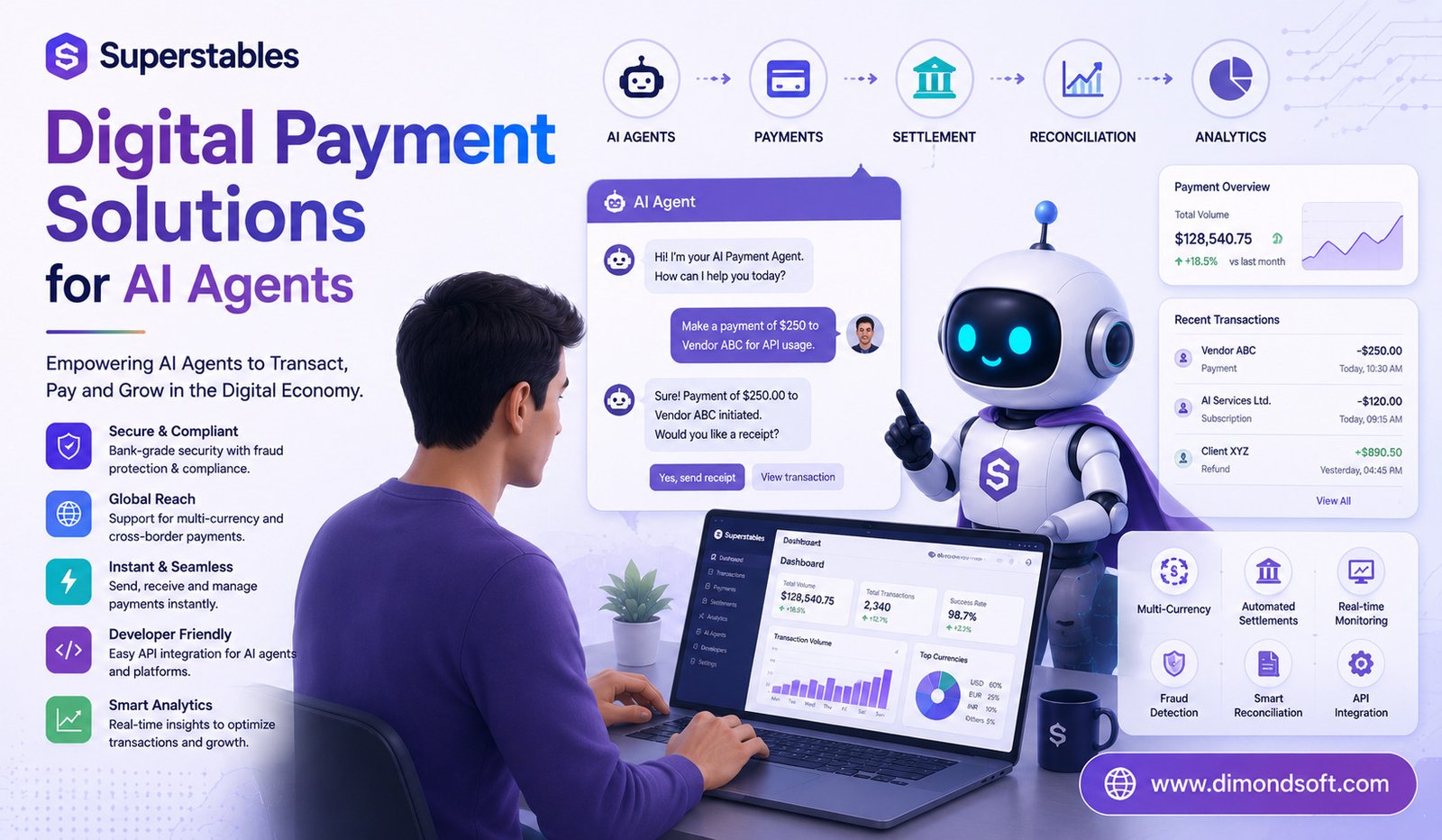
Artificial intelligence is moving beyond simple chatbots and becoming capable of completing increasingly complex tasks. AI agents can research information, manage workflows, interact with software, and potentially make decisions on behalf of users. As these systems become more autonomous, another challenge is becoming important: how can AI agents pay for things?
An AI agent may need to purchase an API call, subscribe to a digital service, pay for computing resources, or complete another online transaction. Traditional payment systems are generally designed for humans, which creates friction when software needs to conduct transactions independently.
This is where concepts such as Superstables and AI-focused digital payment infrastructure become interesting. The broader idea is to create payment systems that make transactions easier for software agents while maintaining appropriate security, control, and transparency.
What Are Superstables?
Superstables can be understood in the context of emerging payment solutions designed around the needs of AI agents and automated software.
Traditional online payments usually involve a human selecting a product or service, entering payment information, authenticating a transaction, and confirming the purchase.
An autonomous AI agent operates differently.
An agent may need to make many small transactions while completing a task. It might need access to a data source, computing service, software API, or other digital resource.
For such scenarios, payment infrastructure needs to support software-driven transactions rather than relying entirely on traditional human checkout processes.
The concept behind Superstables is therefore connected to a larger transformation in digital payments: making money programmable enough for increasingly autonomous software systems.
Why AI Agents Need Payment Systems
Today’s AI agents can perform a growing number of digital tasks, but many useful actions require paid services.
Consider an AI research agent.
It might need to:
- Search a specialized database.
- Purchase access to a particular dataset.
- Use an external AI model.
- Process the information using cloud computing.
- Generate a final report.
If every transaction requires a human to approve a payment manually, the agent’s autonomy becomes limited.
An agent-oriented payment system could allow the user to establish rules and spending limits in advance.
The AI could then conduct approved transactions automatically when necessary.
This creates the possibility of a new type of digital economy in which software agents can both consume services and pay for them.
From Human Payments to Machine Payments
Most payment infrastructure has been built around people.
A person has a bank account or card. They choose what to purchase and authorize the transaction.
Machine-to-machine payments introduce a different model.
Software can operate continuously and potentially conduct hundreds or thousands of transactions. These payments could be very small, frequent, and automated.
For example, an AI agent might pay a fraction of a currency unit every time it accesses a particular data service.
This type of transaction could be difficult to manage efficiently through conventional payment experiences designed for individual human purchases.
Agent-focused payment infrastructure aims to make these interactions more practical.
The Importance of Stable Digital Money
One challenge for automated payments is price stability.
AI agents need predictable costs when deciding whether to purchase a service. If the payment asset changes significantly in value within a short period, automated spending decisions become more complicated.
This is one reason stable-value digital assets can be relevant to discussions around machine payments.
A stable-value asset is generally designed to maintain a relatively stable value against a reference currency or other asset.
For AI agents, predictable pricing can make automated transactions easier to manage.
However, stability depends on the specific mechanism behind the asset, and users should not assume that every digital asset carries the same level of stability or financial risk.
How AI Agent Payments Could Work
Imagine an AI agent helping a business analyze customer data.
The business owner could provide the agent with a digital wallet or controlled payment account.
The account might have rules such as:
- Maximum daily spending
- Approved services
- Maximum transaction amount
- Required approval for large purchases
- Specific budget categories
The agent could then purchase permitted digital resources as needed.
For example, if the agent needs a particular API that costs a small amount per request, it could make the payment automatically rather than interrupting the user.
This creates a model where humans define the financial boundaries while AI handles individual transactions within those boundaries.
Potential Applications
The potential applications for AI agent payments extend across many industries.
AI Research Agents
Research agents could pay for access to specialized databases, premium information services, or computing resources.
Software Development
Coding agents could purchase API calls, testing services, cloud resources, or other developer tools within predefined budgets.
E-Commerce
AI shopping agents could potentially compare products and complete purchases on behalf of consumers, provided the user has clearly authorized the transaction.
Business Automation
Business agents could pay for software services, data processing, advertising tools, or other digital resources.
Content Creation
AI-powered content systems could purchase stock resources, processing services, or specialized APIs required to complete projects.
These scenarios depend heavily on permissions, platform integrations, payment standards, and user trust.
Security Is the Biggest Challenge
Giving an AI agent access to money introduces serious security concerns.
An AI system can make mistakes. It can misunderstand instructions, encounter malicious content, or behave unexpectedly.
If an agent has unrestricted access to a payment account, a single error could potentially result in significant financial losses.
Therefore, agent payment systems need strong controls.
Spending limits, transaction approvals, identity verification, fraud detection, monitoring, and revocation mechanisms can help reduce risks.
A particularly useful principle is least privilege. An AI agent should receive only the financial access required to complete its assigned task.
Human Oversight Still Matters
Autonomous payments do not necessarily mean humans should disappear from the process.
Instead, AI payment systems could use different levels of authorization.
Small routine transactions might be approved automatically, while larger or unusual purchases could require human confirmation.
For example, a user could allow an AI agent to spend up to a fixed amount per day without asking permission. Anything above that threshold could require approval.
This hybrid model balances automation with human control.
Micropayments and AI Agents
One potentially important development is the growth of micropayments.
AI agents may need to pay very small amounts for individual digital resources.
Traditional payment systems can sometimes be inefficient for extremely small transactions because processing costs and user interaction create friction.
Digital payment technologies may make smaller automated payments more practical.
If AI agents eventually interact with millions of digital services, even tiny payments could become meaningful when multiplied across large numbers of transactions.
This could create new business models based on usage rather than traditional subscriptions.
AI Agents Could Become Economic Participants
The most interesting implication of agent-based payments is that AI systems could become active participants in digital commerce.
An AI agent might search for a service, compare prices, select an option, purchase access, use the service, and report the outcome to its user.
In this model, the agent isn’t simply a tool that provides information.
It becomes an intermediary capable of interacting with digital marketplaces.
This could change how software companies design their pricing systems.
Instead of selling exclusively to human customers, businesses may increasingly need to make their services accessible to software agents.
Challenges Beyond Payments
Creating machine-friendly payments is only one part of the problem.
AI agents also need reliable identities.
A service provider needs to know which agent is making a request, who authorized that agent, what permissions it has, and whether the transaction is legitimate.
This raises questions around authentication, accountability, fraud prevention, privacy, and regulatory compliance.
There is also the challenge of interoperability.
If every AI platform creates its own payment system, agents may struggle to interact across different services.
Common standards could therefore become important as the agent economy develops.
The Future of Digital Payments for AI
The emergence of concepts such as Superstables reflects a broader trend toward agentic commerce.
As AI becomes more capable of acting independently, payment infrastructure will need to evolve alongside it.
The future could involve AI agents that have controlled digital wallets, programmable spending limits, verified identities, and the ability to purchase digital resources automatically.
Instead of humans manually approving every small transaction, people could establish rules and allow AI systems to operate within those boundaries.
This could make automated software much more useful.
At the same time, financial security and user control will remain essential. The more autonomy an AI agent receives, the more important it becomes to establish clear safeguards.
Final Thoughts
Superstables represents the broader idea of creating digital payment solutions for AI agents, an area that could become increasingly important as autonomous software develops.
AI agents are becoming capable of performing tasks that previously required human involvement. But completing many of those tasks requires access to paid digital services.
Machine-friendly payment infrastructure could allow agents to purchase those resources automatically while operating within rules established by users or organizations.
The opportunity is significant, but so are the challenges. Security, spending controls, identity, privacy, regulation, and interoperability must all be addressed before autonomous payments can become widely trusted.
If these challenges are solved, AI agents could evolve from software assistants into active participants in the digital economy—able to discover services, transact with them, and complete complex tasks with far less human intervention.