
Content plays an important role in almost every modern business. Websites, blog posts, product descriptions, videos, social media posts, email campaigns, knowledge-base articles, reports, and internal documents all contribute to how an organization communicates with customers and employees.
However, creating content is only one part of managing it successfully. Businesses also need to plan content, assign responsibilities, review quality, publish it through appropriate channels, measure its performance, update outdated information, and eventually archive or remove material that no longer provides value.
This complete process is known as content lifecycle management.
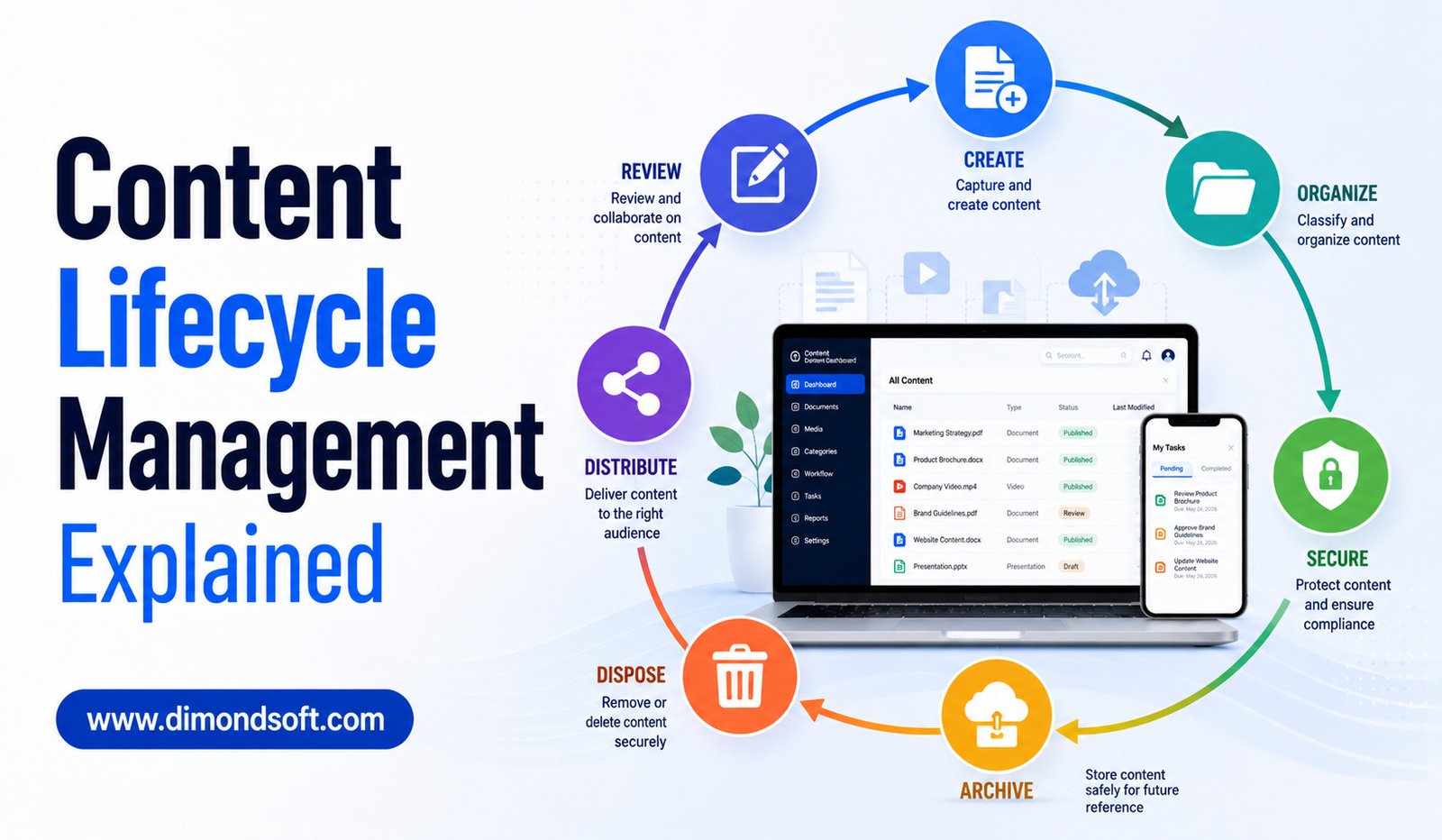
Content lifecycle management provides a structured approach to managing content from its initial idea through its eventual retirement. Instead of treating every article, document, or digital asset as an isolated item, organizations manage content as part of a continuous lifecycle.
As businesses produce larger volumes of digital information, effective lifecycle management can reduce duplication, improve content quality, support compliance, and make content operations more efficient.
What Is Content Lifecycle Management?
Content lifecycle management, often abbreviated as CLM, is the process of planning, creating, organizing, reviewing, publishing, maintaining, measuring, and retiring content throughout its useful life.
The lifecycle can differ between organizations, but it generally includes several connected stages:
- Content planning and strategy
- Creation and development
- Review and approval
- Publishing and distribution
- Performance measurement
- Updating and optimization
- Archiving or removal
The goal is to ensure that every piece of content has a purpose and remains useful for as long as it is relevant.
A lifecycle approach can apply to public-facing content as well as internal business information.
Why Content Lifecycle Management Matters
Without a structured lifecycle, content libraries can quickly become difficult to manage.
A company may publish hundreds of articles but rarely review older pages. Product information may remain online after products are discontinued. Employees may create duplicate documents because they cannot find existing resources.
These problems can waste resources and create inconsistent information.
Lifecycle management provides a framework for keeping content organized throughout its existence.
It also makes ownership clearer. Teams can determine who is responsible for creating content, approving it, reviewing it, and deciding when it should be updated or removed.
Stage One: Content Planning
The lifecycle begins before content is created.
Planning involves determining what information the organization needs and why it should be produced. Businesses may consider customer questions, business objectives, search demand, product priorities, industry developments, and gaps in existing content.
A strong planning process prevents teams from producing content simply because they have an idea.
Each planned asset should have a clear purpose. For example, a blog article might educate potential customers, while a product guide may help existing customers use a service effectively.
Planning should also identify the intended audience, content format, distribution channel, owner, and expected outcome.
Stage Two: Content Creation
Once an idea has been approved, content moves into development.
Creation may involve writers, designers, subject-matter experts, photographers, video producers, developers, or other specialists depending on the type of content.
Businesses should establish standards for tone, formatting, branding, accuracy, accessibility, and quality.
Technology can make this stage more efficient. Content management platforms provide shared workspaces where team members can draft and edit material.
Artificial intelligence can also support research, brainstorming, summarization, editing, and first-draft creation. However, human review remains important because automated systems can produce errors or miss important context.
The objective should be efficient production without sacrificing quality.
Stage Three: Review and Approval
Content should normally go through an appropriate review process before publication.
The level of review depends on the content type. A short social media update may require less oversight than a financial report, technical document, or legal policy.
Reviewers may check:
- Accuracy and factual consistency
- Brand voice
- Grammar and readability
- Search optimization
- Legal or regulatory requirements
- Accessibility
- Links and supporting information
- Visual quality
Clear approval workflows help prevent confusion about who is responsible for the final decision.
Digital content management platforms can automate notifications and track approval status, reducing the need for long email chains.
Stage Four: Publishing and Distribution
After approval, content is published through the appropriate channels.
A business may distribute information through its website, mobile application, email newsletter, social media accounts, customer portal, knowledge base, or internal communication system.
A strong lifecycle strategy considers distribution during the planning stage rather than treating it as an afterthought.
The same core content may also be adapted for multiple channels.
For example, a detailed report could become a website article, email summary, infographic, and social media content.
This approach allows organizations to get greater value from their original work.
Stage Five: Measuring Content Performance
Publishing content does not mean the lifecycle is complete.
Businesses need to understand whether content is achieving its intended purpose.
Depending on the content type, useful metrics may include page views, engagement, conversions, downloads, search traffic, customer interactions, leads, time on page, or internal usage.
Performance should be evaluated against the original objective.
A page designed to generate leads should not be judged only by traffic. A customer-support article might be successful if it reduces support requests, even if it receives relatively little website traffic.
The right measurement framework depends on why the content exists.
Stage Six: Content Maintenance
Content changes over time.
Statistics become outdated, product features change, links stop working, policies are revised, and customer needs evolve.
Regular maintenance ensures that valuable content remains accurate and useful.
Businesses can establish review schedules based on content type. Frequently changing information may need regular checks, while stable reference material may require less frequent review.
AI and analytics tools can help identify potentially outdated pages by detecting old dates, broken links, declining performance, or other signals.
However, human reviewers should determine whether an update is actually necessary.
Content Optimization and Repurposing
Lifecycle management also creates opportunities to improve existing content rather than constantly creating new material.
A high-performing article might be expanded with new information. Several smaller articles could be combined into a comprehensive guide. An outdated page could be rewritten around current customer needs.
Content can also be repurposed into new formats.
A webinar could become a blog article. A research report could become an infographic. A long tutorial could become a series of short educational resources.
Repurposing allows businesses to extend the useful life of content while reducing the effort required to create completely new material.
Stage Seven: Archiving and Retirement
Not every piece of content should remain available indefinitely.
Some information eventually becomes obsolete or irrelevant.
Examples include discontinued product pages, outdated policies, expired campaigns, old announcements, and duplicate resources.
Keeping unnecessary content can create confusion and increase maintenance requirements.
Before removing content, businesses should determine whether it has historical, legal, operational, or SEO value. Some information may need to be archived rather than permanently deleted.
A clear retirement process helps organizations maintain a cleaner and more trustworthy content environment.
The Role of a Content Management System
A content management system can provide the technology needed to support lifecycle management.
Modern platforms can help teams create, organize, publish, update, and archive content from a central environment.
Features such as version control, permissions, workflows, scheduling, metadata, search, analytics, and content expiration can make lifecycle management easier.
For larger organizations, a digital asset management system may also be used to manage images, videos, documents, and other media alongside written content.
The technology should support the organization’s process rather than become the process itself.
AI in Content Lifecycle Management
Artificial intelligence is becoming increasingly important throughout the content lifecycle.
During planning, AI can analyze existing content and identify gaps or potential topics.
During creation, it can assist with drafting, editing, summarization, and content transformation.
During organization, AI can classify documents, generate metadata, and improve search.
During maintenance, AI can identify potentially outdated information or recommend updates.
AI can also support personalization by helping businesses deliver different content to different audiences.
However, the use of AI requires appropriate governance. Organizations need rules for accuracy, privacy, copyright, brand standards, and human approval.
Content Governance
Content governance defines the rules and responsibilities surrounding content management.
It answers questions such as:
Who can create content?
Who approves it?
How should files be named?
How long should content be retained?
When should pages be reviewed?
Who can publish changes?
What happens when content becomes outdated?
Without governance, even advanced content technology can become disorganized.
A clear governance framework provides accountability and helps ensure that content remains consistent and controlled.
Common Content Lifecycle Challenges
Organizations often face several challenges when implementing lifecycle management.
One is unclear ownership. If nobody is responsible for reviewing a page, outdated information can remain online indefinitely.
Another challenge is inconsistent processes. Different departments may create and manage content in completely different ways.
Content duplication is also common. Employees may create new material because they cannot find existing resources.
Technology adoption can present another difficulty. Teams may have access to sophisticated content platforms but fail to use features such as workflows, metadata, or version control effectively.
Training and clear internal processes are therefore just as important as software.
How to Build an Effective Content Lifecycle Strategy
Businesses can begin by creating an inventory of their existing content.
Identify what content exists, where it is stored, who owns it, when it was created, and what purpose it serves.
Next, define clear lifecycle stages and responsibilities.
Create standards for planning, creation, approval, publishing, measurement, review, and retirement.
Organizations should also establish content review schedules and performance metrics.
Finally, use technology to automate repetitive tasks where appropriate.
The strategy should remain practical. A complex process that employees cannot follow consistently will not produce better results.
Benefits of Effective Content Lifecycle Management
A well-managed content lifecycle can provide several business benefits.
It can reduce duplicated work because employees can find existing resources more easily. It can improve accuracy by ensuring information is reviewed regularly.
It can also reduce operational costs by identifying low-value content that no longer needs maintenance.
Better organization improves collaboration because teams know where content belongs and who is responsible for it.
From a customer perspective, lifecycle management can create a more reliable digital experience. Visitors are more likely to trust a website when information is current, consistent, and easy to find.
The Future of Content Lifecycle Management
The future of content management will likely become increasingly automated and data-driven.
AI systems may continuously analyze content libraries and recommend what should be created, updated, combined, or retired.
Content platforms may also become better at managing information across websites, applications, customer portals, and other channels from a single structured source.
Agentic AI could eventually perform multi-step lifecycle tasks, such as identifying an outdated article, preparing a proposed update, checking metadata, and routing it to an employee for approval.
Human oversight will remain important, particularly for sensitive and high-impact information.
Conclusion
Content lifecycle management provides a structured way to manage information from its initial concept to its eventual retirement. It brings planning, creation, review, publishing, measurement, maintenance, optimization, and archiving into one connected process.
For businesses producing large amounts of digital content, this approach can reduce waste, improve consistency, and make information easier to manage.
Technology such as modern CMS platforms, analytics, automation, and AI can make lifecycle management more efficient, but successful implementation depends on clear ownership and governance.
The most effective content strategy is not simply about producing more material. It is about ensuring that every piece of content has a purpose, reaches the right audience, remains accurate while it is useful, and is responsibly updated or retired when its value declines.
By treating content as a continuously managed business asset rather than a one-time publishing task, organizations can create a more efficient, reliable, and sustainable content operation.